Institute of Biology/Geobotany and Botanical Garden, Martin Luther University Halle Wittenberg, Halle, Germany.
PLoS One. 2012;7(4):e35742. doi: 10.1371/journal.pone.0035742. Epub 2012 Apr 23.
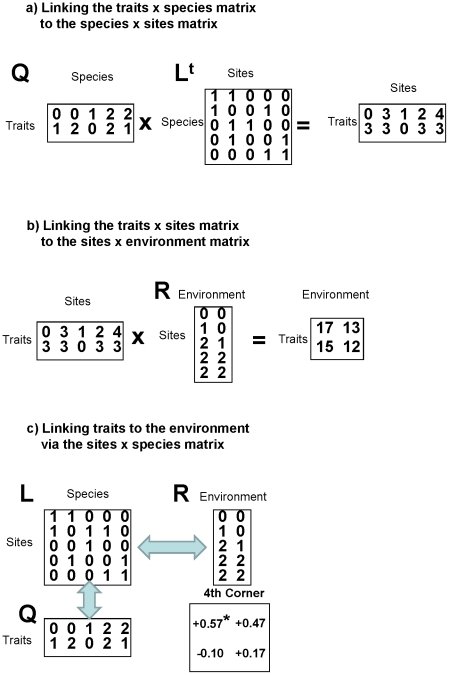
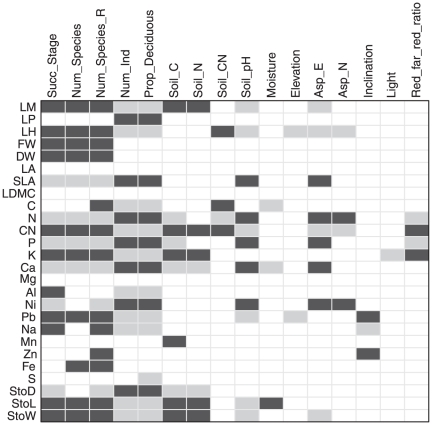
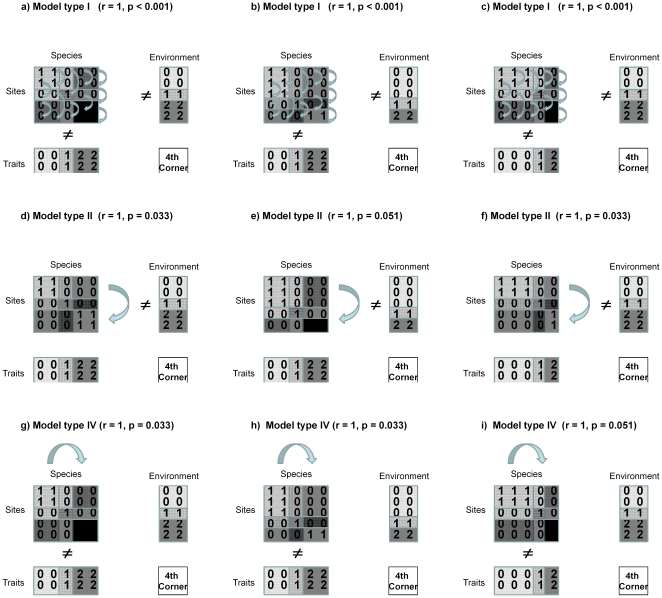
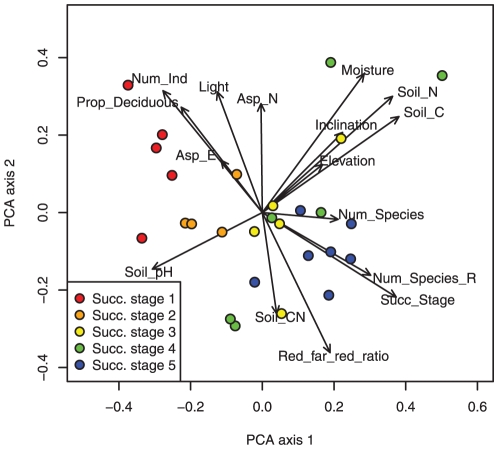
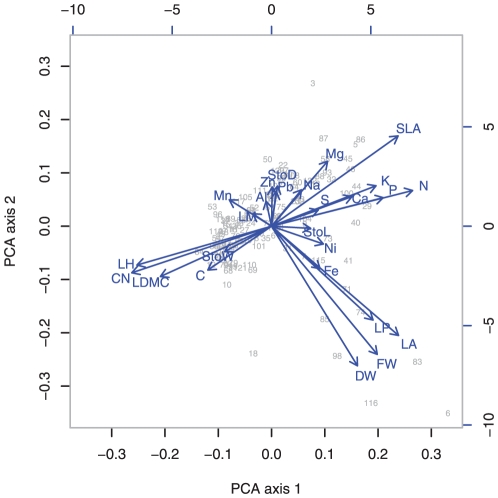
Although trait analyses have become more important in community ecology, trait-environment correlations have rarely been studied along successional gradients. We asked which environmental variables had the strongest impact on intraspecific and interspecific trait variation in the community and which traits were most responsive to the environment. We established a series of plots in a secondary forest in the Chinese subtropics, stratified by successional stages that were defined by the time elapsed since the last logging activities. On a total of 27 plots all woody plants were recorded and a set of individuals of every species was analysed for leaf traits, resulting in a trait matrix of 26 leaf traits for 122 species. A Fourth Corner Analysis revealed that the mean values of many leaf traits were tightly related to the successional gradient. Most shifts in traits followed the leaf economics spectrum with decreasing specific leaf area and leaf nutrient contents with successional time. Beside succession, few additional environmental variables resulted in significant trait relationships, such as soil moisture and soil C and N content as well as topographical variables. Not all traits were related to the leaf economics spectrum, and thus, to the successional gradient, such as stomata size and density. By comparing different permutation models in the Fourth Corner Analysis, we found that the trait-environment link was based more on the association of species with the environment than of the communities with species traits. The strong species-environment association was brought about by a clear gradient in species composition along the succession series, while communities were not well differentiated in mean trait composition. In contrast, intraspecific trait variation did not show close environmental relationships. The study confirmed the role of environmental trait filtering in subtropical forests, with traits associated with the leaf economics spectrum being the most responsive ones.
虽然特质分析在群落生态学中变得越来越重要,但特质-环境相关性很少沿着演替梯度进行研究。我们想知道哪些环境变量对群落中种内和种间的特质变异有最强的影响,以及哪些特质对环境的反应最敏感。我们在中国亚热带的一个次生林中建立了一系列的样地,这些样地按照上一次采伐活动以来的时间间隔来定义的演替阶段进行分层。在总共 27 个样地中,记录了所有的木本植物,并对每个物种的一组个体进行了叶片特征分析,得到了 26 个叶片特征和 122 个物种的特征矩阵。四角分析显示,许多叶片特征的平均值与演替梯度密切相关。随着时间的推移,大多数特征的变化都遵循叶片经济谱,表现为比叶面积和叶片养分含量的降低。除了演替之外,很少有其他环境变量导致显著的特征关系,例如土壤湿度、土壤碳和氮含量以及地形变量。并非所有特征都与叶片经济谱有关,因此与演替梯度有关,例如气孔大小和密度。通过比较四角分析中不同的排列模型,我们发现特征-环境的联系更多地基于物种与环境的关联,而不是群落与物种特征的关联。物种与环境之间的强烈关联是由于物种组成沿着演替系列呈现出明显的梯度,而群落的平均特征组成并没有很好地区分。相比之下,种内特征变异与环境没有密切的关系。该研究证实了环境特征过滤在亚热带森林中的作用,与叶片经济谱相关的特征是最敏感的。