Department of Internal Medicine, Division of Diabetes, Endocrinology, Angiology, Nephrology and Clinical Chemistry, University Hospital of Tübingen, Tübingen, Germany.
BMC Med Educ. 2012 Jun 11;12:24. doi: 10.1186/1472-6920-12-24.
Hospital doctors face constantly increasing workloads. Besides caring for patients, their duties also comprise the education of future colleagues. The aim of this study was to objectively investigate whether the workload arising from increased patient care interferes with student supervision and is associated with more non-medical activities of final-year medical students.
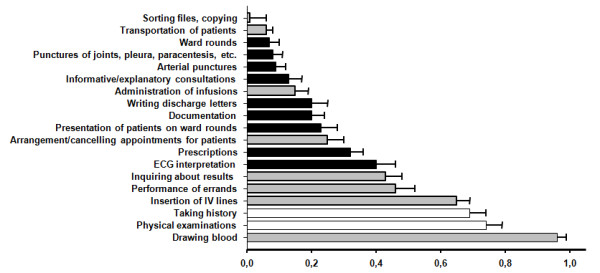
A total of 54 final-year students were asked to keep a diary of their daily activities over a three-week period at the beginning of their internship in Internal Medicine. Students categorized their activities--both medical and non-medical--according to whether they had: (1) only watched, (2) assisted the ward resident, (3) performed the activity themselves under supervision of the ward resident, or (4) performed the activity without supervision. The activities reported on a particular day were matched with a ward specific workload-index derived from the hospital information system, including the number of patients treated on the corresponding ward on that day, a correction factor according to the patient comorbidity complexity level (PCCL), and the number of admissions and discharges. Both students and ward residents were blinded to the study question.
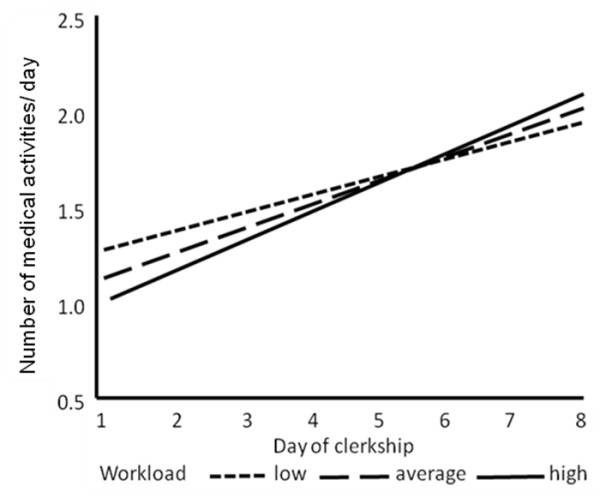
A total of 32 diaries (59 %, 442 recorded working days) were handed back. Overall, the students reported 1.2 ± 1.3 supervised, 1.8 ± 1.6 medical and 3.6 ± 1.7 non-medical activities per day. The more supervised activities were reported, the more the number of reported medical activities increased (p < .0001). No relationship between the ward specific workload and number of medical activities could be shown.
There was a significant association between ward doctors' supervision of students and the number of medical activities performed by medical students. The workload had no significant effect on supervision or the number of medical or non-medical activities of final-year students.
医院医生面临着不断增加的工作量。除了照顾病人,他们的职责还包括对未来同事的教育。本研究的目的是客观地调查增加的患者护理工作量是否会干扰学生的监督,并与医学生最后一年的非医学活动的增加有关。
共有 54 名最后一年的学生被要求在实习开始后的三周内每天记录他们的活动。学生根据他们的活动是:(1)仅观察,(2)协助病房住院医生,(3)在病房住院医生的监督下进行活动,还是(4)在没有监督的情况下进行活动,对他们的活动进行分类-无论是医学的还是非医学的。报告的活动与从医院信息系统中得出的特定病房工作量指数相匹配,包括当天在相应病房接受治疗的患者数量、根据患者合并症复杂程度(PCCL)校正的系数,以及入院和出院的数量。学生和病房住院医生都对研究问题一无所知。
共收回 32 份日记(59%,442 个记录工作日)。总的来说,学生每天报告 1.2 ± 1.3 次监督、1.8 ± 1.6 次医学和 3.6 ± 1.7 次非医学活动。报告的监督活动越多,报告的医学活动数量就越多(p <.0001)。没有显示出病房特定工作量与医学活动数量之间的关系。
病房医生对学生的监督与医学生进行的医学活动数量之间存在显著关联。工作量对监督或医学生最后一年的医学或非医学活动的数量没有显著影响。