Upton Kyle R, Baillie J Kenneth, Faulkner Geoffrey J
Division of Genetics and Genomics; The Roslin Institute and Royal (Dick) School of Veterinary Studies; University of Edinburgh; Easter Bush, UK.
Mob Genet Elements. 2011 Nov 1;1(4):279-282. doi: 10.4161/mge.18422.
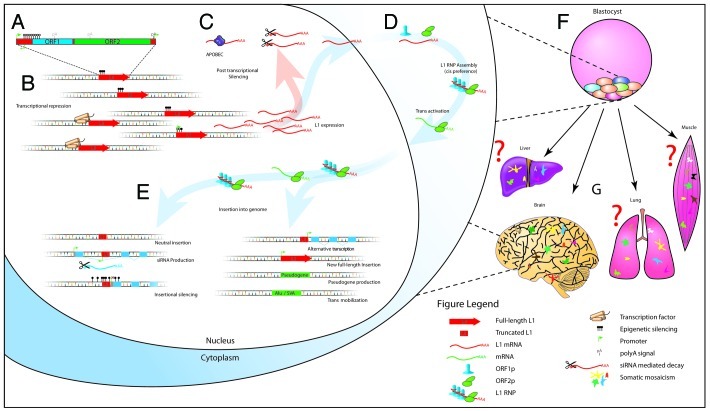
The extraordinary evolutionary success of transposable elements (TEs) invites us to question the nature of the co-evolutionary dynamics between TE and host. Although sometimes assumed to be wholly parasitic, TEs have penetrated and spread throughout eukaryotic genomes at a rate unparalleled by other parasites. This near-ubiquity, occurring despite the potentially deleterious effects of insertional mutagenesis, raises the possibility that a counterbalancing benefit exists for the host. Such a benefit may act at the population level to generate genomic diversity within a species and hence greater adaptability under new selective pressures, or at the level of primary gain for the individual. Recent studies have highlighted the occurrence of retrotransposition events in the germline and discovered a surprisingly high rate of mobilization in somatic cells. Here we examine the available evidence for somatic retrotransposition and discuss how this phenomenon may confer a selective advantage upon an individual or species.
转座元件(TEs)在进化上取得的非凡成功促使我们去质疑TE与宿主之间共同进化动态的本质。尽管TEs有时被认为完全是寄生性的,但它们在真核生物基因组中的渗透和传播速度是其他寄生虫所无法比拟的。尽管插入诱变可能具有潜在的有害影响,但这种几乎无处不在的现象增加了宿主存在某种平衡益处的可能性。这种益处可能在种群层面发挥作用,在一个物种内产生基因组多样性,从而在新的选择压力下具有更强的适应性,或者在个体层面带来主要益处。最近的研究强调了生殖系中逆转录转座事件的发生,并发现体细胞中的转座率高得出奇。在这里,我们研究了体细胞逆转录转座的现有证据,并讨论了这种现象如何可能赋予个体或物种一种选择优势。