Division of Urology, Washington University School of Medicine, St Louis, MO, USA.
BMC Urol. 2012 Apr 30;12:11. doi: 10.1186/1471-2490-12-11.
Partial nephrectomy has been increasingly recommended over radical nephrectomy for the management of small renal masses based on improved renal functional outcomes without sacrifice of oncologic effectiveness. Robot-assisted partial nephrectomy (RAPN) has been introduced in an effort to offer another minimally invasive option for nephron-sparing surgery. However, reports of RAPN have been limited to short-term perioperative outcomes. The goal of this study is to report and evaluate the initial oncologic outcomes of RAPN. Utilizing prospectively obtained data on RAPN performed by four surgeons at four separate tertiary care centers, we selected patients with unilateral, localized, non-familial, pathologically-confirmed pT1 renal cell carcinoma and a minimum post-operative follow-up of 12 months.
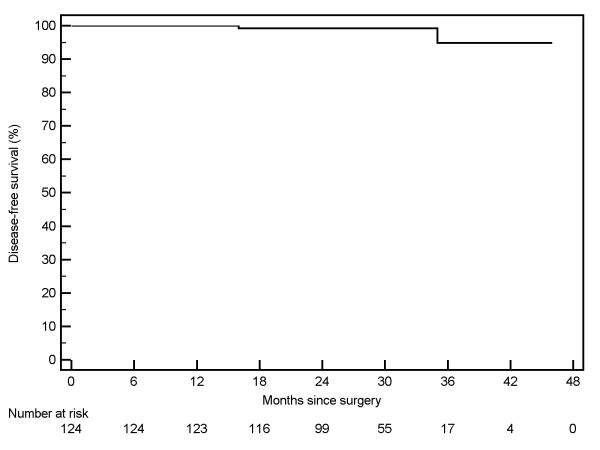
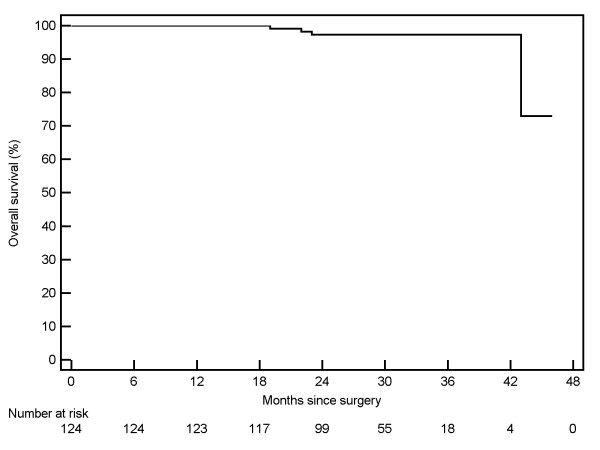
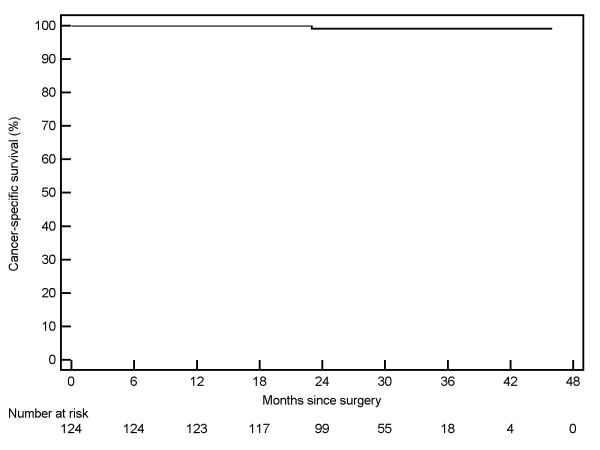
Utilizing prospectively obtained data on RAPN performed by four surgeons at four separate tertiary care centers, we selected patients with unilateral, localized, non-familial, pathologically-confirmed pT1 renal cell carcinoma and a minimum post-operative follow-up of 12 months. Survival analysis (disease-free, cancer-specific, and overall survival) was performed, and Kaplan-Meier curves were generated.
RAPN was performed in 124 patients with a median tumor size of 3.0 cm (IQR 2.2-4.2 cm). Median follow-up was 29 months (range 12-46 months). Positive parenchymal surgical margins occurred in two patients (1.6 %), both of whom were recurrence-free at 30 and 34 months after surgery. The three-year Kaplan-Meier estimated disease-free survival was 94.9 %, cancer-specific survival was 99.1%, and overall survival was 97.3 %.
In our cohort of patients with small renal carcinomas who were followed for a median of 29 months, recurrence and survival outcomes were similar to those reported for open and laparoscopic partial nephrectomy. Further long-term outcomes will be needed to definitively claim that RAPN is oncologically equivalent to other surgical approaches.
基于改善的肾功能结果,而不牺牲肿瘤学效果,部分肾切除术已越来越多地被推荐用于小的肾肿瘤的治疗,而不是根治性肾切除术。机器人辅助部分肾切除术(RAPN)的引入是为了为保肾手术提供另一种微创选择。然而,RAPN 的报告仅限于短期围手术期结果。本研究的目的是报告和评估 RAPN 的初始肿瘤学结果。利用四位外科医生在四个不同的三级护理中心进行的 RAPN 的前瞻性获得的数据,我们选择了单侧、局限性、非家族性、病理证实的 pT1 肾细胞癌患者,并且至少有 12 个月的术后随访。
利用四位外科医生在四个不同的三级护理中心进行的 RAPN 的前瞻性获得的数据,我们选择了单侧、局限性、非家族性、病理证实的 pT1 肾细胞癌患者,并且至少有 12 个月的术后随访。进行生存分析(无病、癌症特异性和总生存),并生成 Kaplan-Meier 曲线。
RAPN 共在 124 例患者中进行,肿瘤大小中位数为 3.0cm(IQR 2.2-4.2cm)。中位随访时间为 29 个月(范围 12-46 个月)。2 例患者(1.6%)切缘阳性,术后 30 个月和 34 个月时均无复发。3 年 Kaplan-Meier 估计无病生存率为 94.9%,癌症特异性生存率为 99.1%,总生存率为 97.3%。
在我们的小肾癌患者队列中,中位随访时间为 29 个月,复发和生存结果与开放和腹腔镜部分肾切除术报道的结果相似。需要进一步的长期结果来明确声称 RAPN 在肿瘤学上与其他手术方法等效。