Institute of Pharmacology, National Yang-Ming University, Taipei, Taiwan, Republic of China.
Cardiovasc Diabetol. 2012 May 3;11:49. doi: 10.1186/1475-2840-11-49.
Chronic elevation of glucose level activates vascular inflammation and increases endothelial adhesiveness to monocytes, an early sign of atherogenesis. This study aimed to elucidate the detailed mechanisms of high-glucose-induced endothelial inflammation, and to investigate the potential effects of Ginkgo biloba extract (GBE), an antioxidant herbal medicine, on such inflammation.
Human aortic endothelial cells were cultured in high glucose or mannitol as osmotic control for 4 days. The expression of cytokines and adhesion molecules and the adhesiveness of endothelial cells to monocytes were examined. The effects of pretreatment of GBE or N-acetylcysteine, an antioxidant, were also investigated.
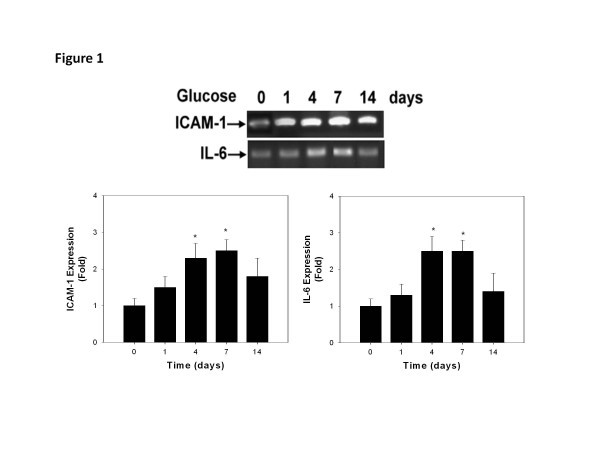
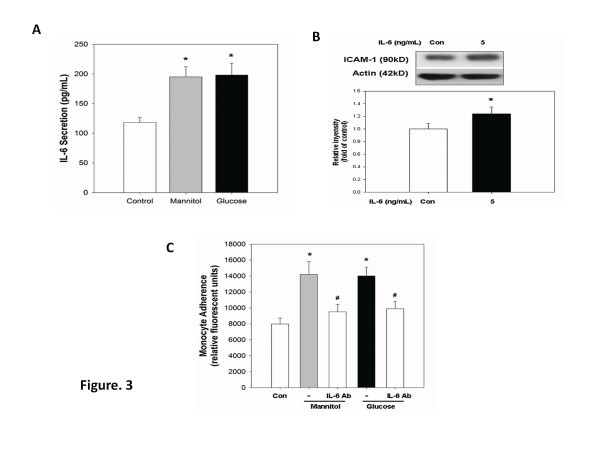
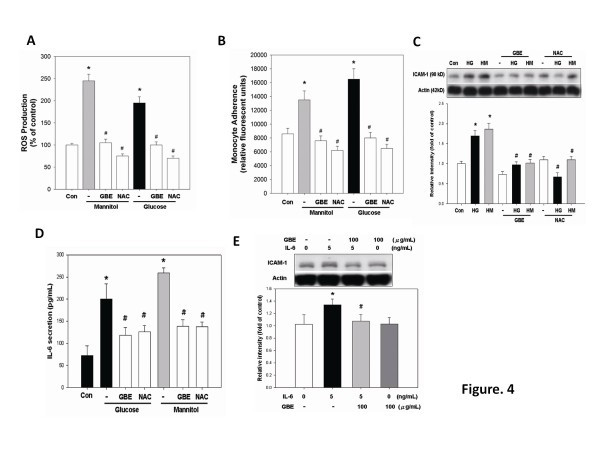
Either high glucose or mannitol significantly increased reactive oxygen species (ROS) production, interleukin-6 secretion, intercellular adhesion molecule-1 (ICAM-1) expression, as well as endothelial adhesiveness to monocytes. The high-glucose-induced endothelial adhesiveness was significantly reduced either by an anti-ICAM-1 antibody or by an interleukin-6 neutralizing antibody. Interleukin-6 (5 ng/ml) significantly increased endothelial ICAM-1 expression. Piceatannol, a signal transducer and activator of transcription (STAT) 1/3 inhibitor, but not fludarabine, a STAT1 inhibitor, suppressed high-glucose-induced ICAM-1 expression. Pretreatment with GBE or N-acetylcysteine inhibited high-glucose-induced ROS, interleukin-6 production, STAT1/3 activation, ICAM-1 expression, and endothelial adhesiveness to monocytes.
Long-term presence of high glucose induced STAT3 mediated ICAM-1 dependent endothelial adhesiveness to monocytes via the osmotic-related redox-dependent interleukin-6 pathways. GBE reduced high-glucose-induced endothelial inflammation mainly by inhibiting interleukin-6 activation. Future study is indicated to validate the antioxidant/anti-inflammatory strategy targeting on interleukin-6 for endothelial protection in in vivo and clinical hyperglycemia.
慢性高血糖会激活血管炎症,增加内皮细胞对单核细胞的黏附性,这是动脉粥样硬化形成的早期标志。本研究旨在阐明高血糖诱导内皮炎症的详细机制,并研究银杏叶提取物(GBE)这种抗氧化草药对这种炎症的潜在影响。
将人主动脉内皮细胞在高葡萄糖或甘露醇中培养(甘露醇作为渗透对照)4 天。检测细胞因子和黏附分子的表达以及内皮细胞与单核细胞的黏附性。还研究了 GBE 或 N-乙酰半胱氨酸(一种抗氧化剂)预处理的作用。
高葡萄糖或甘露醇均可显著增加活性氧(ROS)的产生、白细胞介素-6(IL-6)的分泌、细胞间黏附分子-1(ICAM-1)的表达以及内皮细胞与单核细胞的黏附性。抗 ICAM-1 抗体或白细胞介素-6 中和抗体均可显著降低高葡萄糖诱导的内皮黏附性。白细胞介素-6(5ng/ml)可显著增加内皮细胞 ICAM-1 的表达。信号转导子和转录激活子(STAT)1/3 抑制剂白藜芦醇,但不是 STAT1 抑制剂氟达拉滨,可抑制高葡萄糖诱导的 ICAM-1 表达。GBE 或 N-乙酰半胱氨酸预处理可抑制高葡萄糖诱导的 ROS、IL-6 产生、STAT1/3 激活、ICAM-1 表达和内皮细胞与单核细胞的黏附性。
长期高血糖通过与渗透压相关的氧化还原依赖的白细胞介素-6 途径诱导 STAT3 介导的 ICAM-1 依赖性内皮细胞与单核细胞的黏附。GBE 主要通过抑制白细胞介素-6 的激活来减少高葡萄糖诱导的内皮炎症。需要进一步的研究来验证针对白细胞介素-6 的抗氧化/抗炎策略对体内和临床高血糖患者内皮保护的作用。