Public Health Ontario, Toronto, ON, Canada.
Malar J. 2012 May 3;11:148. doi: 10.1186/1475-2875-11-148.
Clinical observations suggest that Canadian-born (CB) travellers are prone to more severe malaria, characterized by higher parasite density in the blood, and severe symptoms, such as cerebral malaria and renal failure, than foreign-born travellers (FB) from areas of malaria endemicity. It was hypothesized that host cytokine and chemokine responses differ significantly in CB versus FB patients returning with malaria, contributing to the courses of severity. A more detailed understanding of the profiles of cytokines, chemokines, and endothelial activation may be useful in developing biomarkers and novel therapeutic approaches for malaria.
The patient population for the study (n = 186) was comprised of travellers returning to Toronto, Canada between 2007 and 2011. The patient blood samples' cytokine, chemokine and angiopoietin concentrations were determined using cytokine multiplex assays, and ELISA assays.
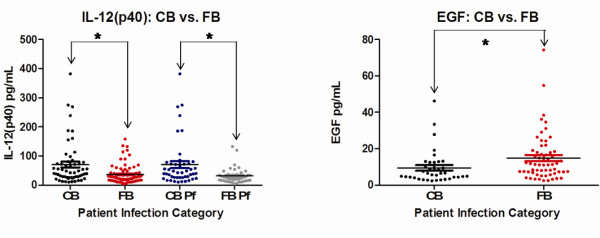
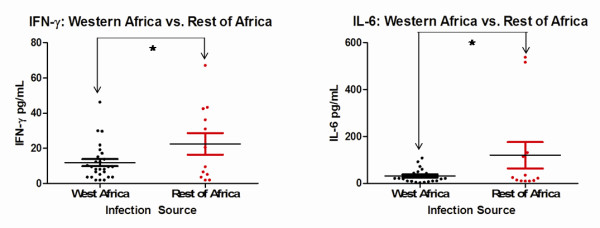
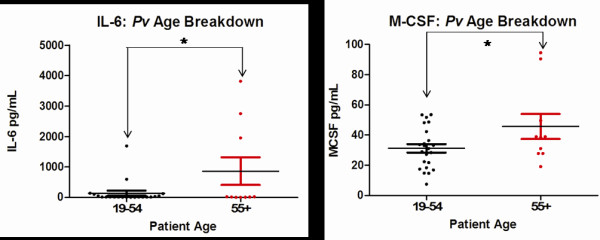
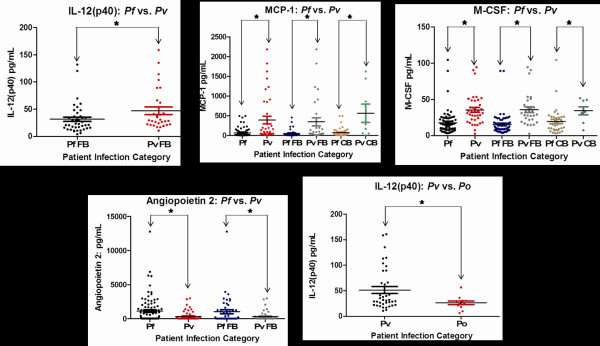
Significantly higher plasma cytokine levels of IL-12 (p40) were observed in CB compared to FB travellers, while epidermal growth factor (EGF) was observed to be higher in FB than CB travellers. Older travellers (55 years old or greater) with Plasmodium vivax infections had significantly higher mean cytokine levels for IL-6 and macrophage colony-stimulating factor (M-CSF) than other adults with P. vivax (ages 18-55). Patients with P. vivax infections had significantly higher mean cytokine levels for monocyte chemotactic protein-1 (MCP-1), and M-CSF than patients with Plasmodium falciparum. Angiopoietin 2 (Ang-2) was higher for patients infected with P. falciparum than P. vivax, especially when comparing just the FB groups. IL-12 (p40) was higher in FB patients with P. vivax compared to P. falciparum. Il-12 (p40) was also higher in patients infected with P. vivax than those infected with Plasmodium ovale. For patients travelling to West Africa, IFN-γ and IL-6 was lower than for patients who were in other regions of Africa.
Significantly higher levels of IL-12 (p40) and lower levels of EGF in CB travellers may serve as useful prognostic markers of disease severity and help guide clinical management upon return. IL-6 and M-CSF in older adults and MCP-1, IL-12 (p40) and M-CSF for P. vivax infected patients may also prove useful in understanding age-associated and species-specific host immune responses, as could the species-specific differences in Ang-2. Regional differences in host immune response to malaria infection within the same species may speak to unique strains circulating in parts of West Africa.
临床观察表明,与来自疟疾流行地区的外国出生旅行者(FB)相比,加拿大出生(CB)旅行者更容易感染更严重的疟疾,其特征是血液中的寄生虫密度更高,出现更严重的症状,如脑疟疾和肾衰竭。据推测,宿主细胞因子和趋化因子的反应在 CB 与 FB 疟疾病例返回时存在显著差异,这导致了疾病严重程度的不同。更详细地了解细胞因子、趋化因子和血管内皮细胞激活的特征可能有助于开发疟疾的生物标志物和新的治疗方法。
本研究的患者人群(n=186)由 2007 年至 2011 年间返回多伦多的旅行者组成。使用细胞因子多重分析和 ELISA 检测患者血液样本中的细胞因子、趋化因子和血管生成素浓度。
与 FB 旅行者相比,CB 旅行者的血浆细胞因子 IL-12(p40)水平明显更高,而表皮生长因子(EGF)水平则在 FB 旅行者中更高。55 岁或以上的老年旅行者(55 岁或以上)感染间日疟原虫时,IL-6 和巨噬细胞集落刺激因子(M-CSF)的平均细胞因子水平明显高于其他年龄在 18-55 岁的间日疟原虫感染者。感染间日疟原虫的患者的单核细胞趋化蛋白-1(MCP-1)和 M-CSF 的平均细胞因子水平明显高于感染恶性疟原虫的患者。感染恶性疟原虫的患者的血管生成素 2(Ang-2)水平明显高于感染间日疟原虫的患者,特别是在仅比较 FB 组时。FB 感染间日疟原虫的患者的 IL-12(p40)水平高于感染恶性疟原虫的患者。感染间日疟原虫的患者的 IL-12(p40)水平也高于感染卵形疟原虫的患者。前往西非的患者的 IFN-γ和 IL-6 水平低于在非洲其他地区的患者。
CB 旅行者中更高水平的 IL-12(p40)和更低水平的 EGF 可能作为疾病严重程度的有用预后标志物,并有助于指导旅行者返回后的临床管理。老年患者的 IL-6 和 M-CSF 以及感染间日疟原虫患者的 MCP-1、IL-12(p40)和 M-CSF 也可能有助于了解年龄相关和物种特异性宿主免疫反应,而 Ang-2 的物种特异性差异也可能如此。在同一物种内,疟疾感染的宿主免疫反应在不同地区存在差异,这可能表明在西非部分地区存在独特的流行株。