Van Rompaey Bart, Elseviers Monique M, Van Drom Wim, Fromont Veronique, Jorens Philippe G
Crit Care. 2012 May 4;16(3):R73. doi: 10.1186/cc11330.
This study hypothesised that a reduction of sound during the night using earplugs could be beneficial in the prevention of intensive care delirium. Two research questions were formulated. First, does the use of earplugs during the night reduce the onset of delirium or confusion in the ICU? Second, does the use of earplugs during the night improve the quality of sleep in the ICU?
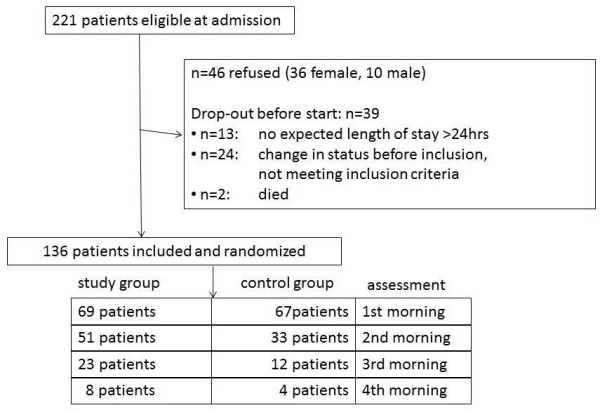
A randomized clinical trial included adult intensive care patients in an intervention group of 69 patients sleeping with earplugs during the night and a control group of 67 patients sleeping without earplugs during the night. The researchers were blinded during data collection. Assignment was performed by an independent nurse researcher using a computer program. Eligible patients had an expected length of stay in the ICU of more than 24 hours, were Dutch- or English-speaking and scored a minimum Glasgow Coma Scale of 10. Delirium was assessed using the validated NEECHAM scale, sleep perception was reported by the patient in response to five questions.
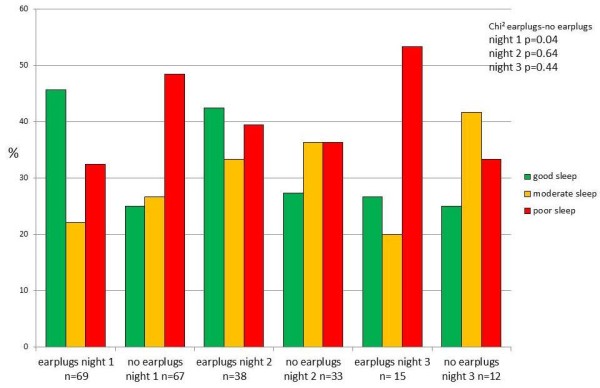
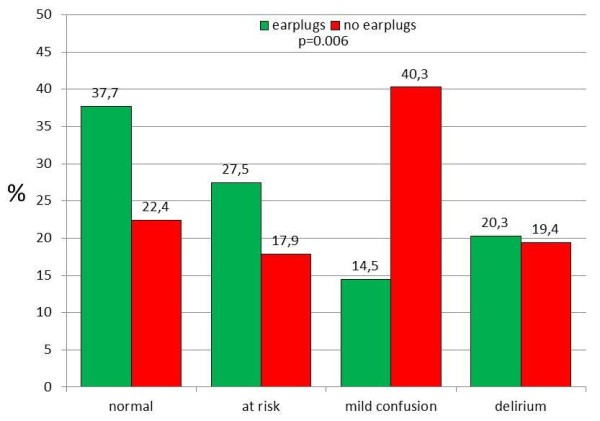
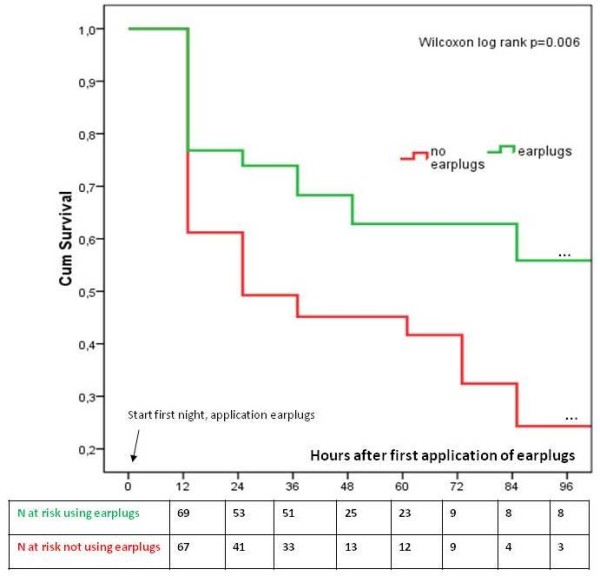
The use of earplugs during the night lowered the incidence of confusion in the studied intensive care patients. A vast improvement was shown by a Hazard Ratio of 0.47 (95% confidence interval (CI) 0.27 to 0.82). Also, patients sleeping with earplugs developed confusion later than the patients sleeping without earplugs. After the first night in the ICU, patients sleeping with earplugs reported a better sleep perception.
Earplugs may be a useful instrument in the prevention of confusion or delirium. The beneficial effects seem to be strongest within 48 hours after admission. The relation between sleep, sound and delirium, however, needs further research.
Current Controlled Trials ISRCTN36198138.
本研究假设,夜间使用耳塞减少噪音可能有助于预防重症监护病房谵妄。提出了两个研究问题。第一,夜间使用耳塞是否能降低重症监护病房谵妄或意识模糊的发生率?第二,夜间使用耳塞是否能改善重症监护病房的睡眠质量?
一项随机临床试验纳入了成年重症监护患者,其中干预组69例患者夜间使用耳塞睡觉,对照组67例患者夜间不使用耳塞睡觉。数据收集过程中研究人员处于盲态。由一名独立的护士研究人员使用计算机程序进行分组。符合条件的患者预计在重症监护病房的住院时间超过24小时,说荷兰语或英语,格拉斯哥昏迷量表最低得分10分。使用经过验证的NEECHAM量表评估谵妄,患者通过回答五个问题报告睡眠感受。
夜间使用耳塞降低了所研究的重症监护患者意识模糊的发生率。风险比为0.47(95%置信区间(CI)0.27至0.82),显示出显著改善。此外,使用耳塞睡觉的患者比不使用耳塞睡觉的患者出现意识模糊的时间更晚。在重症监护病房的第一个晚上之后,使用耳塞睡觉的患者报告睡眠感受更好。
耳塞可能是预防意识模糊或谵妄的有用工具。有益效果似乎在入院后48小时内最为明显。然而,睡眠、声音和谵妄之间的关系需要进一步研究。
当前对照试验ISRCTN36198138。