Division of Cell and Developmental Biology, College of Life Science, University of Dundee, Dundee, DD1 5EH, Scotland, UK.
Dis Model Mech. 2012 Nov;5(6):940-7. doi: 10.1242/dmm.008607. Epub 2012 Apr 5.
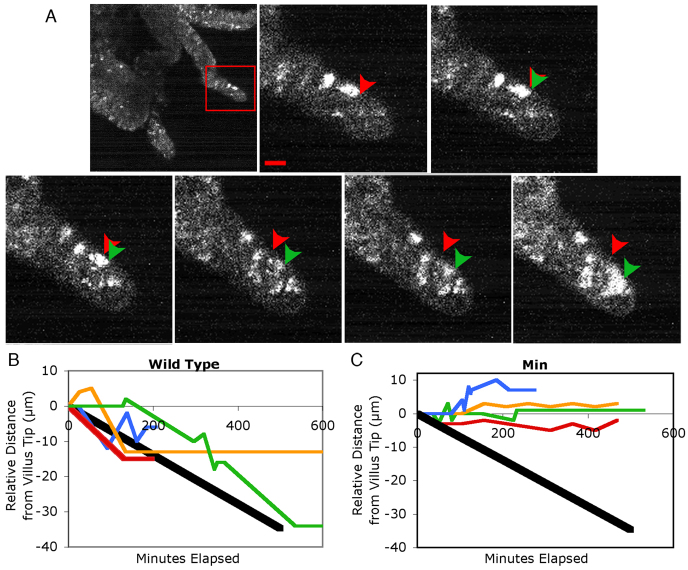
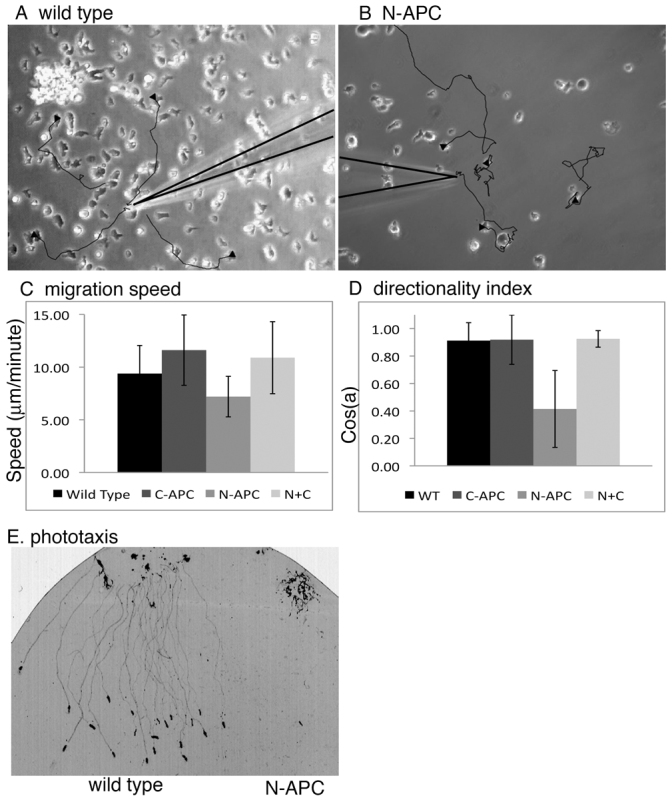
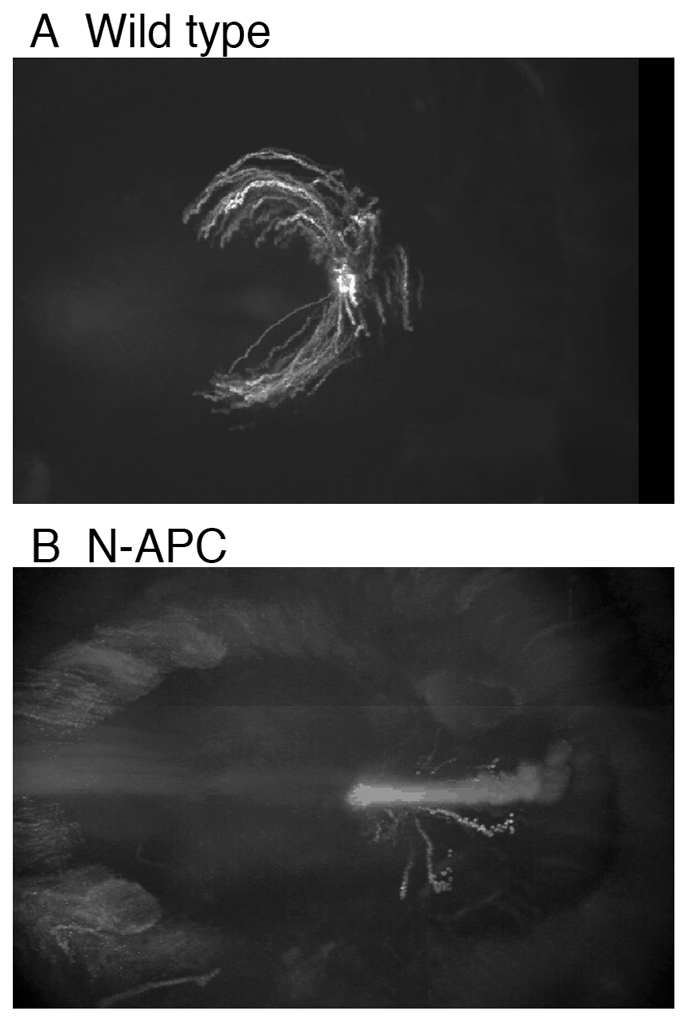
Nonsense mutations that result in the expression of truncated, N-terminal, fragments of the adenomatous polyposis coli (APC) tumour suppressor protein are found in most sporadic and some hereditary colorectal cancers. These mutations can cause tumorigenesis by eliminating β-catenin-binding sites from APC, which leads to upregulation of β-catenin and thereby results in the induction of oncogenes such as MYC. Here we show that, in three distinct experimental model systems, expression of an N-terminal fragment of APC (N-APC) results in loss of directionality, but not speed, of cell motility independently of changes in β-catenin regulation. We developed a system to culture and fluorescently label live pieces of gut tissue to record high-resolution three-dimensional time-lapse movies of cells in situ. This revealed an unexpected complexity of normal gut cell migration, a key process in gut epithelial maintenance, with cells moving with spatial and temporal discontinuity. Quantitative comparison of gut tissue from wild-type mice and APC heterozygotes (APC(Min/+); multiple intestinal neoplasia model) demonstrated that cells in precancerous epithelia lack directional preference when moving along the crypt-villus axis. This effect was reproduced in diverse experimental systems: in developing chicken embryos, mesoderm cells expressing N-APC failed to migrate normally; in amoeboid Dictyostelium, which lack endogenous APC, expressing an N-APC fragment maintained cell motility, but the cells failed to perform directional chemotaxis; and multicellular Dictyostelium slug aggregates similarly failed to perform phototaxis. We propose that N-terminal fragments of APC represent a gain-of-function mutation that causes cells within tissue to fail to migrate directionally in response to relevant guidance cues. Consistent with this idea, crypts in histologically normal tissues of APC(Min/+) intestines are overpopulated with cells, suggesting that a lack of migration might cause cell accumulation in a precancerous state.
导致腺瘤性结肠息肉病(APC)肿瘤抑制蛋白的截短、N 端片段表达的无意义突变存在于大多数散发性和一些遗传性结直肠癌中。这些突变可以通过从 APC 中消除β-连环蛋白结合位点来导致肿瘤发生,从而导致β-连环蛋白上调,从而导致癌基因如 MYC 的诱导。在这里,我们表明,在三个不同的实验模型系统中,APC 的 N 端片段(N-APC)的表达导致细胞迁移的方向性丧失,但不改变β-连环蛋白调节的速度。我们开发了一种培养和荧光标记活体肠道组织的系统,以记录原位细胞的高分辨率三维延时电影。这揭示了正常肠道细胞迁移的一个意想不到的复杂性,这是肠道上皮维持的一个关键过程,细胞以空间和时间不连续的方式移动。对来自野生型小鼠和 APC 杂合子(APC(Min/+);多发性肠肿瘤模型)的肠道组织的定量比较表明,在沿着隐窝-绒毛轴移动时,癌前上皮细胞缺乏方向性偏好。这种效应在不同的实验系统中得到了重现:在发育中的鸡胚中,表达 N-APC 的中胚层细胞不能正常迁移;在缺乏内源性 APC 的变形虫 Dictyostelium 中,表达 N-APC 片段维持了细胞的运动性,但细胞不能进行定向趋化性;而多细胞 Dictyostelium slug 聚集体也不能进行光趋化性。我们提出,APC 的 N 端片段代表一种获得性功能突变,导致组织内的细胞不能对相关的导向信号做出定向迁移。与这一观点一致的是,APC(Min/+)肠道组织中组织学正常的隐窝中细胞过度增殖,这表明迁移缺失可能导致细胞在癌前状态下积累。