Bellingham Shayne A, Guo Belinda B, Coleman Bradley M, Hill Andrew F
Department of Biochemistry and Molecular Biology, The University of Melbourne Melbourne, VIC 3010, Australia.
Front Physiol. 2012 May 3;3:124. doi: 10.3389/fphys.2012.00124. eCollection 2012.
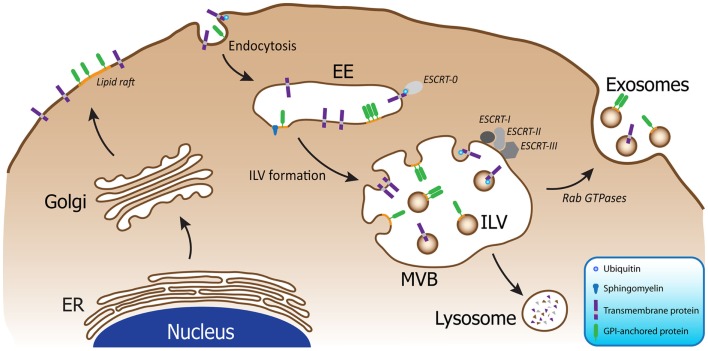
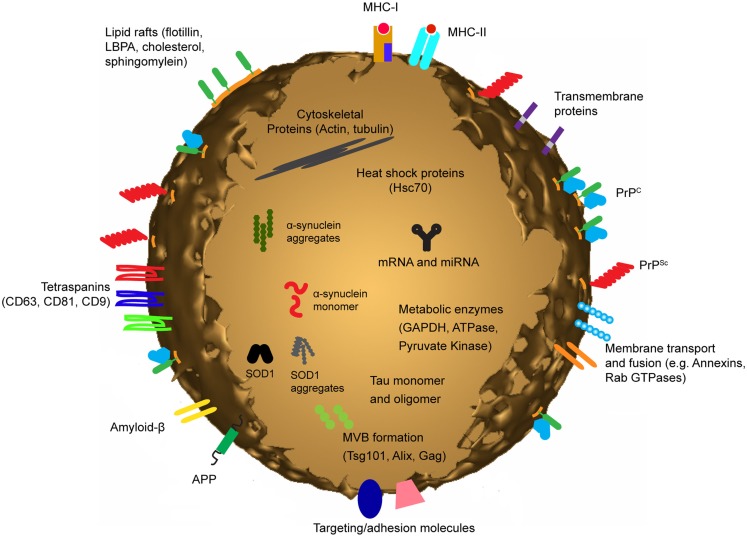
Exosomes are small membranous vesicles secreted by a number of cell types including neurons and can be isolated from conditioned cell media or bodily fluids such as urine and plasma. Exosome biogenesis involves the inward budding of endosomes to form multivesicular bodies (MVB). When fused with the plasma membrane, the MVB releases the vesicles into the extracellular environment as exosomes. Proposed functions of these vesicles include roles in cell-cell signaling, removal of unwanted proteins, and the transfer of pathogens between cells. One such pathogen which exploits this pathway is the prion, the infectious particle responsible for the transmissible neurodegenerative diseases such as Creutzfeldt-Jakob disease (CJD) of humans or bovine spongiform encephalopathy (BSE) of cattle. Similarly, exosomes are also involved in the processing of the amyloid precursor protein (APP) which is associated with Alzheimer's disease. Exosomes have been shown to contain full-length APP and several distinct proteolytically cleaved products of APP, including Aβ. In addition, these fragments can be modulated using inhibitors of the proteases involved in APP cleavage. These observations provide further evidence for a novel pathway in which PrP and APP fragments are released from cells. Other proteins such as superoxide dismutase I and alpha-synuclein (involved in amyotrophic lateral sclerosis and Parkinson's disease, respectively) are also found associated with exosomes. This review will focus on the role of exosomes in neurodegenerative disorders and discuss the potential of these vesicles for the spread of neurotoxicity, therapeutics, and diagnostics for these diseases.
外泌体是由包括神经元在内的多种细胞类型分泌的小膜泡,可从条件细胞培养基或尿液和血浆等体液中分离出来。外泌体生物发生涉及内体向内出芽形成多泡体(MVB)。当与质膜融合时,MVB将这些囊泡作为外泌体释放到细胞外环境中。这些囊泡的推测功能包括在细胞间信号传导、清除不需要的蛋白质以及细胞间病原体转移中发挥作用。利用这一途径的一种病原体是朊病毒,它是导致人类克雅氏病(CJD)或牛海绵状脑病(BSE)等可传播神经退行性疾病的感染性粒子。同样,外泌体也参与了与阿尔茨海默病相关的淀粉样前体蛋白(APP)的加工过程。已证明外泌体含有全长APP以及APP的几种不同的蛋白水解切割产物,包括Aβ。此外,这些片段可以使用参与APP切割的蛋白酶抑制剂进行调节。这些观察结果为PrP和APP片段从细胞中释放的新途径提供了进一步的证据。其他蛋白质,如超氧化物歧化酶I和α-突触核蛋白(分别与肌萎缩侧索硬化症和帕金森病有关)也被发现与外泌体相关。本综述将重点关注外泌体在神经退行性疾病中的作用,并讨论这些囊泡在神经毒性传播、治疗和这些疾病诊断方面的潜力。