School of Life Sciences, Northumbria University, Newcastle-upon-Tyne, United Kingdom.
PLoS One. 2012;7(4):e35930. doi: 10.1371/journal.pone.0035930. Epub 2012 Apr 26.
Elements of the human central nervous system (CNS) constantly oscillate. In addition, there are also methodological factors and changes in muscle mechanics during dynamic muscle contractions that threaten the stability and consistency of transcranial magnetic stimulation (TMS) and perpherial nerve stimulation (PNS) measures.
To determine the repeatability of TMS and PNS measures during lengthening and shortening muscle actions in the intact human tibialis anterior.
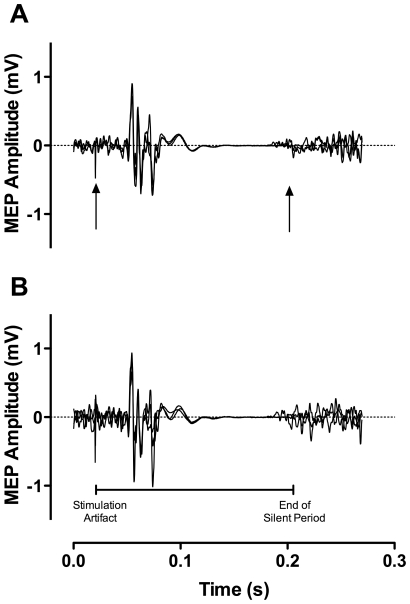
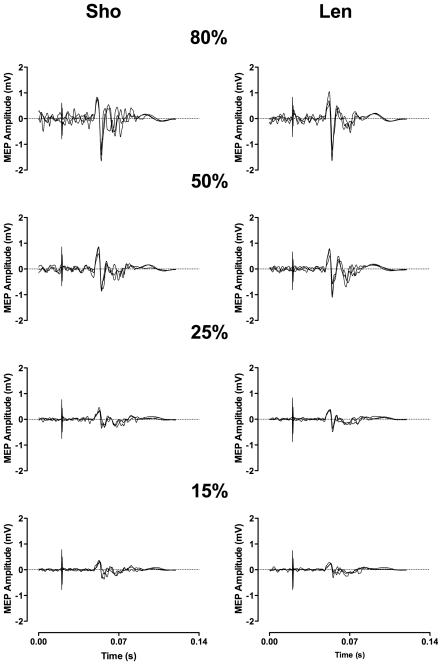
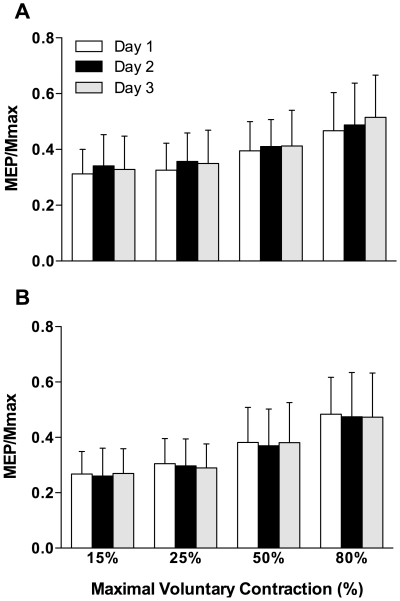
On three consecutive days, 20 males performed lengthening and shortening muscle actions at 15, 25, 50 and 80% of maximal voluntary contraction (MVC). The amplitude of the Motor Evoked Potentials (MEPs) produced by TMS was measured at rest and during muscle contraction at 90° of ankle joint position. MEPs were normalised to Mmax determined with PNS. The corticospinal silent period was recorded at 80% MVC. Hoffman reflex (H-reflex) at 10% isometric and 25% shortening and lengthening MVCs, and V-waves during MVCs were also evoked on each of the three days.
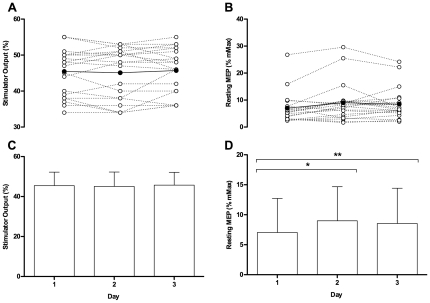
With the exception of MEPs evoked at 80% shortening MVC, all TMS-derived measures showed good reliability (ICC = 0.81-0.94) from days 2 to 3. Confidence intervals (CI, 95%) were lower between days 2 and 3 when compared to days 1 and 2. MEPs significantly increased at rest from days 1 to 2 (P = 0.016) and days 1 to 3 (P = 0.046). The H-reflex during dynamic muscle contraction was reliable across the three days (ICC = 0.76-0.84). V-waves (shortening, ICC = 0.77, lengthening ICC = 0.54) and the H-reflex at 10% isometric MVC (ICC = 0.66) was generally less reliable over the three days.
Although it is well known that measures of the intact human CNS exhibit moment-to-moment fluctuations, careful experimental arrangements make it possible to obtain consistent and repeatable measurements of corticospinal and spinal excitability in the actively lengthening and shortening human TA muscle.
人类中枢神经系统 (CNS) 的元素不断波动。此外,在动态肌肉收缩期间,还存在方法学因素和肌肉力学变化,这对经颅磁刺激 (TMS) 和周围神经刺激 (PNS) 测量的稳定性和一致性构成威胁。
确定完整人类胫骨前肌在拉长和缩短肌肉运动期间 TMS 和 PNS 测量的可重复性。
在连续三天的时间里,20 名男性以最大自主收缩 (MVC) 的 15%、25%、50%和 80%进行拉长和缩短肌肉运动。在踝关节位置为 90°的肌肉收缩期间,测量 TMS 产生的运动诱发电位 (MEP) 的幅度。MEP 被归一化为用 PNS 确定的 Mmax。在 80%MVC 时记录皮质脊髓静息期。在 10%等长和 25%缩短和拉长 MVC 以及 MVC 期间还诱发出 H 反射 (H-reflex) 和 V 波。
除了在 80%缩短 MVC 时诱发的 MEP 之外,所有源自 TMS 的测量值在第 2 天至第 3 天之间均具有良好的可靠性(ICC=0.81-0.94)。与第 1 天至第 2 天相比,第 2 天至第 3 天的置信区间(CI,95%)较低。MEP 在第 1 天至第 2 天(P=0.016)和第 1 天至第 3 天(P=0.046)时在休息时显着增加。在三天的时间里,动态肌肉收缩期间的 H 反射具有可靠性(ICC=0.76-0.84)。V 波(缩短时 ICC=0.77,拉长时 ICC=0.54)和 10%等长 MVC 时的 H 反射(ICC=0.66)在三天内的可靠性通常较差。
尽管众所周知,完整的人类中枢神经系统的测量值会随时间波动,但精心的实验安排可使主动拉长和缩短的人类 TA 肌肉的皮质脊髓和脊髓兴奋性的测量值具有一致性和可重复性。