Park Yang Jin, Lee Kyung-Bok, Kim Dong-Ik, Roh Young-Nam, Kim Nari, Kim Duk-Kyung, Kim Young-Wook
Division of Vascular Surgery, Department of Surgery, Cardiac and Vascular Center, Samsung Medical Center, Sungkyunkwan University School of Medicine, Seoul, Korea.
J Korean Surg Soc. 2012 May;82(5):306-11. doi: 10.4174/jkss.2012.82.5.306. Epub 2012 Apr 26.
To determine the risk factors of delayed recanalization of isolated calf vein thrombosis (CVT).
One hundred fifty limbs of 110 patients with CVT between September 2007 and April 2010 were enrolled. We used ultrasonography for the diagnosis and follow-up examinations of CVT. We calculated recanalization rates at 1 and 3 months after initial diagnosis and analyzed the risk factors associated with delayed recanalization of CVT.
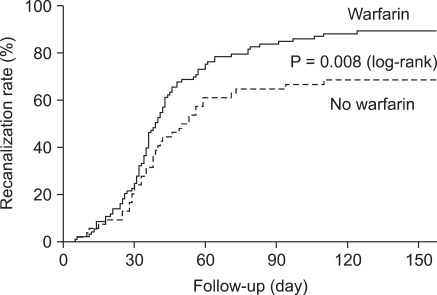
CVTs were located in the muscular calf vein in 110 (73.3%), in the deep calf vein in 18 (12%), and in both in 22 cases (14.7%). Among all CVTs, 94 limbs (63%) were symptomatic. Major risk factors for CVT were orthopedic surgery (87.3%), malignancy (21.3%), and immobilization (15.3%). Sixty-seven patients (60.9%) were treated with oral anticoagulation therapy, while 43 patients by low molecular weight heparin (n = 19) or by conservative methods including elastic compression stockings and ambulation (n = 21). The cumulative recanalization rate at 1 and 3 months was 23% and 82% and it was significantly higher in patients who underwent oral anticoagulation therapy compared with patients without oral anticoagulation therapy (84% vs. 65%, P = 0.008 by log-rank test). Malignancy (odds ratio [OR], 2.789; P = 0.043) and immobilization (OR, 4.191; P = 0.029) were independent risk factors for delayed recanalization of CVT and oral anticoagulation (OR, 0.300; P = 0.020) was an independent factor in promoting recanalization in multivariate analysis.
For patients with isolated CVT, no oral anticoagulation resulted in higher rates of delayed recanalization compared to oral anticoagulation treatment. Immobilization and having malignancy were independent risk factors for delayed recanalization.
确定孤立性小腿静脉血栓形成(CVT)再通延迟的危险因素。
纳入2007年9月至2010年4月期间110例CVT患者的150条肢体。我们使用超声对CVT进行诊断和随访检查。我们计算了初次诊断后1个月和3个月时的再通率,并分析了与CVT再通延迟相关的危险因素。
CVT位于小腿肌肉静脉的有110例(73.3%),位于小腿深静脉的有18例(12%),两者均累及的有22例(14.7%)。在所有CVT中,94条肢体(63%)有症状。CVT的主要危险因素是骨科手术(87.3%)、恶性肿瘤(21.3%)和制动(15.3%)。67例患者(60.9%)接受了口服抗凝治疗,而43例患者接受了低分子量肝素治疗(n = 19)或采用包括弹力袜和活动在内的保守方法治疗(n = 21)。1个月和3个月时的累积再通率分别为23%和82%,接受口服抗凝治疗的患者与未接受口服抗凝治疗的患者相比,再通率显著更高(84%对65%,对数秩检验P = 0.008)。恶性肿瘤(优势比[OR],2.789;P = 0.043)和制动(OR,4.191;P = 0.029)是CVT再通延迟的独立危险因素,在多变量分析中口服抗凝(OR,0.300;P = 0.020)是促进再通的独立因素。
对于孤立性CVT患者,与口服抗凝治疗相比,未进行口服抗凝导致再通延迟率更高。制动和患有恶性肿瘤是再通延迟的独立危险因素。