Lee Kwanghyuk, Khan Saadullah, Ansar Muhammad, Santos-Cortez Regie Lyn P, Ahmad Wasim, Leal Suzanne M
Department of Molecular and Human Genetics, Baylor College of Medicine, Houston, Tx 77030, USA.
Genet Res Int. 2011;2011:368915. doi: 10.4061/2011/368915. Epub 2011 Sep 25.
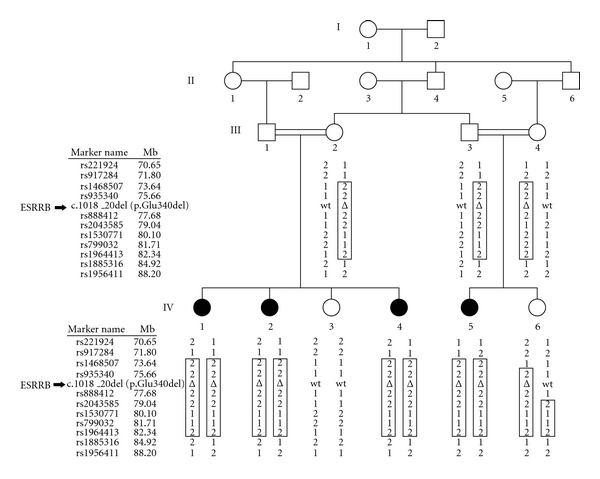
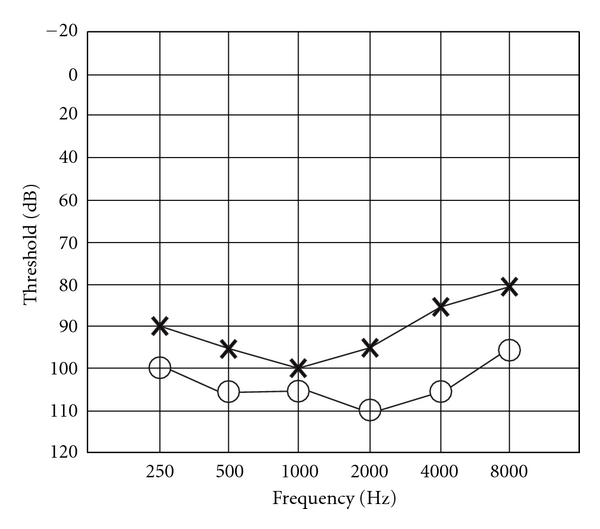
Mutations in the estrogen-related receptor beta (ESRRB) gene is the underlying cause of autosomal recessive nonsyndromic hearing impairment (ARNSHI) due to the DFNB35 locus which maps to 14q24.3. A genome scan of a large consanguineous Pakistani pedigree with ARNSHI established linkage with a maximum multipoint LOD score of 4.2 to the 14q24 region and the region of homozygosity contained the ESRRB gene. Sequencing of the ESRRB gene using DNA samples from hearing-impaired family members uncovered a novel three-nucleotide deletion c.1018_1020delGAG (p.Glu340del). The deletion segregates with hearing impairment in the pedigree and was not observed in 500 control chromosomes. The deletion of glutamic acid residue occurs in the ligand-binding domain of ESRRB protein. It is expected that the deletion affects the ligand-binding activity of the domain in ESRRB, which leads to the ARNSHI.
雌激素相关受体β(ESRRB)基因的突变是常染色体隐性非综合征性听力障碍(ARNSHI)的根本原因,该病症由定位于14q24.3的DFNB35位点引起。对一个患有ARNSHI的巴基斯坦近亲大家族进行的全基因组扫描显示,与14q24区域建立了连锁关系,最大多点对数优势分数为4.2,纯合区域包含ESRRB基因。使用听力受损家庭成员的DNA样本对ESRRB基因进行测序,发现了一个新的三核苷酸缺失c.1018_1020delGAG(p.Glu340del)。该缺失在家族中与听力障碍共分离,在500条对照染色体中未观察到。谷氨酸残基的缺失发生在ESRRB蛋白的配体结合结构域中。预计该缺失会影响ESRRB结构域的配体结合活性,从而导致ARNSHI。