Department of Biology, Stanford University, Stanford, CA 94305, USA.
Curr Biol. 2012 May 8;22(9):R350-9. doi: 10.1016/j.cub.2012.02.041. Epub 2012 May 7.
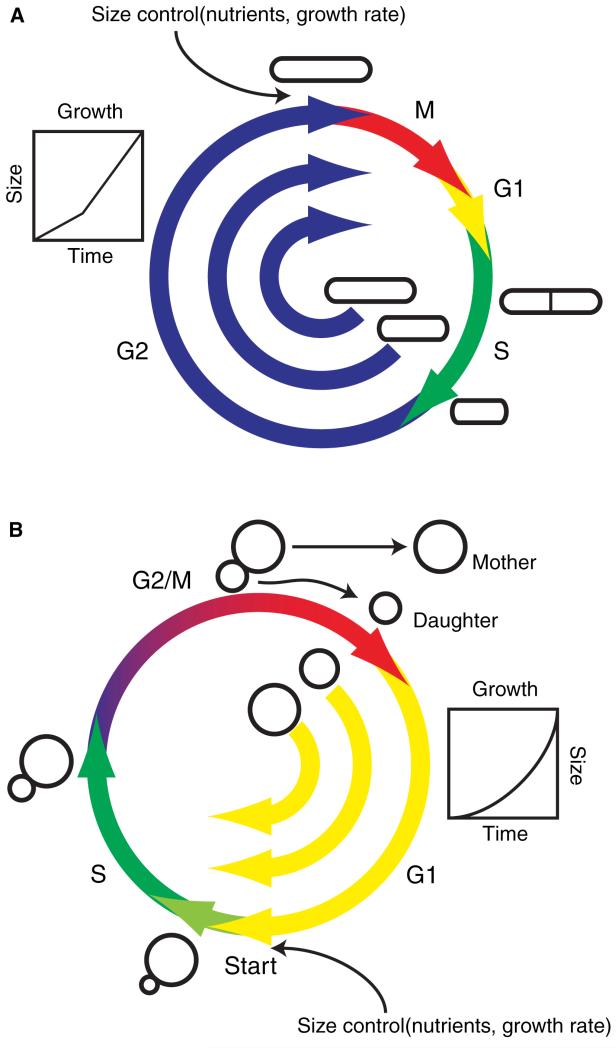
Cell size is an important adaptive trait that influences nearly all aspects of cellular physiology. Despite extensive characterization of the cell-cycle regulatory network, the molecular mechanisms coupling cell growth to division, and thereby controlling cell size, have remained elusive. Recent work in yeast has reinvigorated the size control field and suggested provocative mechanisms for the distinct functions of setting and sensing cell size. Further examination of size-sensing models based on spatial gradients and molecular titration, coupled with elucidation of the pathways responsible for nutrient-modulated target size, may reveal the fundamental principles of eukaryotic cell size control.
细胞大小是一个重要的适应性特征,几乎影响细胞生理学的所有方面。尽管细胞周期调控网络得到了广泛的描述,但将细胞生长与分裂相耦合从而控制细胞大小的分子机制仍然难以捉摸。最近在酵母中的研究工作重新激发了大小控制领域,并提出了一些引人注目的机制,用于解释细胞大小的设定和感知的不同功能。进一步研究基于空间梯度和分子滴定的大小感知模型,以及阐明负责营养调节靶大小的途径,可能揭示真核细胞大小控制的基本原理。