Blasco-Fontecilla Hilario, Perez-Rodriguez M Mercedes, Garcia-Nieto Rebeca, Fernandez-Navarro Pablo, Galfalvy Hanga, de Leon Jose, Baca-Garcia Enrique
Department of Psychiatry, IIS-Jimenez Diaz Foundation, Autonoma University, CIBERSAM, Madrid, Spain.
BMJ Open. 2012 May 14;2(3). doi: 10.1136/bmjopen-2011-000785. Print 2012.
To investigate the trends and correlations of gross domestic product (GDP) adjusted for purchasing power parity (PPP) per capita on suicide rates in 10 WHO regions during the past 30 years.
Analyses of databases of PPP-adjusted GDP per capita and suicide rates. Countries were grouped according to the Global Burden of Disease regional classification system.
World Bank's official website and WHO's mortality database.
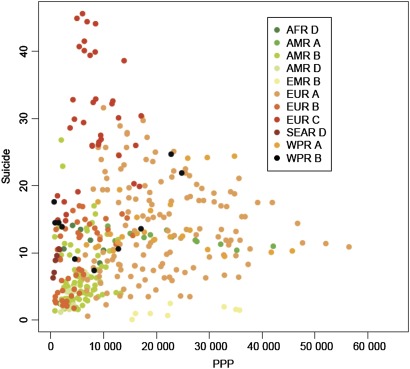
After graphically displaying PPP-adjusted GDP per capita and suicide rates, mixed effect models were used for representing and analysing clustered data.
Three different groups of countries, based on the correlation between the PPP-adjusted GDP per capita and suicide rates, are reported: (1) positive correlation: developing (lower middle and upper middle income) Latin-American and Caribbean countries, developing countries in the South East Asian Region including India, some countries in the Western Pacific Region (such as China and South Korea) and high-income Asian countries, including Japan; (2) negative correlation: high-income and developing European countries, Canada, Australia and New Zealand and (3) no correlation was found in an African country.
PPP-adjusted GDP per capita may offer a simple measure for designing the type of preventive interventions aimed at lowering suicide rates that can be used across countries. Public health interventions might be more suitable for developing countries. In high-income countries, however, preventive measures based on the medical model might prove more useful.
调查过去30年中世界卫生组织10个区域按购买力平价(PPP)调整的人均国内生产总值(GDP)与自杀率之间的趋势和相关性。
对按PPP调整的人均GDP和自杀率数据库进行分析。国家根据全球疾病负担区域分类系统进行分组。
世界银行官方网站和世界卫生组织死亡率数据库。
在以图形方式展示按PPP调整的人均GDP和自杀率后,使用混合效应模型来表示和分析聚类数据。
根据按PPP调整的人均GDP与自杀率之间的相关性,报告了三组不同的国家:(1)正相关:发展中(中低收入和中高收入)拉丁美洲和加勒比国家、包括印度在内的东南亚区域发展中国家、西太平洋区域的一些国家(如中国和韩国)以及高收入亚洲国家,包括日本;(2)负相关:高收入和发展中的欧洲国家、加拿大、澳大利亚和新西兰;(3)在一个非洲国家未发现相关性。
按PPP调整的人均GDP可能为设计旨在降低自杀率的预防性干预措施类型提供一种简单的衡量标准,可在各国使用。公共卫生干预措施可能更适合发展中国家。然而,在高收入国家,基于医学模式的预防措施可能更有用。