Harrison David G, Marvar Paul J, Titze Jens M
Division of Clinical Pharmacology, Department of Medicine, Vanderbilt University Nashville, TN, USA.
Front Physiol. 2012 May 7;3:128. doi: 10.3389/fphys.2012.00128. eCollection 2012.
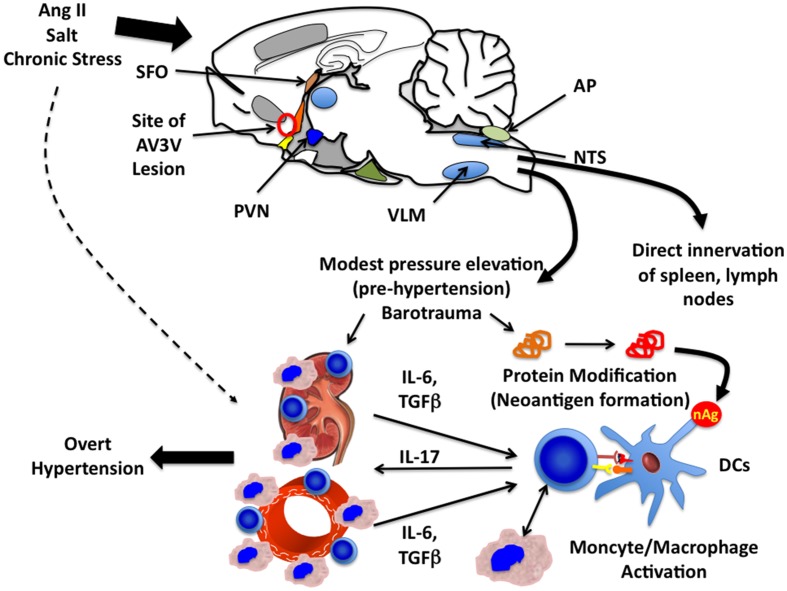
Hypertension is a common disorder with uncertain etiology. In the last several years, it has become evident that components of both the innate and adaptive immune system play an essential role in hypertension. Macrophages and T cells accumulate in the perivascular fat, the heart and the kidney of hypertensive patients, and in animals with experimental hypertension. Various immunosuppressive agents lower blood pressure and prevent end-organ damage. Mice lacking lymphocytes are protected against hypertension, and adoptive transfer of T cells, but not B cells in the animals restores their blood pressure response to stimuli such as angiotensin II or high salt. Recent studies have shown that mice lacking macrophages have blunted hypertension in response to angiotensin II and that genetic deletion of macrophages markedly reduces experimental hypertension. Dendritic cells have also been implicated in this disease. Many hypertensive stimuli have triggering effects on the central nervous system and signals arising from the circumventricular organ seem to promote inflammation. Studies have suggested that central signals activate macrophages and T cells, which home to the kidney and vasculature and release cytokines, including IL-6 and IL-17, which in turn cause renal and vascular dysfunction and lead to blood pressure elevation. These recent discoveries provide a new understanding of hypertension and provide novel therapeutic opportunities for treatment of this serious disease.
高血压是一种病因不明的常见疾病。在过去几年中,先天免疫系统和适应性免疫系统的组成部分在高血压中发挥重要作用已变得很明显。巨噬细胞和T细胞在高血压患者以及实验性高血压动物的血管周围脂肪、心脏和肾脏中积聚。各种免疫抑制剂可降低血压并预防靶器官损害。缺乏淋巴细胞的小鼠可免受高血压影响,在这些动物中过继转移T细胞而非B细胞可恢复其对血管紧张素II或高盐等刺激的血压反应。最近的研究表明,缺乏巨噬细胞的小鼠对血管紧张素II的高血压反应减弱,巨噬细胞的基因缺失显著降低实验性高血压。树突状细胞也与这种疾病有关。许多高血压刺激对中枢神经系统有触发作用,来自室周器官的信号似乎会促进炎症。研究表明,中枢信号激活巨噬细胞和T细胞,它们归巢至肾脏和血管并释放细胞因子,包括白细胞介素-6和白细胞介素-17,进而导致肾脏和血管功能障碍并导致血压升高。这些最新发现为高血压提供了新的认识,并为治疗这种严重疾病提供了新的治疗机会。