Department of Ecology and Genetics/Limnology, Uppsala University, Uppsala, Sweden.
PLoS One. 2012;7(5):e36959. doi: 10.1371/journal.pone.0036959. Epub 2012 May 14.
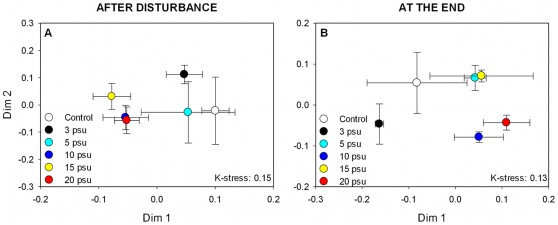
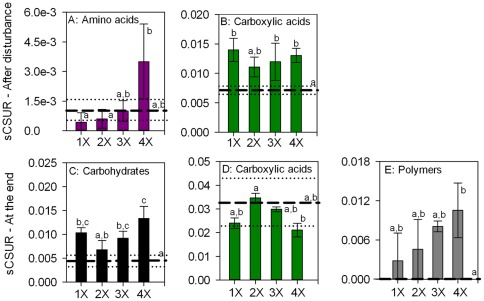
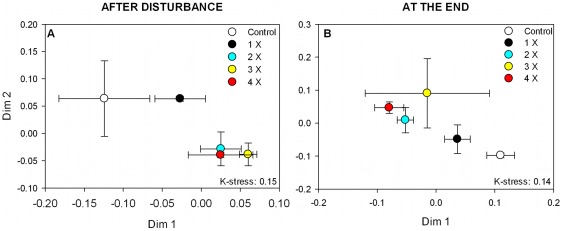
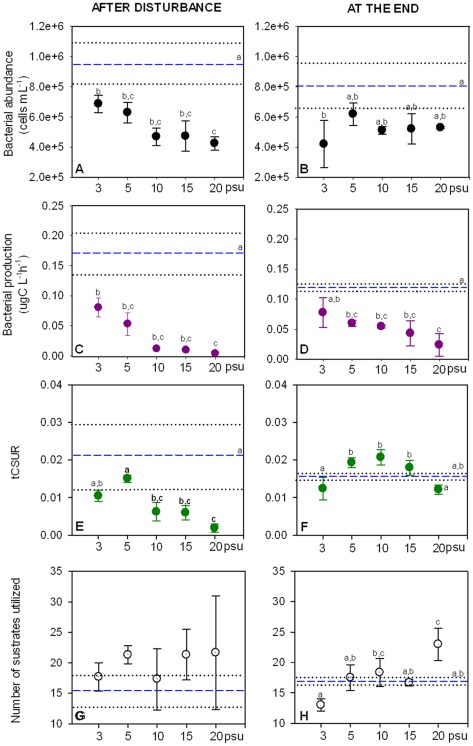
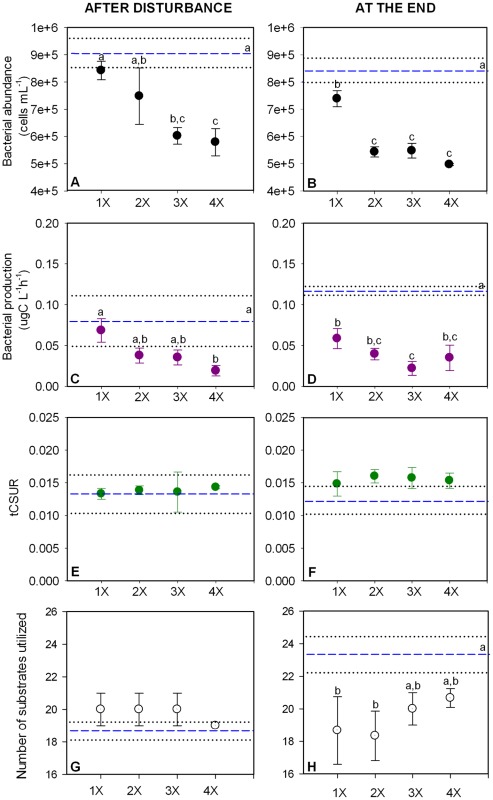
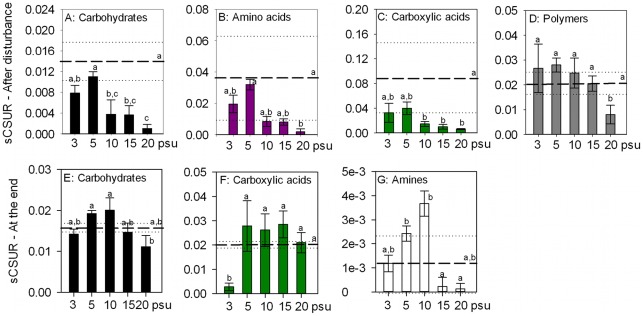
Disturbances influence community structure and ecosystem functioning. Bacteria are key players in ecosystems and it is therefore crucial to understand the effect of disturbances on bacterial communities and how they respond to them, both compositionally and functionally. The main aim of this study was to test the effect of differences in disturbance strength on bacterial communities. For this, we implemented two independent short-term experiments with dialysis bags containing natural bacterial communities, which were transplanted between ambient and 'disturbed' incubation tanks, manipulating either the intensity or the frequency of a salinity disturbance. We followed changes in community composition by terminal restriction fragment analysis (T-RFLP) and measured various community functions (bacterial production, carbon substrate utilization profiles and rates) directly after and after a short period of recovery under ambient conditions. Increases in disturbance strength resulted in gradually stronger changes in bacterial community composition and functions. In the disturbance intensity experiment, the sensitivity to the disturbance and the ability of recovery differed between different functions. In the disturbance frequency experiment, effects on the different functions were more consistent and recovery was not observed. Moreover, in case of the intensity experiment, there was also a time lag in the responses of community composition and functions, with functional responses being faster than compositional ones. To summarize, our study shows that disturbance strength has the potential to change the functional performance and composition of bacterial communities. It further highlights that the overall effects, rates of recovery and the degree of congruence in the response patterns of community composition and functioning along disturbance gradients depend on the type of function and the character of the disturbance.
干扰会影响群落结构和生态系统功能。细菌是生态系统中的关键参与者,因此了解干扰对细菌群落的影响以及它们如何对此做出反应,无论是在组成上还是在功能上,都是至关重要的。本研究的主要目的是测试干扰强度差异对细菌群落的影响。为此,我们进行了两个独立的短期实验,使用含有自然细菌群落的透析袋,将其在环境和“干扰”孵育罐之间移植,分别操纵盐度干扰的强度或频率。我们通过末端限制性片段分析(T-RFLP)来跟踪群落组成的变化,并在环境条件下进行短期恢复后直接测量各种群落功能(细菌生产力、碳底物利用谱和速率)。干扰强度的增加导致细菌群落组成和功能逐渐发生更强的变化。在干扰强度实验中,不同功能对干扰的敏感性和恢复能力不同。在干扰频率实验中,对不同功能的影响更为一致,并且没有观察到恢复。此外,在强度实验中,群落组成和功能的响应也存在时间滞后,功能响应比组成响应更快。总之,我们的研究表明,干扰强度有可能改变细菌群落的功能表现和组成。它进一步强调,沿干扰梯度的群落组成和功能的整体效应、恢复速度以及响应模式的一致性程度取决于功能类型和干扰特征。