Department of Phylogeny and Systematics, Goethe University, Frankfurt am Main, Hesse, Germany.
PLoS One. 2012;7(5):e37089. doi: 10.1371/journal.pone.0037089. Epub 2012 May 14.
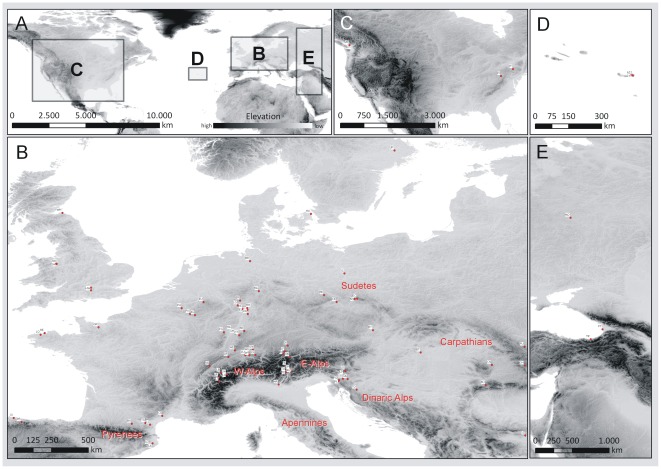
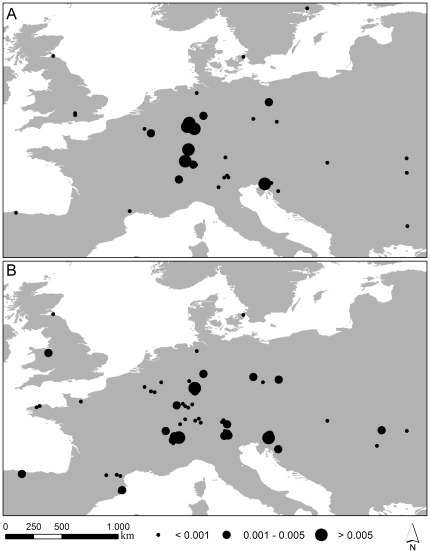
The Alpine Region, constituting the Alps and the Dinaric Alps, has played a major role in the formation of current patterns of biodiversity either as a contact zone of postglacial expanding lineages or as the origin of genetic diversity. In our study, we tested these hypotheses for two widespread, sympatric microgastropod taxa--Carychium minimum O.F. Müller, 1774 and Carychium tridentatum (Risso, 1826) (Gastropoda, Eupulmonata, Carychiidae)--by using COI sequence data and species potential distribution models analyzed in a statistical phylogeographical framework. Additionally, we examined disjunct transatlantic populations of those taxa from the Azores and North America. In general, both Carychium taxa demonstrate a genetic structure composed of several differentiated haplotype lineages most likely resulting from allopatric diversification in isolated refugial areas during the Pleistocene glacial periods. However, the genetic structure of Carychium minimum is more pronounced, which can be attributed to ecological constraints relating to habitat proximity to permanent bodies of water. For most of the Carychium lineages, the broader Alpine Region was identified as the likely origin of genetic diversity. Several lineages are endemic to the broader Alpine Region whereas a single lineage per species underwent a postglacial expansion to (re)colonize previously unsuitable habitats, e.g. in Northern Europe. The source populations of those expanding lineages can be traced back to the Eastern and Western Alps. Consequently, we identify the Alpine Region as a significant 'hot-spot' for the formation of genetic diversity within European Carychium lineages. Passive dispersal via anthropogenic means best explains the presence of transatlantic European Carychium populations on the Azores and in North America. We conclude that passive (anthropogenic) transport could mislead the interpretation of observed phylogeographical patterns in general.
阿尔卑斯地区,包括阿尔卑斯山脉和迪纳拉山脉,在形成当前生物多样性模式方面发挥了重要作用,既是后冰川时代扩张谱系的接触区,也是遗传多样性的起源地。在我们的研究中,我们通过使用 COI 序列数据和在统计系统地理学框架中分析的物种潜在分布模型,测试了这两个广泛分布、同域的小型腹足纲分类群——Carychium minimum O.F. Müller, 1774 和 Carychium tridentatum (Risso, 1826)(腹足纲,肺螺亚纲,Carychiidae)的这些假设。此外,我们还研究了来自亚速尔群岛和北美的这些分类群的间断跨大西洋种群。一般来说,这两个 Carychium 分类群的遗传结构由几个分化的单倍型谱系组成,这些谱系很可能是由于在更新世冰川时期隔离避难所的地理隔离而产生的。然而,Carychium minimum 的遗传结构更为明显,这可以归因于与接近永久性水体的栖息地相关的生态限制。对于大多数 Carychium 谱系,更广泛的阿尔卑斯地区被确定为遗传多样性的可能起源地。有几个谱系是阿尔卑斯地区特有的,而每个物种的单一谱系则经历了后冰川时代的扩张,以(重新)殖民以前不适宜的栖息地,例如在北欧。这些扩张谱系的源种群可以追溯到东阿尔卑斯山和西阿尔卑斯山。因此,我们确定阿尔卑斯地区是欧洲 Carychium 谱系遗传多样性形成的重要“热点”。通过人为手段的被动扩散最好地解释了亚速尔群岛和北美的跨大西洋欧洲 Carychium 种群的存在。我们得出结论,被动(人为)运输可能会导致对观察到的系统地理学模式的解释产生偏差。