Department of Phylogeny and Systematics, Institute for Ecology, Evolution and Diversity, Biosciences, Goethe-University Frankfurt, Max-von-Laue Straße 13, 60438 Frankfurt am Main, Germany.
BMC Evol Biol. 2013 Jan 23;13:18. doi: 10.1186/1471-2148-13-18.
Current biodiversity patterns are considered largely the result of past climatic and tectonic changes. In an integrative approach, we combine taxonomic and phylogenetic hypotheses to analyze temporal and geographic diversification of epigean (Carychium) and subterranean (Zospeum) evolutionary lineages in Carychiidae (Eupulmonata, Ellobioidea). We explicitly test three hypotheses: 1) morphospecies encompass unrecognized evolutionary lineages, 2) limited dispersal results in a close genetic relationship of geographical proximally distributed taxa and 3) major climatic and tectonic events had an impact on lineage diversification within Carychiidae.
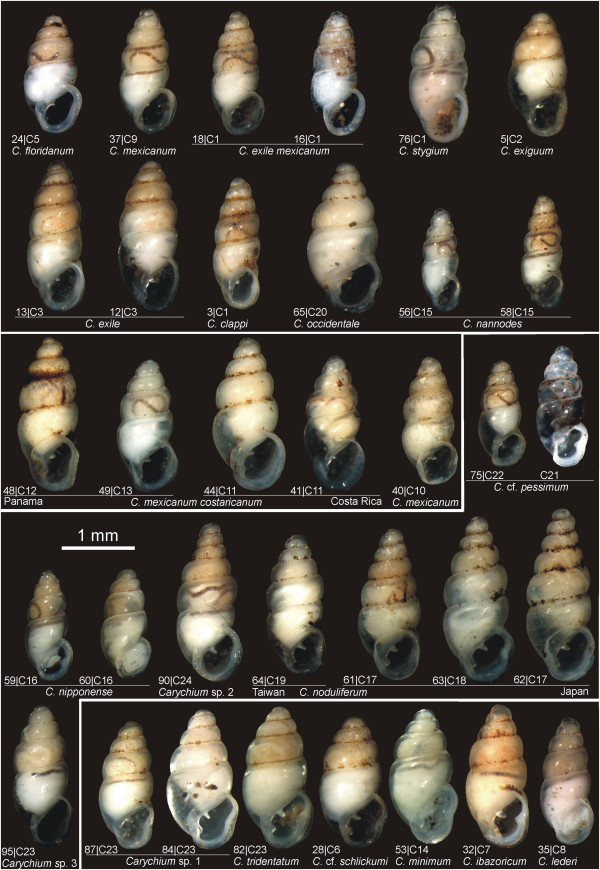
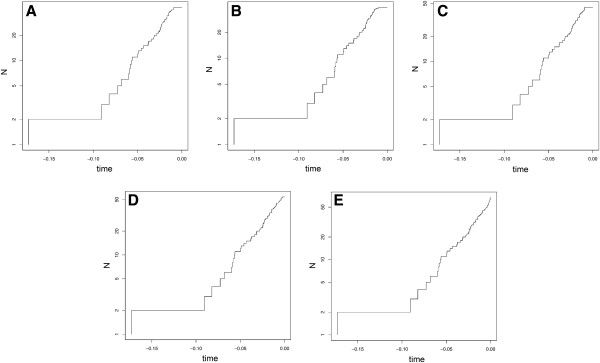
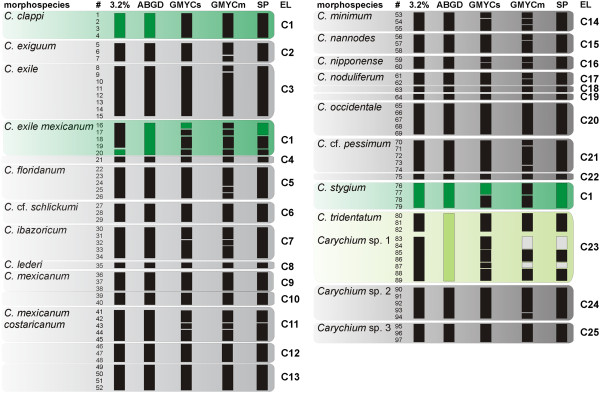
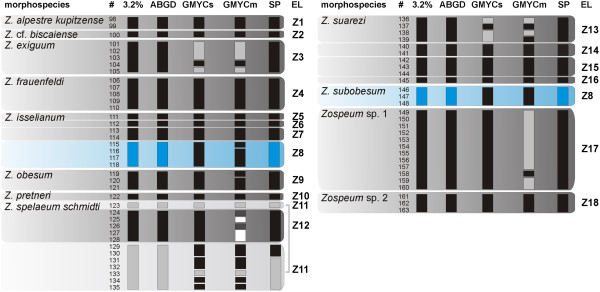
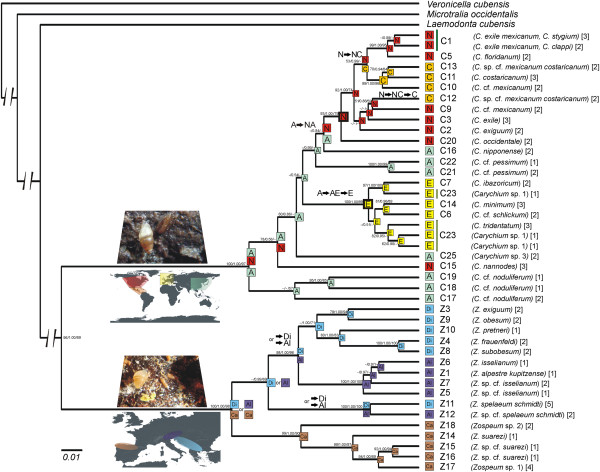
Initial morphospecies assignments were investigated by different molecular delimitation approaches (threshold, ABGD, GMYC and SP). Despite a conservative delimitation strategy, carychiid morphospecies comprise a great number of unrecognized evolutionary lineages. We attribute this phenomenon to historic underestimation of morphological stasis and phenotypic variability amongst lineages. The first molecular phylogenetic hypothesis for the Carychiidae (based on COI, 16S and H3) reveals Carychium and Zospeum to be reciprocally monophyletic. Geographical proximally distributed lineages are often closely related. The temporal diversification of Carychiidae is best described by a constant rate model of diversification. The evolution of Carychiidae is characterized by relatively few (long distance) colonization events. We find support for an Asian origin of Carychium. Zospeum may have arrived in Europe before extant members of Carychium. Distantly related Carychium clades inhabit a wide spectrum of the available bioclimatic niche and demonstrate considerable niche overlap.
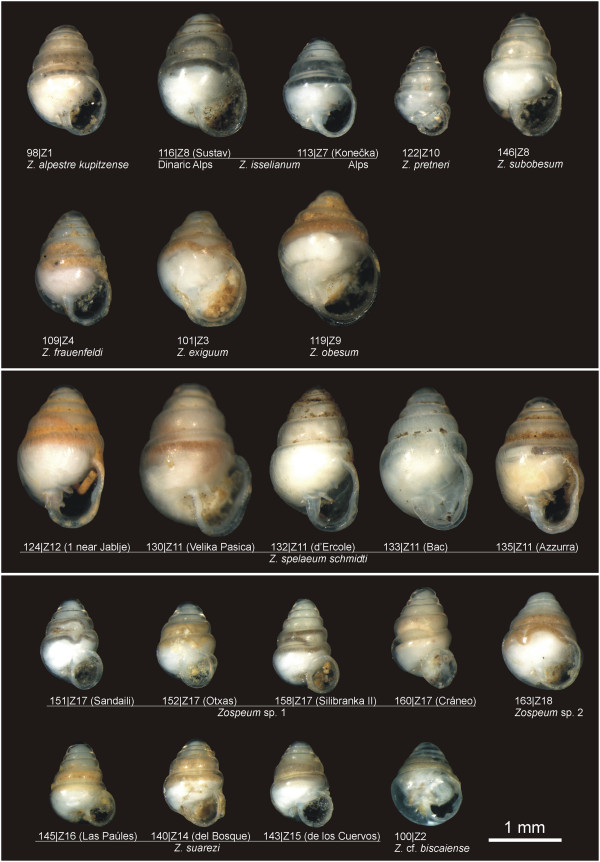
Carychiid taxonomy is in dire need of revision. An inferred wide distribution and variable phenotype suggest underestimated diversity in Zospeum. Several Carychium morphospecies are results of past taxonomic lumping. By collecting populations at their type locality, molecular investigations are able to link historic morphospecies assignments to their respective evolutionary lineage. We propose that rare founder populations initially colonized a continent or cave system. Subsequent passive dispersal into adjacent areas led to in situ pan-continental or mountain range diversifications. Major environmental changes did not influence carychiid diversification. However, certain molecular delimitation methods indicated a recent decrease in diversification rate. We attribute this decrease to protracted speciation.
目前的生物多样性模式被认为主要是过去气候和构造变化的结果。在综合方法中,我们结合分类学和系统发育假说来分析 Carychiidae(Eupulmonata,Ellobioidea)中陆生(Carychium)和地下(Zospeum)进化谱系的时间和地理多样化。我们明确测试了三个假设:1)形态种包含未被识别的进化谱系,2)有限的扩散导致地理上接近的分类群具有密切的遗传关系,3)主要的气候和构造事件对 Carychiidae 内的谱系多样化产生了影响。
通过不同的分子界定方法(阈值、ABGD、GMYC 和 SP)研究了初始形态种的分配。尽管采用了保守的界定策略,但 Carychiidae 的形态种包含大量未被识别的进化谱系。我们将这种现象归因于历史上对谱系之间形态稳定性和表型变异性的低估。基于 COI、16S 和 H3 的 Carychiidae 的第一个分子系统发育假说揭示了 Carychium 和 Zospeum 是相互单系的。地理上接近的分布谱系通常密切相关。Carychiidae 的时间多样化最好用多样化的恒定速率模型来描述。Carychiidae 的进化特征是相对较少(长距离)的殖民事件。我们发现 Carychium 的亚洲起源得到了支持。Zospeum 可能在现存的 Carychium 成员到达之前就已经到达了欧洲。远缘的 Carychium 分支栖息在广泛的可用生物气候生态位中,并表现出相当大的生态位重叠。
Carychiidae 的分类学急需修订。推断的广泛分布和可变表型表明 Zospeum 的多样性被低估了。一些 Carychium 形态种是过去分类学合并的结果。通过在其模式产地收集种群,分子研究能够将历史形态种的分配与各自的进化谱系联系起来。我们提出,稀有创始种群最初殖民了一个大陆或洞穴系统。随后,被动扩散到相邻地区导致了原地的泛大陆或山脉多样化。主要的环境变化没有影响 Carychiidae 的多样化。然而,某些分子界定方法表明,多样化率最近有所下降。我们将这种下降归因于长期的物种形成。