Centre for Physical Activity and Nutrition Research, School of Exercise and Nutrition Sciences, Deakin University, Burwood, VIC, Australia.
Int J Behav Nutr Phys Act. 2012 May 18;9:57. doi: 10.1186/1479-5868-9-57.
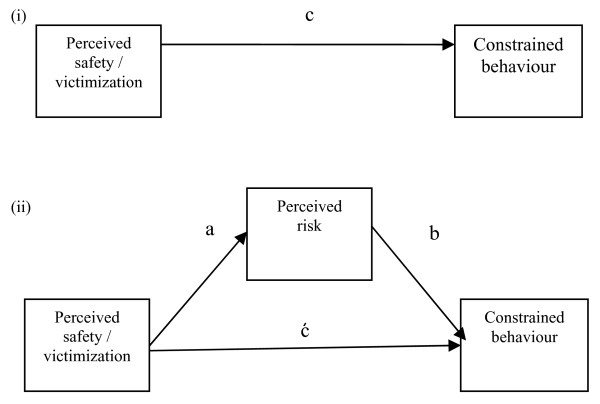
There is evidence that adolescence is a critical period of decline in physical activity. However, adolescents may have limited opportunities to be physically active outdoors if their parents are concerned about neighborhood safety and restrict their adolescent's physical activity within their neighborhood. Pathways that lead to parental restriction of adolescents' physical activity (constrained behavior) are under-researched. This study aimed to examine perceived risk as a potential mediator of associations between perceived safety/victimization and constrained behavior.
Cross-sectional study of adolescents (43% boys) aged 15-17 years (n = 270) in Melbourne, Australia. Parents reported perceived safety (road safety, incivilities and personal safety) and prior victimization in their neighborhood, perceived risk of their children being harmed and whether they constrained their adolescent's physical activity. Constrained behavior was categorized as 'avoidance' or 'defensive' behavior depending on a whether physical activity was avoided or modified, respectively, due to perceived risk. MacKinnon's product-of-coefficients test of mediation was used to assess potential mediating pathways between perceived safety/victimization and constrained behavior.
For girls only, perceived risk was a significant mediator of associations between perceived road safety and avoidance/defensive behavior, and between perceived incivilities, perceived personal safety, victimization and defensive behavior.
Associations between perceived safety/victimization and constrained behavior are complex. Findings may guide the design of interventions that aim to improve actual and perceived levels of safety and reduce perceptions of risk. This is of particular importance for adolescent girls among whom low and declining levels of physical activity have been observed worldwide.
有证据表明,青少年时期是体力活动下降的关键时期。然而,如果父母担心邻里安全并限制青少年在邻里范围内的体力活动,那么青少年可能没有太多机会在户外进行体力活动。导致父母限制青少年体力活动(受限行为)的途径尚未得到充分研究。本研究旨在检验感知风险是否是感知安全/受害与受限行为之间关联的潜在中介。
在澳大利亚墨尔本对年龄在 15-17 岁的青少年(43%为男性)进行横断面研究(n=270)。父母报告了他们邻里的安全感(道路安全、不文明行为和个人安全)和以前的受害情况、他们孩子受到伤害的感知风险以及他们是否限制了青少年的体力活动。受限行为根据是否由于感知风险而分别避免或修改体力活动,分为“回避”或“防御”行为。MacKinnon 的乘积系数中介检验用于评估感知安全/受害与受限行为之间潜在的中介途径。
仅对于女孩,感知风险是感知道路安全与回避/防御行为之间以及感知不文明行为、感知个人安全、受害与防御行为之间关联的一个重要中介。
感知安全/受害与受限行为之间的关联是复杂的。研究结果可能为旨在提高实际和感知安全水平以及降低风险感知的干预措施的设计提供指导。对于全世界范围内观察到的体力活动水平较低和下降的青少年女孩来说,这一点尤为重要。