Public Health School, Faculty of Medicine, KU Leuven, Kapucijnenvoer, Leuven, Belgium.
Implement Sci. 2012 May 18;7:47. doi: 10.1186/1748-5908-7-47.
Although care pathways are often said to promote teamwork, high-level evidence that supports this statement is lacking. Furthermore, knowledge on conditions and facilitators for successful pathway implementation is scarce. The objective of the European Quality of Care Pathway (EQCP) study is therefore to study the impact of care pathways on interprofessional teamwork and to build up understanding on the implementation process.
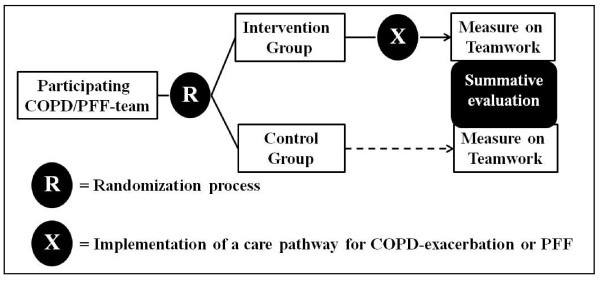
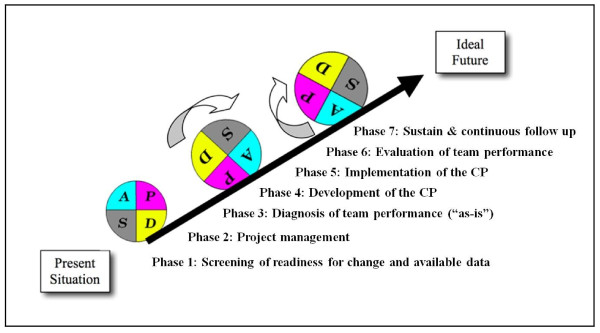
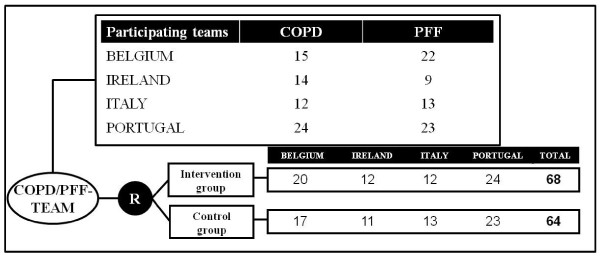
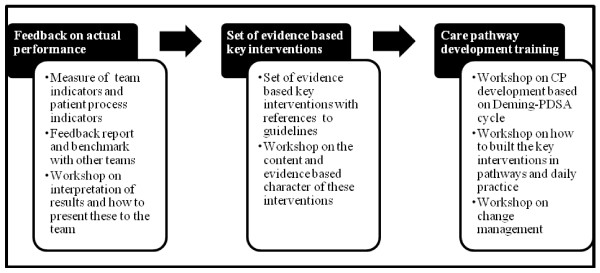
METHODS/DESIGN: An international post-test-only cluster Randomised Controlled Trial (cRCT), combined with process evaluations, will be performed in Belgium, Ireland, Italy, and Portugal. Teams caring for proximal femur fracture (PFF) patients and patients hospitalized with an exacerbation of chronic obstructive pulmonary disease (COPD) will be randomised into an intervention and control group. The intervention group will implement a care pathway for PFF or COPD containing three active components: a formative evaluation of the actual teams' performance, a set of evidence-based key interventions, and a training in care pathway-development. The control group will provide usual care. A set of team input, process and output indicators will be used as effect measures. The main outcome indicator will be relational coordination. Next to these, process measures during and after pathway development will be used to evaluate the implementation processes. In total, 132 teams have agreed to participate, of which 68 were randomly assigned to the intervention group and 64 to the control group. Based on power analysis, a sample of 475 team members per arm is required. To analyze results, multilevel analysis will be performed.
Results from our study will enhance understanding on the active components of care pathways. Through this, preferred implementation strategies can be defined.
尽管护理路径常被认为能促进团队合作,但缺乏支持这一说法的高级证据。此外,成功实施路径的条件和促进因素的知识也很匮乏。因此,欧洲护理路径质量(EQCP)研究的目的是研究护理路径对跨专业团队合作的影响,并深入了解实施过程。
方法/设计:这是一项在比利时、爱尔兰、意大利和葡萄牙开展的国际、群组后测随机对照试验(cRCT),并结合了过程评估。接受股骨近端骨折(PFF)和慢性阻塞性肺疾病(COPD)急性加重住院治疗的患者的护理团队将被随机分配到干预组和对照组。干预组将实施 PFF 或 COPD 护理路径,该路径包含三个主动组件:对实际团队绩效的形成性评估、一套基于证据的关键干预措施,以及护理路径开发培训。对照组将提供常规护理。将使用一组团队投入、过程和输出指标作为效果衡量标准。主要的结局指标是关系协调。除了这些指标之外,还将在路径开发期间和之后使用过程指标来评估实施过程。共有 132 个团队同意参与,其中 68 个团队被随机分配到干预组,64 个团队被分配到对照组。根据功效分析,每个手臂需要 475 名团队成员的样本。为了分析结果,将进行多层次分析。
我们的研究结果将增强对护理路径的积极因素的理解。通过这种方式,可以定义首选的实施策略。