Murakami Hidetaka, Soejima Takashi, Inoue Takashi, Kanazawa Tomonoshin, Noguchi Kouji, Katouda Michihiro, Tabuchi Kousuke, Noyama Megumi, Yasunaga Hideki, Nagata Kensei
Department of Orthopaedic Surgery, Kurume University School of Medicine, 67 Asahi-machi, Kurume City, Fukuoka, 830-0011, Japan.
Sports Med Arthrosc Rehabil Ther Technol. 2012 May 20;4(1):17. doi: 10.1186/1758-2555-4-17.
To investigate the usefulness of the "inducer grafting" technique for regeneration of the semitendinosus (ST) tendon after its harvest for anterior cruciate ligament (ACL) reconstruction.
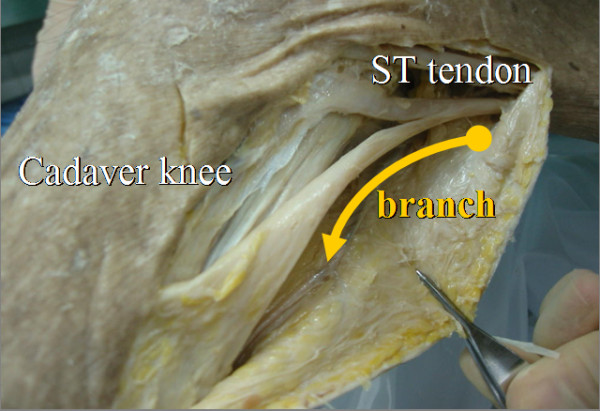
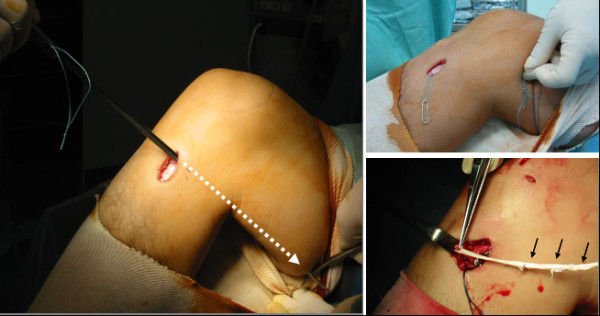
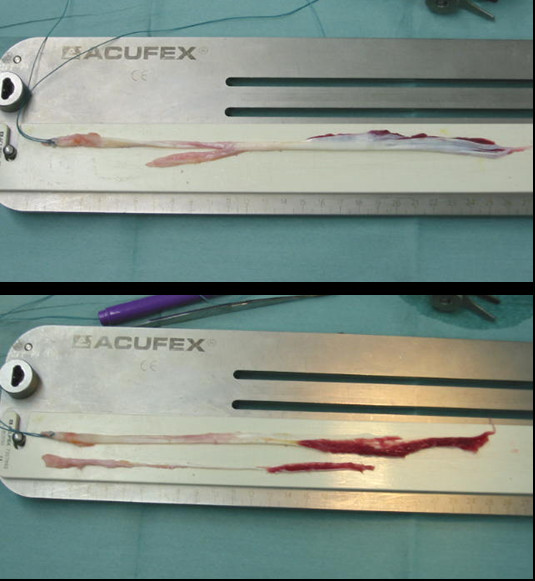
Twenty knees of 20 patients (mean age at the time of surgery, 23.1 years) underwent ACL reconstruction with a double bundle autograft using the ST tendon (7 patients) and the ST + the gracilis (G) tendons (13 patients)."Inducer grafting" techniqueAfter harvesting the ST tendon, a passing pin with a loop thread is inserted along with the tendon stripper. The passing pin is pulled out from the medial thigh and the loop thread retained. As an inducer graft, the ST tendon branch is used. After the ACL graft has been secured, the inducer graft is sutured to the pes anserinus and the proximal end passed through by pulling the thread out. Then the inducer graft is placed within the tendon canal. The mean follow-up period was 15 months. The presence and morphology of the regenerated ST tendon were examined by MRI. And the isometric hamstring strength was examined at 45°, 90° and 120° of knee flexion.
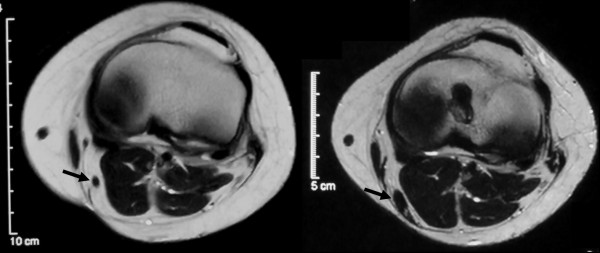
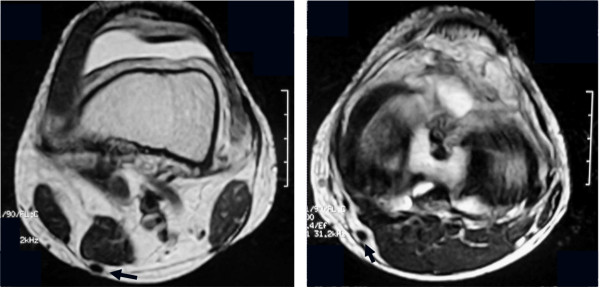
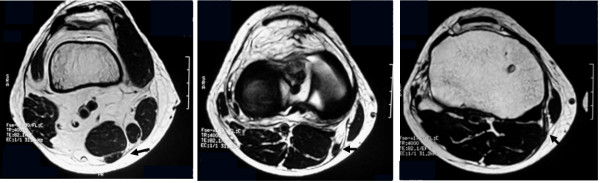
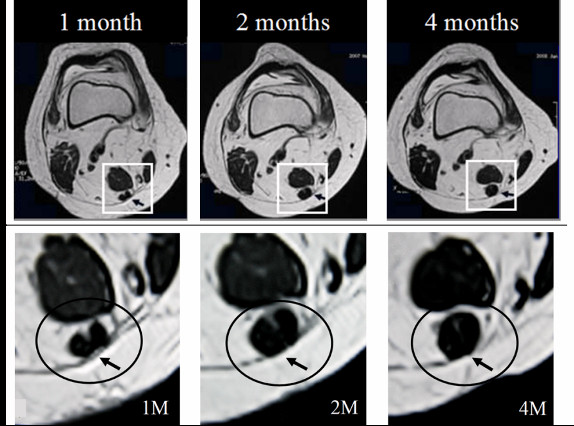
One month after the operation in all the patients, MRI demonstrated a low-intensity structure at the anatomical location of the ST, at the level of the superior pole of the patella and the joint line, apparently representing the regenerated ST tendon. Four months after the operation, the distal portion of the regenerated ST tendon had reached the pes anserinus in all patients. Twelve months after the operation, the regenerated ST tendon was hypertrophic in 19 of the 20 patients (95%). The isometric knee flexion torque of the ACL-reconstructed limb was significantly lower at 90° and 120° compared with the contralateral limb.
These results suggest that the "inducer grafting" technique is able to improve the regeneration rate of the harvested ST tendon and promote hypertrophy of the regenerated ST tendon, extending all the way to the pes anserinus. However, this technique couldn't improve the deficits in knee flexion torque after ACL reconstruction.
探讨“诱导移植”技术在前交叉韧带(ACL)重建中半腱肌(ST)肌腱取材后再生的有效性。
20例患者的20个膝关节(手术时平均年龄23.1岁)接受了ACL重建,其中7例采用ST肌腱双束自体移植,13例采用ST肌腱加股薄肌(G)肌腱双束自体移植。“诱导移植”技术
取材ST肌腱后,将带环缝线的穿针与肌腱剥离器一起插入。将穿针从大腿内侧拔出,保留环缝线。作为诱导移植物,使用ST肌腱分支。固定ACL移植物后,将诱导移植物缝合至鹅足,通过拉线使近端穿过。然后将诱导移植物置于肌腱管内。平均随访期为15个月。通过MRI检查再生ST肌腱的存在和形态。并在膝关节屈曲45°、90°和120°时检查等长绳肌力量。
所有患者术后1个月,MRI显示ST肌腱解剖位置、髌骨上极水平及关节线处有低强度结构,明显代表再生的ST肌腱。术后4个月,所有患者再生ST肌腱的远端均已到达鹅足处。术后12个月,20例患者中有19例(95%)再生ST肌腱肥厚。与对侧肢体相比,ACL重建肢体在90°和120°时的等长屈膝扭矩明显较低。
这些结果表明,“诱导移植”技术能够提高取材后ST肌腱的再生率,并促进再生ST肌腱的肥大,一直延伸至鹅足处。然而,该技术不能改善ACL重建后屈膝扭矩的不足。