Mapunya Manyatja Brenda, Nikolova Roumiana Vassileva, Lall Namrita
Department of Biodiversity, School of Molecular and Life Sciences, University of Limpopo (UL), Private Bag X1106, Sovenga 0727, South Africa.
Evid Based Complement Alternat Med. 2012;2012:374017. doi: 10.1155/2012/374017. Epub 2012 Apr 24.
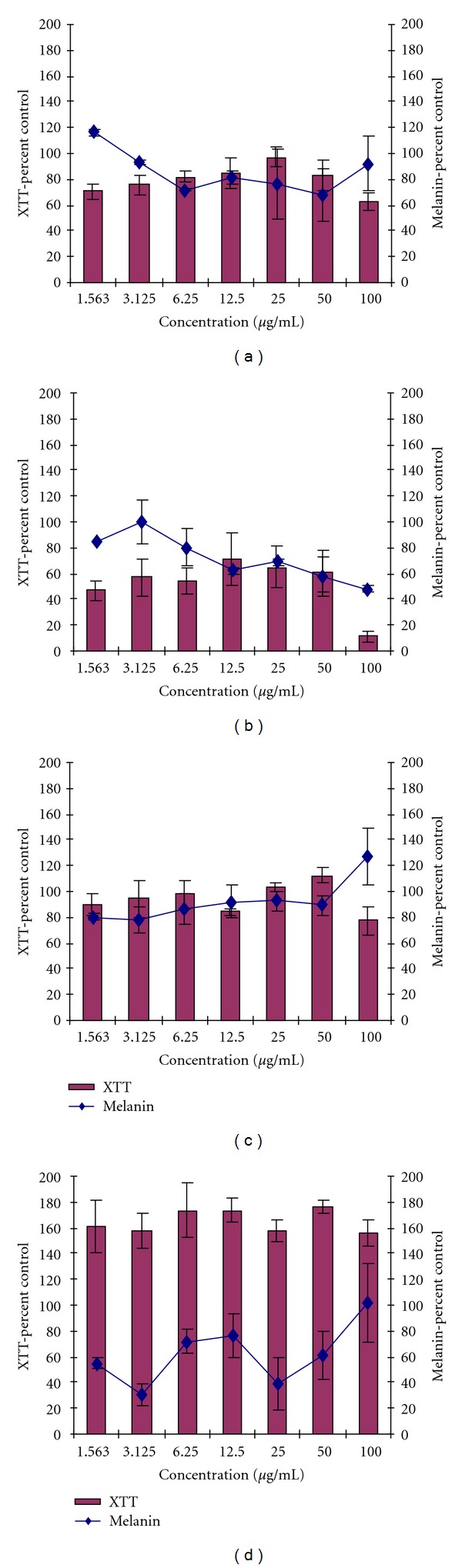
Melanin is the pigment that is responsible for the colour of eyes, hair, and skin in humans. Tyrosinase is known to be the key enzyme in melanin biosynthesis. Overactivity of this enzyme leads to dermatological disorders such as age spots, melanoma and sites of actinic damage. Ten plants belonging to four families (Asphodelaceae, Anacardiaceae, Oleaceae, and Rutaceae) were investigated for their effect on tyrosinase using both L-tyrosine and L-DOPA as substrates. Ethanol leaf extracts (500 μg/mL) of Aloe ferox, Aloe aculeata, Aloe pretoriensis, and Aloe sessiliflora showed 60%, 31%, 17%, and 13% inhibition of tyrosinase activity respectively, when L-tyrosine was used as a substrate. Harpephyllum caffrum (leaves) at a concentration of 500 μg/mL had an inhibitory effect of 70% on tyrosinase when L-DOPA was used as a substrate. The IC(50) of Harpephyllum caffrum (leaves and bark) were found to be 51 ± 0.002 and 40 ± 0.035 μg/mL, respectively. Following the results obtained from the tyrosinase assay, extracts from Harpephyllum caffrum were selected for further testing on their effect on melanin production and their cytotoxicity on melanocytes in vitro. The IC(50) of both extracts was found to be 6.25 μg/mL for melanocyte cells. Bark extract of Harpephyllum caffrum showed 26% reduction in melanin content of melanocyte cells at a concentration of 6.25 μg/mL. The leaf extract of this plant showed some toxicity on melanocyte cells. Therefore, the bark extract of Harpephyllum caffrum could be considered as an antityrosinase agent for dermatological disorders such as age spots and melasoma.
黑色素是决定人类眼睛、头发和皮肤颜色的色素。酪氨酸酶是黑色素生物合成中的关键酶。该酶的过度活跃会导致皮肤病,如老年斑、黑色素瘤和光化性损伤部位。对属于四个科(阿福花科、漆树科、木犀科和芸香科)的10种植物以L - 酪氨酸和L - 多巴为底物研究了它们对酪氨酸酶的影响。当以L - 酪氨酸为底物时,费氏芦荟、具刺芦荟、普氏芦荟和无柄芦荟的乙醇叶提取物(500μg/mL)对酪氨酸酶活性的抑制率分别为60%、31%、17%和13%。当以L - 多巴为底物时,浓度为500μg/mL的南非钩枝藤(叶)对酪氨酸酶的抑制作用为70%。南非钩枝藤(叶和树皮)的半数抑制浓度(IC50)分别为51±0.002和40±0.035μg/mL。根据酪氨酸酶测定结果,选择南非钩枝藤的提取物进一步测试其对黑色素生成的影响以及对体外黑素细胞的细胞毒性。两种提取物对黑素细胞的IC50均为6.25μg/mL。南非钩枝藤的树皮提取物在浓度为6.25μg/mL时,黑素细胞中的黑色素含量降低了26%。该植物的叶提取物对黑素细胞有一定毒性。因此,南非钩枝藤的树皮提取物可被视为治疗老年斑和黑色素瘤等皮肤病的抗酪氨酸酶剂。