Department of Integrated Medical Care, Medical University of Białystok, Białystok, Poland.
Malar J. 2012 Jun 29;11:171. doi: 10.1186/1475-2875-11-171.
Health status is one of the basic factors of a high quality of life and the problem of the acceptance of illness is important for adaptation to the limitations imposed by it. The purpose of the study was the evaluation of the quality of life, satisfaction with life and the acceptance of illness by malaria patients, as well as the discovery of a relationship between studied parameters.
The study was undertaken in August 2010, on 120 Nigerian patients with confirmed malaria. A method of diagnostic survey, based on standardized scales - Acceptance of Illness Scale, The Satisfaction With Life Scale and a standardized survey questionnaire World Health Organization Quality of Life/BREF - was used in this study. Descriptive statistics, variability range, 95% confidence interval, correlation analysis, Spearman's non-parametric correlation coefficient, Mann-Whitney test and Kruskal-Wallis test were applied and the, so called, test statistics was calculated, followed by the calculation of the test probability p. Results of analyses were presented in a box graph, and a graph of dispersion.
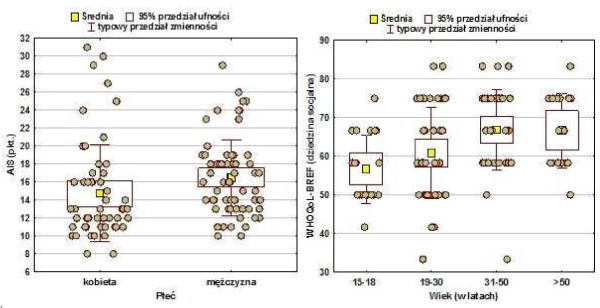
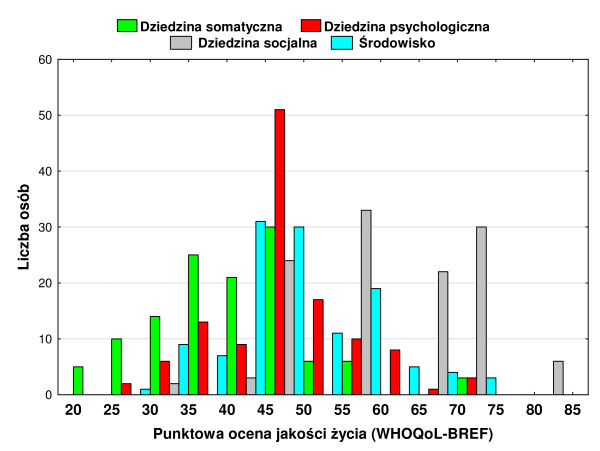
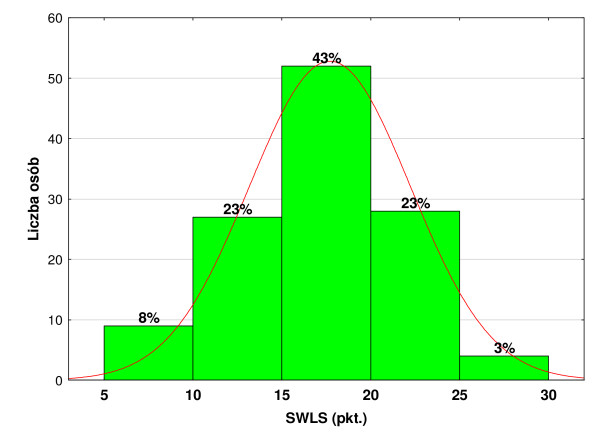
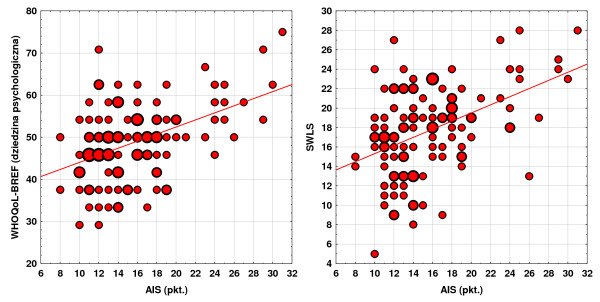
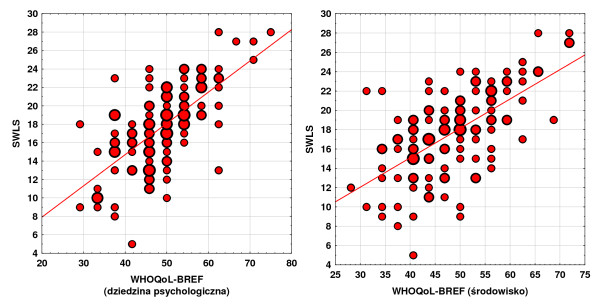
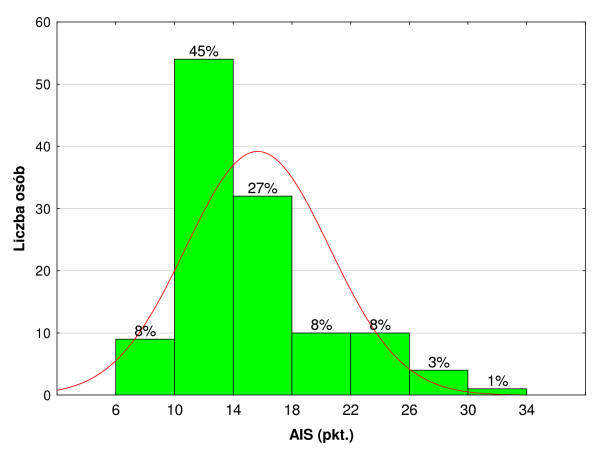
A dominating share in the adjective scale of the AIS scale was the category of "no acceptance", given by 71.7% of respondents. The average level of a "somatic domain" was 41.7, and of a "social domain" was 62.8. The mean satisfaction of life evaluation in the SWLS scale was 18 points. The correlation between acceptance of the disease and quality of life for the psychological domain was 0.39***, and between acceptance of the disease and satisfaction with life was 0.40***. The correlation between satisfaction with life and quality of life for the psychological domain was 0.65***, and between satisfaction with life and quality of life for the environment domain was 0.60***. The mean level of AIS for the studied population of men was 16.5, and test probability: p = 0.0014**, and for the environment domain the level was 50, and the test probability: p = 0.0073**. For quality of life in the social sphere the test probability: p = 0.0013** in relatively older individuals.
The majority of people do not accept their condition. Evaluation of the quality of life was the highest in the social domain, and the lowest in the somatic domain. There is a statistically significant correlation between the level of acceptance of illness and the quality of life and satisfaction with life. The strongest correlation is found between satisfaction with life and the evaluation of the quality of life in psychological and environmental domains. Men evaluate their quality of life in the environmental domain higher and demonstrate a higher acceptance of their disease. There is a correlation regarding a significantly higher quality of life in the social sphere in relatively older people.
健康状况是高质量生活的基本因素之一,而对疾病的接受程度问题对于适应其带来的限制非常重要。本研究的目的是评估疟疾患者的生活质量、生活满意度和对疾病的接受程度,并发现这些研究参数之间的关系。
本研究于 2010 年 8 月进行,共纳入 120 名尼日利亚确诊疟疾患者。采用诊断性调查方法,基于标准化量表——疾病接受量表、生活满意度量表和标准化问卷调查表世界卫生组织生活质量/简短量表——进行研究。采用描述性统计、变异性范围、95%置信区间、相关性分析、斯皮尔曼非参数相关系数、曼-惠特尼检验和克鲁斯卡尔-沃利斯检验,并计算所谓的检验统计量,然后计算检验概率 p。分析结果以箱线图和散布图表示。
在 AIS 量表的形容词量表中,占主导地位的是 71.7%的受访者选择的“不接受”类别。“躯体领域”的平均水平为 41.7,“社会领域”为 62.8。SWLS 量表中对生活满意度的平均评估得分为 18 分。心理领域疾病接受度与生活质量的相关性为 0.39***,疾病接受度与生活满意度的相关性为 0.40***。心理领域生活满意度与生活质量的相关性为 0.65***,生活满意度与环境领域生活质量的相关性为 0.60***。研究人群中男性的 AIS 平均水平为 16.5,检验概率:p=0.0014**,环境领域的水平为 50,检验概率:p=0.0073**。在社会领域,年龄较大的人生活质量的检验概率:p=0.0013**。
大多数人不接受自己的病情。生活质量评估最高的是社会领域,最低的是躯体领域。疾病接受程度与生活质量和生活满意度之间存在显著的相关性。相关性最强的是生活满意度与心理和环境领域的生活质量评估之间的相关性。男性对环境领域的生活质量评价较高,对疾病的接受程度也较高。在年龄较大的人群中,社会领域的生活质量明显更高。