Reis Ana Luiza, Reis Leonardo Oliveira, Saade Ricardo Destro, Santos Carlos Alberto, Lima Marcelo Lopes de, Fregonesi Adriano
Department of Surgery (Urology), Faculty of Medical Sciences, University of Campinas (Unicamp), Brazil.
Medicine (Urology), Center for Life Sciences, Pontifical Catholic University of Campinas (PUCCampinas), Brazil.
Int Braz J Urol. 2015 Jan-Feb;41(1):155-67. doi: 10.1590/S1677-5538.IBJU.2015.01.21.
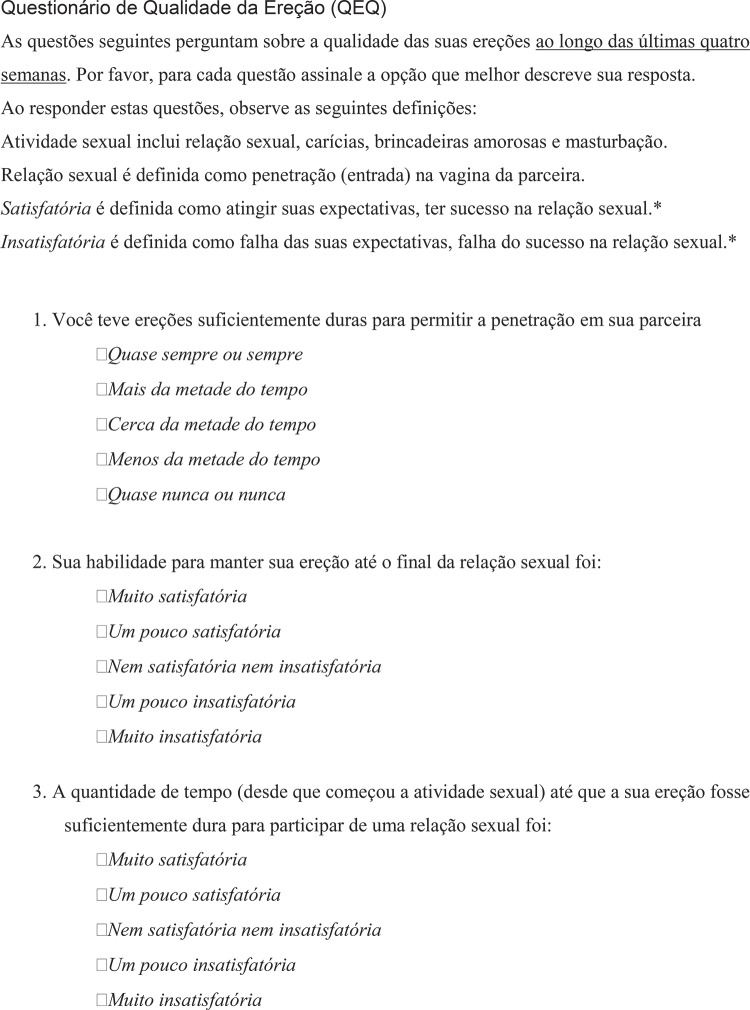
To validate the Quality of Erection Questionnaire (QEQ) considering Brazilian social-cultural aspects.
To determine equivalence between the Portuguese and the English QEQ versions, the Portuguese version was back-translated by two professors who are native English speakers. After language equivalence had been determined, urologists considered the QEQ Portuguese version suitable. Men with self-reported erectile dysfunction (ED) and infertile men who had a stable sexual relationship for at least 6 months were invited to answer the QEQ, the International Index of Erectile Function (IIEF) and the RAND 36-Item Health Survey (RAND-36). The questionnaires were presented together and answered without help in a private room. Internal consistency (Cronbach's α), test-retest reliability (Spearman), convergent validity (Spearman correlation) coefficients and known-groups validity (the ability of the QEQ Portuguese version to differentiate erectile dysfunction severity groups) were assessed.
We recruited 197 men (167 ED patients and 30 non-ED patients), mean age of 53.3 and median of 55.5 years (23-82 years). The Portuguese version of the QEQ had high internal consistency (Cronbach α=0.93), high stability between test and retest (ICC 0.83, with IC 95%: 0.76-0.88, p<0.001) and Spearman correlation coefficient r=0.82 (p<0.001), which demonstrated the high correlation between the QEQ and IIEF results. The correlations between the QEQ and RAND-36 were significantly low in ED (r=0.20, p=0.01) and non-ED patients (r=0.37, p=0.04).
The QEQ Portuguese version presented good psychometric properties and high convergent validity in relation to IIEF. The low correlations between the QEQ and the RAND-36, as well as between the IIEF and the RAND-36 indicated IIEF and QEQ specificity, which may have resulted from the patients' psychological adaptations that minimized the impact of ED on Quality of Life (QoL) and reestablished the well-being feeling.
结合巴西社会文化方面的因素验证勃起质量问卷(QEQ)。
为确定葡萄牙语版和英语版QEQ之间的等效性,葡萄牙语版由两位以英语为母语的教授进行回译。在确定语言等效性后,泌尿科医生认为葡萄牙语版QEQ是合适的。邀请自我报告有勃起功能障碍(ED)的男性以及有稳定性关系至少6个月的不育男性回答QEQ、国际勃起功能指数(IIEF)和兰德36项健康调查(RAND - 36)。问卷一起发放,在一个私人房间里独立作答。评估内部一致性(克朗巴哈α系数)、重测信度(斯皮尔曼系数)、收敛效度(斯皮尔曼相关系数)以及已知群组效度(葡萄牙语版QEQ区分勃起功能障碍严重程度组别的能力)。
我们招募了197名男性(167名ED患者和30名非ED患者),平均年龄53.3岁,中位数55.5岁(23 - 82岁)。葡萄牙语版QEQ具有较高的内部一致性(克朗巴哈α = 0.93),重测稳定性高(组内相关系数ICC 0.83,95%置信区间:0.76 - 0.88,p < 0.001),斯皮尔曼相关系数r = 0.82(p < 0.001),这表明QEQ与IIEF结果之间具有高度相关性。在ED患者(r = 0.20,p = 0.01)和非ED患者中(r = 0.37,p = 0.04),QEQ与RAND - 36之间的相关性显著较低。
葡萄牙语版QEQ呈现出良好的心理测量特性,并且与IIEF具有较高的收敛效度。QEQ与RAND - 36之间以及IIEF与RAND - 36之间的低相关性表明了IIEF和QEQ的特异性,这可能是由于患者的心理适应使得ED对生活质量(QoL)的影响最小化,并重新建立了幸福感。