Department of Anatomy and Neurobiology, University of California Irvine Irvine, CA, USA.
Front Neural Circuits. 2012 May 16;6:23. doi: 10.3389/fncir.2012.00023. eCollection 2012.
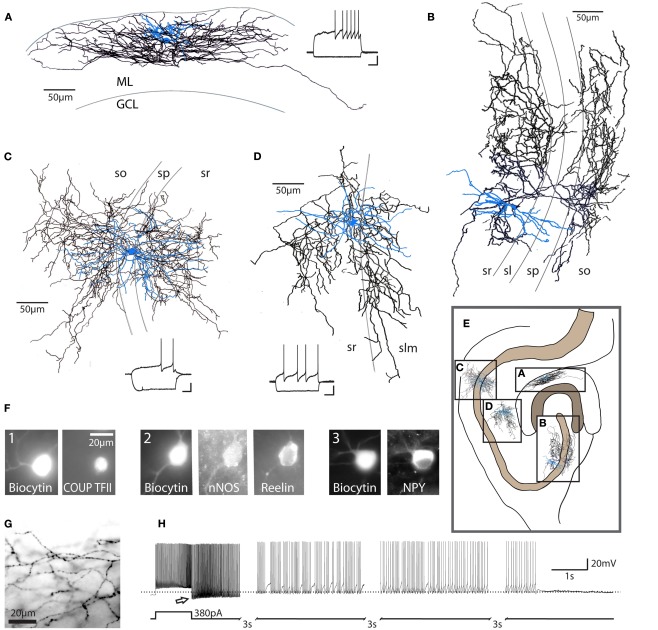
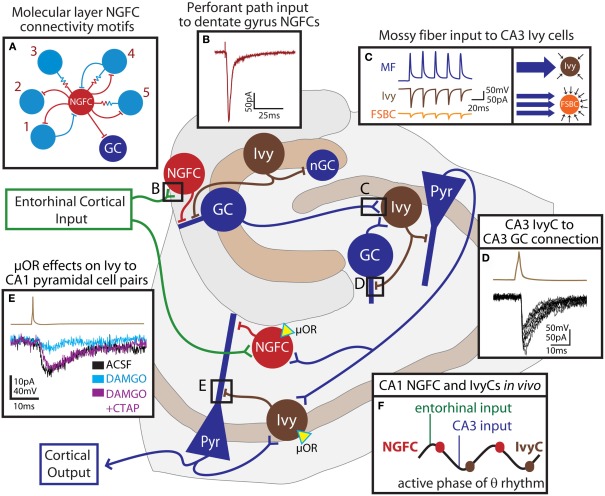
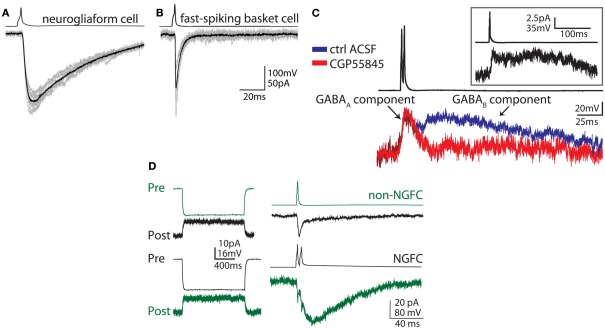
Neurogliaform and Ivy cells are members of an abundant family of neuronal nitric oxide synthase (nNOS) expressing GABAergic interneurons found in diverse brain regions. These cells have a defining dense local axonal plexus, and display unique synaptic properties including a biphasic postsynaptic response with both a slow GABA(A) component and a GABA(B) component following even a single action potential. The type of transmission displayed by these cells has been termed "volume transmission," distinct from both tonic and classical synaptic transmission. Electrical connections are also notable in that, unlike other GABAergic cell types, neurogliaform family cells will form gap junctions not only with other neurogliaform cells, but also with non-neurogliaform family GABAergic cells. In this review, we focus on neurogliaform and Ivy cells throughout the hippocampal formation, where recent studies highlight their role in feedforward inhibition, uncover their ability to display a phenomenon called persistent firing, and reveal their modulation by opioids. The unique properties of this family of cells, their abundance, rich connectivity, and modulation by clinically relevant drugs make them an attractive target for future studies in vivo during different behavioral and pharmacological conditions.
神经胶质形态细胞和长春花细胞是富含神经元型一氧化氮合酶 (nNOS) 的 GABA 能中间神经元家族的成员,存在于不同的脑区。这些细胞具有特征性的密集局部轴突丛,并表现出独特的突触特性,包括双相突触后反应,即使是单个动作电位后也会同时出现 GABA(A) 成分和 GABA(B) 成分。这些细胞所显示的传递类型被称为“容积传递”,与紧张性和经典突触传递都不同。电连接也很显著,因为不同于其他 GABA 能细胞类型,神经胶质形态细胞不仅会与其他神经胶质形态细胞形成缝隙连接,还会与非神经胶质形态细胞形成缝隙连接。在这篇综述中,我们重点关注海马结构中的神经胶质形态细胞和长春花细胞,最近的研究强调了它们在前馈抑制中的作用,揭示了它们表现出一种称为持续放电的现象的能力,并揭示了它们被阿片类药物的调制。这个细胞家族的独特性质,它们的丰富性、丰富的连接性以及被临床相关药物的调制,使它们成为未来在不同行为和药理学条件下进行体内研究的有吸引力的目标。