Division of Molecular Cell Immunology and Allergology, Advanced Medical Research Center, Nihon University Graduate School of Medical Science Tokyo, Japan.
Front Immunol. 2012 May 16;3:112. doi: 10.3389/fimmu.2012.00112. eCollection 2012.
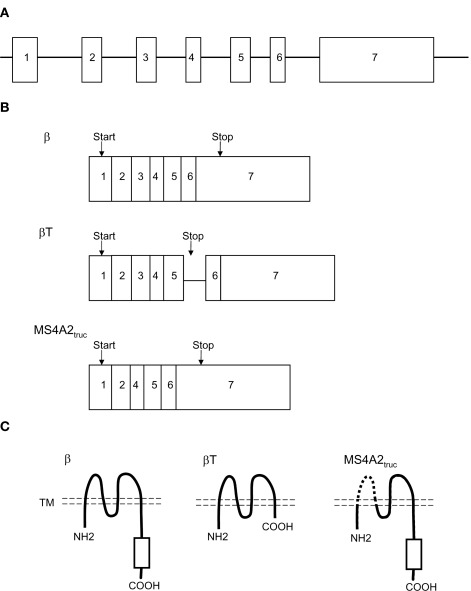
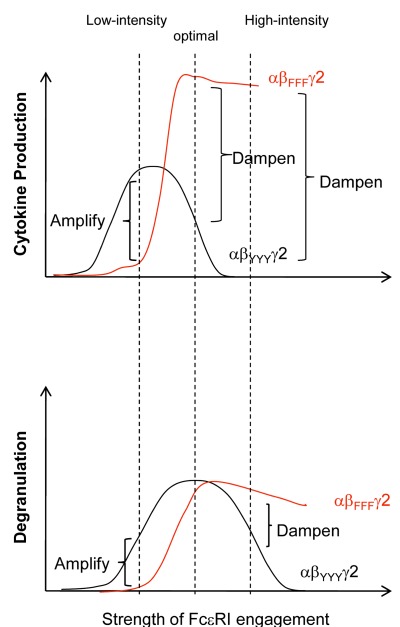
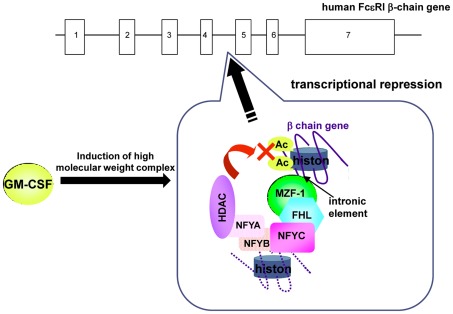
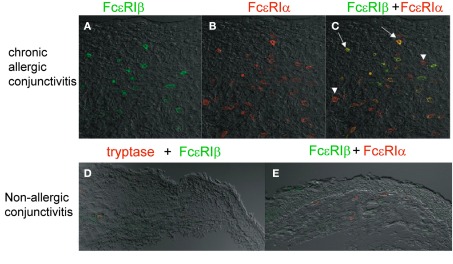
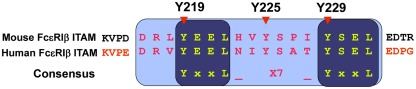
Mast cells play a key role in allergic reaction and disorders through the high affinity receptor for IgE (Fc(ε)RI) which is primarily activated by IgE and antigen complex. In humans, mast cells express two types of Fc(ε)RI on the cell surface, tetrameric αβγ(2) and trimeric αγ(2), whereas in mice, the tetrameric αβγ(2) type is exclusively expressed. In human allergic inflammation lesions, mast cells increase in number and preferentially express the αβγ(2) type Fc(ε)RI. By contrast, in the lesion of non-allergic inflammation, mast cells mainly express the αγ(2)type. Since the β chain amplifies the expression and signaling of FcεRI, mast cell effector functions and allergic reaction in vivo are enhanced in the presence of the β chain. In contrast, a truncated β chain-isoform (βT) inhibits FcεRI surface expression. The human Fc(ε)RIβ gene contains seven exons and a repressor element located in the forth intron, through which Fc(ε)RIβ transcription is repressed in the presence of GM-CSF. Regarding the additional signal regulatory function of the β chain, the β chain ITAM has dual (positive and negative) functions in the regulation of the mast cell activation. Namely, the Fc(ε)RIβ chain ITAM enhances the mast cell activation signal triggered by a low-intensity (weak) stimulation whereas it suppresses the signal triggered by high-intensity (strong) stimulation. In an oxazolone-induced mouse CHS model, IgE-mediated mast cell activation is required and the β chain ITAM is crucially involved. Adenosine receptor, one of the GPCRs, triggers a synergistic degranulation response with FcεRI in mast cells, for which the β chain ITAM critically plays positive role, possibly reflecting the in vivo allergic response. These regulatory functions of the FcεRIβ ITAM finely tune FcεRI-induced mast cell activation depending on the stimulation strength, enabling the Fc(ε)RIβ chain to become a potential molecular target for the development of new strategies for therapeutic interventions for allergies.
肥大细胞通过高亲和力 IgE 受体(Fc(ε)RI)在过敏反应和疾病中发挥关键作用,该受体主要被 IgE 和抗原复合物激活。在人类中,肥大细胞在细胞表面表达两种类型的 Fc(ε)RI,即四聚体 αβγ(2)和三聚体 αγ(2),而在小鼠中,仅表达四聚体 αβγ(2)型。在人类过敏炎症病变中,肥大细胞数量增加,并优先表达 αβγ(2)型 Fc(ε)RI。相比之下,在非过敏炎症病变中,肥大细胞主要表达 αγ(2)型。由于β链放大了 FcεRI 的表达和信号转导,因此在存在β链的情况下,肥大细胞效应功能和体内过敏反应增强。相比之下,截短的β链同工型(βT)抑制 FcεRI 表面表达。人类 Fc(ε)RIβ 基因包含七个外显子和一个位于第四内含子中的抑制元件,通过该元件,在 GM-CSF 存在的情况下,Fc(ε)RIβ 转录被抑制。关于β链的附加信号调节功能,β 链 ITAM 在调节肥大细胞激活方面具有双重(正和负)功能。即,Fc(ε)RIβ 链 ITAM 增强了由低强度(弱)刺激触发的肥大细胞激活信号,而抑制了由高强度(强)刺激触发的信号。在奥沙酮诱导的小鼠 CHS 模型中,IgE 介导的肥大细胞激活是必需的,β 链 ITAM 至关重要。腺苷受体是 GPCR 之一,在肥大细胞中与 FcεRI 触发协同脱颗粒反应,β 链 ITAM 在此反应中发挥关键的正向作用,可能反映了体内过敏反应。Fc(ε)RIβ ITAM 的这些调节功能根据刺激强度精细调节 FcεRI 诱导的肥大细胞激活,使 Fc(ε)RIβ 链成为开发治疗过敏新策略的潜在分子靶标。