Institute of Tropical Medicine, Department of Public Health, Antwerp, Belgium.
PLoS One. 2012;7(5):e36954. doi: 10.1371/journal.pone.0036954. Epub 2012 May 18.
Victims of Buruli ulcer disease (BUD) frequently report to specialized units at a late stage of the disease. This delay has been associated with local beliefs and a preference for traditional healing linked to a reportedly mystical origin of the disease. We assessed the role beliefs play in determining BUD sufferers' choice between traditional and biomedical treatments.
Anthropological fieldwork was conducted in community and clinical settings in the region of Ayos and Akonolinga in Central Cameroon. The research design consisted of a mixed methods study, triangulating a qualitative strand based on ethnographic research and quantitative data obtained through a survey presented to all patients at the Ayos and Akonolinga hospitals (N = 79) at the time of study and in four endemic communities (N = 73) belonging to the hospitals' catchment area.
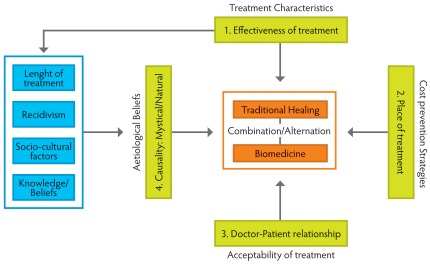
The analysis of BUD sufferers' health-seeking behaviour showed extremely complex therapeutic itineraries, including various attempts and failures both in the biomedical and traditional fields. Contrary to expectations, nearly half of all hospital patients attributed their illness to mystical causes, while traditional healers admitted patients they perceived to be infected by natural causes. Moreover, both patients in hospitals and in communities often combined elements of both types of treatments. Ultimately, perceptions regarding the effectiveness of the treatment, the option for local treatment as a cost prevention strategy and the characteristics of the doctor-patient relationship were more determinant for treatment choice than beliefs.
The ascription of delay and treatment choice to beliefs constitutes an over-simplification of BUD health-seeking behaviour and places the responsibility directly on the shoulders of BUD sufferers while potentially neglecting other structural elements. While more efficacious treatment in the biomedical sector is likely to reduce perceived mystical involvement in the disease, additional decentralization could constitute a key element to reduce delay and increase adherence to biomedical treatment.
患有布鲁里溃疡病(BUD)的患者经常在疾病的晚期才到专门的单位就诊。这种延迟与当地的信仰以及与该病据称的神秘起源有关的传统治疗偏好有关。我们评估了信仰在确定 BUD 患者在传统和生物医学治疗之间的选择中所起的作用。
在中非阿约斯和阿科诺隆加地区的社区和临床环境中进行了人类学实地工作。研究设计包括混合方法研究,将基于民族志研究的定性部分与通过向阿约斯和阿科诺隆加医院的所有患者(n=79)和属于医院服务区的四个流行社区(n=73)在研究时提出的调查获得的定量数据相结合。
对 BUD 患者寻求医疗服务行为的分析表明,治疗途径非常复杂,包括在生物医学和传统领域的各种尝试和失败。与预期相反,几乎一半的医院患者将他们的疾病归因于神秘原因,而传统治疗师则承认他们认为是由自然原因感染的患者。此外,医院和社区的患者经常将两种治疗方法结合起来。最终,对治疗效果的看法、作为成本预防策略的当地治疗选择以及医患关系的特点对治疗选择的决定作用大于信仰。
将延迟和治疗选择归因于信仰,是对 BUD 寻求医疗服务行为的过度简化,将责任直接归咎于 BUD 患者,而可能忽略了其他结构因素。虽然生物医学领域更有效的治疗可能会降低人们对疾病中神秘因素的感知,但更多的权力下放可能是减少延迟和增加对生物医学治疗的依从性的关键因素。