Lane Center for Computational Biology, School of Computer Science, Carnegie Mellon University, Pittsburgh, Pennsylvania, United States of America.
PLoS One. 2012;7(5):e36973. doi: 10.1371/journal.pone.0036973. Epub 2012 May 22.
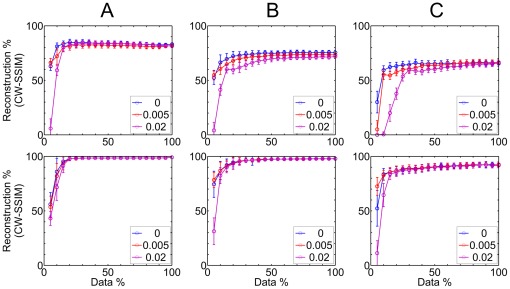
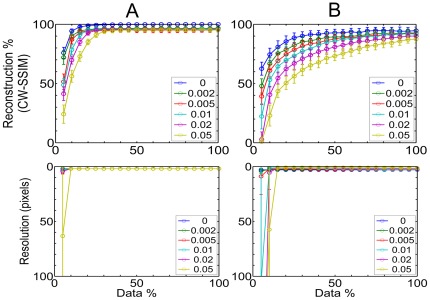
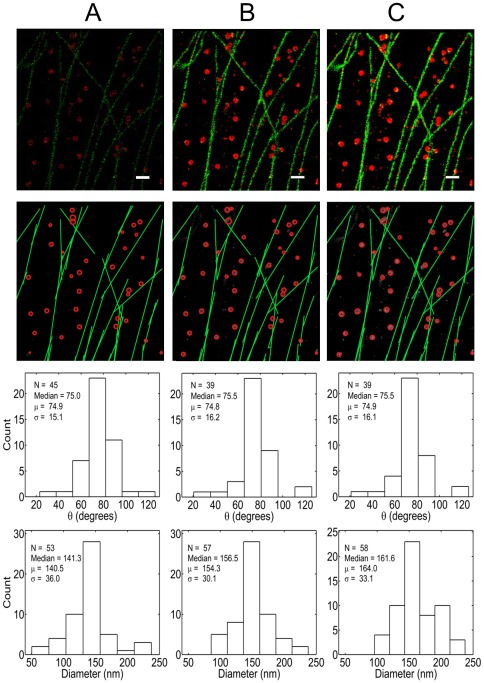
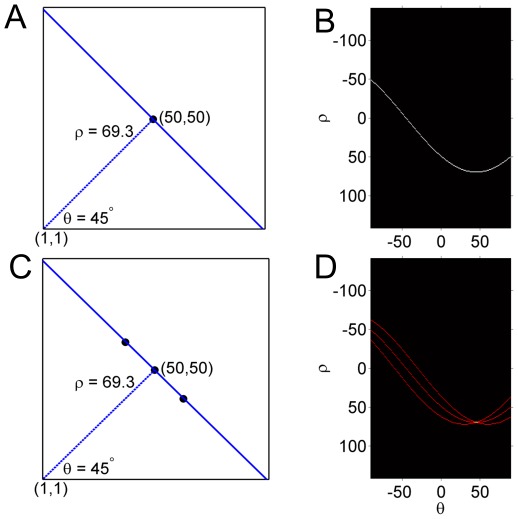
Localization-based super resolution imaging is presently limited by sampling requirements for dynamic measurements of biological structures. Generating an image requires serial acquisition of individual molecular positions at sufficient density to define a biological structure, increasing the acquisition time. Efficient analysis of biological structures from sparse localization data could substantially improve the dynamic imaging capabilities of these methods. Using a feature extraction technique called the Hough Transform simple biological structures are identified from both simulated and real localization data. We demonstrate that these generative models can efficiently infer biological structures in the data from far fewer localizations than are required for complete spatial sampling. Analysis at partial data densities revealed efficient recovery of clathrin vesicle size distributions and microtubule orientation angles with as little as 10% of the localization data. This approach significantly increases the temporal resolution for dynamic imaging and provides quantitatively useful biological information.
基于定位的超分辨率成像是目前受到生物结构动态测量的采样要求限制。生成图像需要以足够的密度连续获取单个分子位置,以定义生物结构,从而增加了采集时间。从稀疏定位数据中高效分析生物结构可以大大提高这些方法的动态成像能力。我们使用一种称为霍夫变换的特征提取技术,从模拟和真实定位数据中识别出简单的生物结构。我们证明,这些生成模型可以从远少于完全空间采样所需的定位数量中,有效地推断出数据中的生物结构。在部分数据密度下的分析表明,通过仅使用 10%的定位数据,就可以有效地恢复网格蛋白囊泡的大小分布和微管取向角度。这种方法显著提高了动态成像的时间分辨率,并提供了具有定量意义的有用生物学信息。