Center for Evidence-based Practice, University of Pennsylvania Health System, Philadelphia, 19104, USA.
BMC Fam Pract. 2012 May 25;13:40. doi: 10.1186/1471-2296-13-40.
Insomnia is common in primary care, can persist after co-morbid conditions are treated, and may require long-term medication treatment. A potential alternative to medications is cognitive behavioral therapy for insomnia (CBT-I).
In accordance with PRISMA guidelines, we systematically reviewed MEDLINE, EMBASE, the Cochrane Central Register, and PsycINFO for randomized controlled trials (RCTs) comparing CBT-I to any prescription or non-prescription medication in patients with primary or comorbid insomnia. Trials had to report quantitative sleep outcomes (e.g. sleep latency) in order to be included in the analysis. Extracted results included quantitative sleep outcomes, as well as psychological outcomes and adverse effects when available. Evidence base quality was assessed using GRADE.
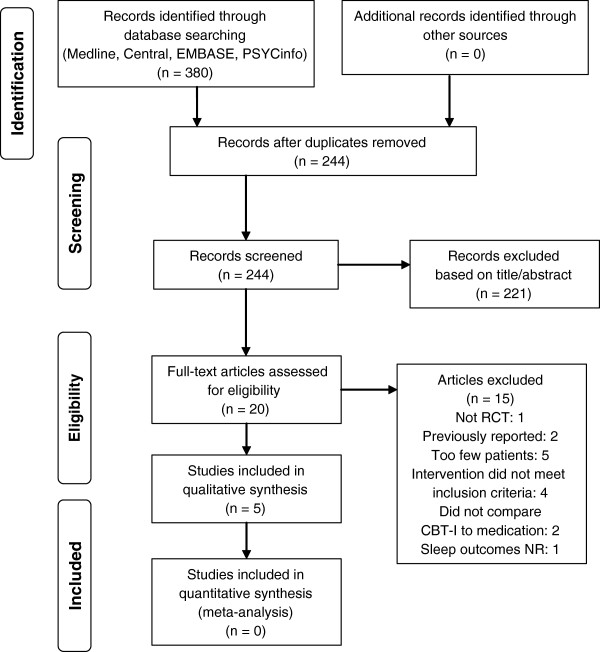
Five studies met criteria for analysis. Low to moderate grade evidence suggests CBT-I has superior effectiveness to benzodiazepine and non-benzodiazepine drugs in the long term, while very low grade evidence suggests benzodiazepines are more effective in the short term. Very low grade evidence supports use of CBT-I to improve psychological outcomes.
CBT-I is effective for treating insomnia when compared with medications, and its effects may be more durable than medications. Primary care providers should consider CBT-I as a first-line treatment option for insomnia.
失眠在基层医疗中很常见,即使合并症得到治疗后仍可能持续存在,并且可能需要长期药物治疗。药物治疗的潜在替代方法是失眠的认知行为疗法(CBT-I)。
根据 PRISMA 指南,我们系统地检索了 MEDLINE、EMBASE、Cochrane 中央登记册和 PsycINFO,以查找比较 CBT-I 与原发性或合并性失眠患者的任何处方或非处方药物的随机对照试验(RCT)。为了纳入分析,试验必须报告定量睡眠结果(例如睡眠潜伏期)。提取的结果包括定量睡眠结果以及可用的心理结果和不良反应。使用 GRADE 评估证据基础质量。
五项研究符合分析标准。低到中等质量证据表明,CBT-I 在长期治疗中比苯二氮䓬类药物和非苯二氮䓬类药物更有效,而极低质量证据表明苯二氮䓬类药物在短期治疗中更有效。非常低质量的证据支持使用 CBT-I 来改善心理结果。
与药物治疗相比,CBT-I 治疗失眠有效,其效果可能比药物更持久。基层医疗服务提供者应考虑将 CBT-I 作为失眠的一线治疗选择。