Department of Electrical Engineering, University of California, Los Angeles, USA.
Malar J. 2012 May 25;11:175. doi: 10.1186/1475-2875-11-175.
Malaria is a global health priority with a heavy burden of fatality and morbidity. Improvements in field diagnostics are needed to support the agenda for malaria elimination. Saliva has shown significant potential for use in non-invasive diagnostics, but the development of off-the-shelf saliva diagnostic kits requires best practices for sample preparation and quantitative insight on the availability of biomarkers and the dynamics of immunoassay in saliva. This pilot study measured the levels of the PfHRP2 in patient saliva to inform the development of salivary diagnostic tests for malaria.
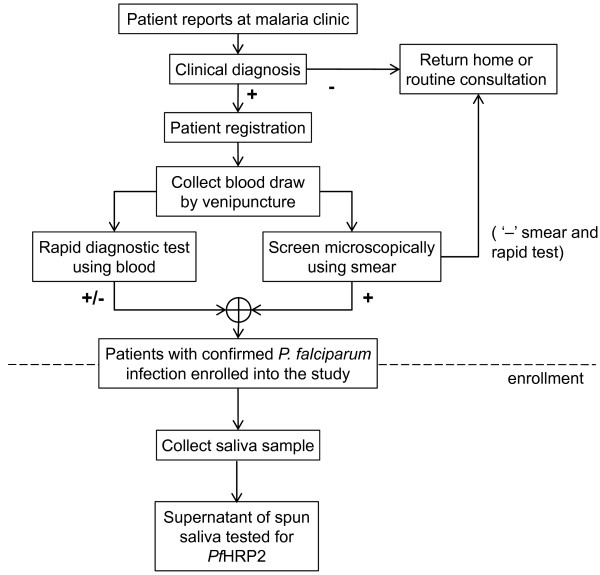
Matched samples of blood and saliva were collected between January and May, 2011 from eight patients at Palawan Baptist Hospital in Roxas, Palawan, Philippines. Parasite density was determined from thick-film blood smears. Concentrations of PfHRP2 in saliva of malaria-positive patients were measured using a custom chemiluminescent ELISA in microtitre plates. Sixteen negative-control patients were enrolled at UCLA. A substantive difference between this protocol and previous related studies was that saliva samples were stabilized with protease inhibitors.
Of the eight patients with microscopically confirmed P. falciparum malaria, seven tested positive for PfHRP2 in the blood using rapid diagnostic test kits, and all tested positive for PfHRP2 in saliva. All negative-control samples tested negative for salivary PfHRP2. On a binary-decision basis, the ELISA agreed with microscopy with 100 % sensitivity and 100 % specificity. Salivary levels of PfHRP2 ranged from 17 to 1,167 pg/mL in the malaria-positive group.
Saliva is a promising diagnostic fluid for malaria when protein degradation and matrix effects are mitigated. Systematic quantitation of other malaria biomarkers in saliva would identify those with the best clinical relevance and suitability for off-the-shelf diagnostic kits.
疟疾是全球卫生重点关注的疾病,其病死率和发病率都很高。为了支持消除疟疾的议程,需要改进现场诊断。唾液在非侵入性诊断中具有很大的应用潜力,但要开发即用型唾液诊断试剂盒,就需要针对样品制备制定最佳实践,并定量了解生物标志物的可用性以及免疫分析在唾液中的动态。本初步研究测量了患者唾液中的 PfHRP2 水平,为开发疟疾唾液诊断检测提供信息。
2011 年 1 月至 5 月,在菲律宾罗哈斯省巴拉望浸信会医院(Palawan Baptist Hospital),从 8 位患者中采集了血液和唾液匹配样本。从厚血膜涂片确定寄生虫密度。使用微孔板中的定制化学发光 ELISA 测量疟原虫阳性患者唾液中的 PfHRP2 浓度。在加州大学洛杉矶分校(UCLA)还招募了 16 位阴性对照患者。与之前的相关研究相比,该方案的一个实质性区别是,唾液样本用蛋白酶抑制剂稳定。
在 8 位经显微镜确认的恶性疟原虫疟疾患者中,有 7 位使用快速诊断试剂盒在血液中检测到 PfHRP2 阳性,所有患者唾液中均检测到 PfHRP2 阳性。所有阴性对照样本唾液中 PfHRP2 均为阴性。根据二元决策,ELISA 与显微镜检查的一致性为 100%敏感性和 100%特异性。在疟原虫阳性组中,唾液中 PfHRP2 的浓度范围为 17 至 1167pg/ml。
当减轻蛋白质降解和基质效应时,唾液是一种很有前途的疟疾诊断液。系统定量分析唾液中的其他疟疾生物标志物将确定那些具有最佳临床相关性和适合即用型诊断试剂盒的生物标志物。