National Institute of Biological Sciences Beijing, China.
Front Plant Sci. 2011 Oct 31;2:71. doi: 10.3389/fpls.2011.00071. eCollection 2011.
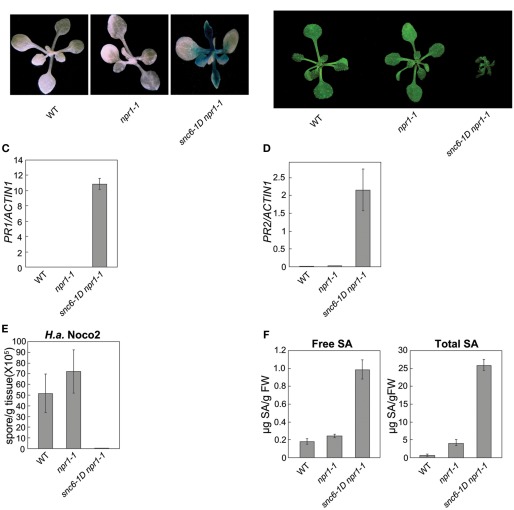
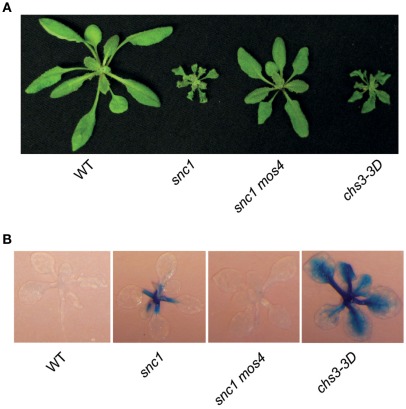
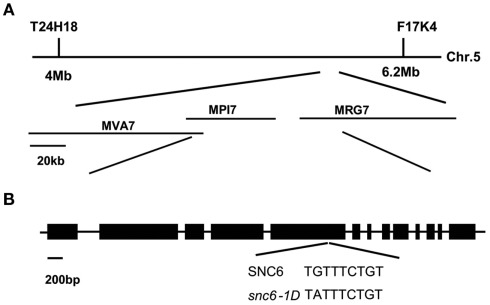
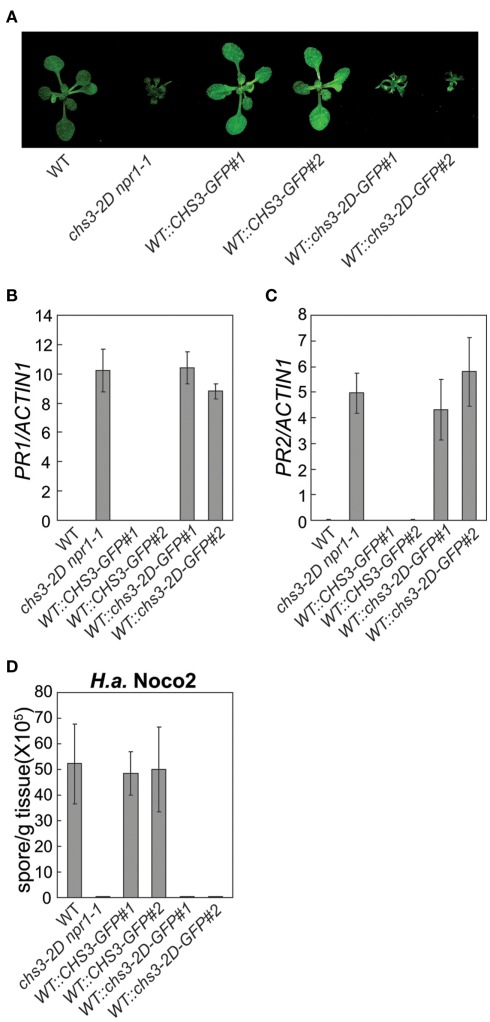
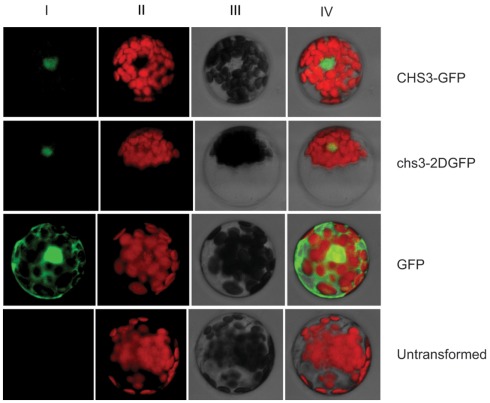
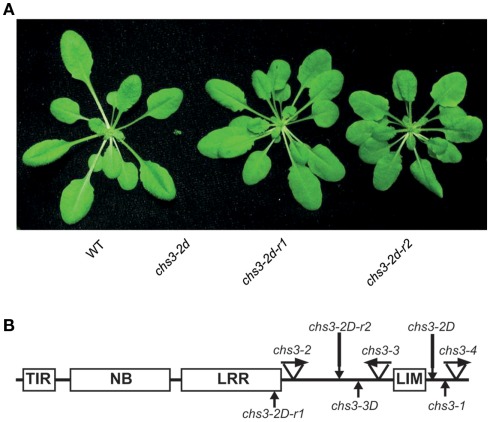
In order to defend against microbial infection, plants employ a complex immune system that relies partly on resistance (R) proteins that initiate intricate signaling cascades upon pathogen detection. The resistance signaling network utilized by plants is only partially characterized. A genetic screen conducted to identify novel defense regulators involved in this network resulted in the isolation of the snc6-1D mutant. Positional cloning revealed that this mutant contained a molecular lesion in the chilling sensitive 3 (CHS3) gene, thus the allele was renamed chs3-2D. CHS3 encodes a TIR-NB-LRR R protein that contains a C-terminal zinc-binding LIM (Lin-11, Isl-1, Mec-3) domain. Although this protein has been previously implicated in cold stress and defense response, the role of the LIM domain in modulating protein activity is unclear. The chs3-2D allele contains a G to A point mutation causing a C1340 to Y1340 substitution close to the LIM domain. It encodes a dominant gain-of-function mutation. The chs3-2D mutant is severely stunted and displays curled leaf morphology. Additionally, it constitutively expresses PATHOGENESIS-RELATED (PR) genes, accumulates salicylic acid, and shows enhanced resistance to the virulent oomycete isolate Hyaloperonospora arabidopsidis (H.a.) Noco2. Subcellular localization assays using GFP fusion constructs indicate that both CHS3 and chs3-2D localize to the nucleus. A third chs3 mutant allele, chs3-3D, was identified in an unrelated genetic screen in our lab. This allele contains a C to T point mutation resulting in an M1017 to V1017 substitution in the LRR-LIM linker region. Additionally, a chs3-2D suppressor screen identified two revertant alleles containing secondary mutations that abolish the mutant morphology. Analysis of the locations of these molecular lesions provides support for the hypothesis that the LIM domain represses CHS3 R-like protein activity. This repression may occur through either autoinhibition or binding of a negative defense regulator.
为了抵御微生物感染,植物采用了复杂的免疫系统,该系统部分依赖于抗性 (R) 蛋白,这些蛋白在检测到病原体时会引发复杂的信号级联反应。植物利用的抗性信号网络仅部分特征化。为了鉴定参与该网络的新防御调节剂而进行的遗传筛选导致了 snc6-1D 突变体的分离。定位克隆表明,该突变体在感冷 3 (CHS3) 基因中存在分子病变,因此该等位基因被重新命名为 chs3-2D。CHS3 编码一种 TIR-NB-LRR R 蛋白,该蛋白含有一个 C 末端锌结合 LIM (Lin-11、Isl-1、Mec-3) 结构域。尽管该蛋白先前已被牵连到冷胁迫和防御反应中,但 LIM 结构域在调节蛋白活性方面的作用尚不清楚。chs3-2D 等位基因包含一个 G 到 A 的点突变,导致 LIM 结构域附近的 C1340 到 Y1340 取代。它编码一个显性获得性功能突变。chs3-2D 突变体严重矮小,表现出卷曲的叶片形态。此外,它组成型表达病程相关 (PR) 基因,积累水杨酸,并表现出对毒力较大的卵菌分离株 Hyaloperonospora arabidopsidis (H.a.) Noco2 的增强抗性。使用 GFP 融合构建体进行的亚细胞定位测定表明,CHS3 和 chs3-2D 都定位于细胞核。在我们实验室的另一个独立遗传筛选中,鉴定出了第三个 chs3 突变等位基因 chs3-3D。该等位基因包含一个 C 到 T 的点突变,导致 LRR-LIM 连接区的 M1017 到 V1017 取代。此外,chs3-2D 抑制筛选鉴定出两个含有二次突变的回复突变等位基因,这些突变消除了突变体的形态。这些分子病变位置的分析为 LIM 结构域抑制 CHS3 R 样蛋白活性的假说提供了支持。这种抑制可能通过自身抑制或结合负防御调节剂来发生。