Centre for Primary Health Care and Equity, School of Public Health and Community Medicine, University of New South Wales, Sydney, Australia.
BMC Fam Pract. 2012 May 28;13:44. doi: 10.1186/1471-2296-13-44.
People with low health literacy may not have the capacity to self-manage their health and prevent the development of chronic disease through lifestyle risk factor modification. The aim of this narrative synthesis is to determine the effectiveness of primary healthcare providers in developing health literacy of patients to make SNAPW (smoking, nutrition, alcohol, physical activity and weight) lifestyle changes.
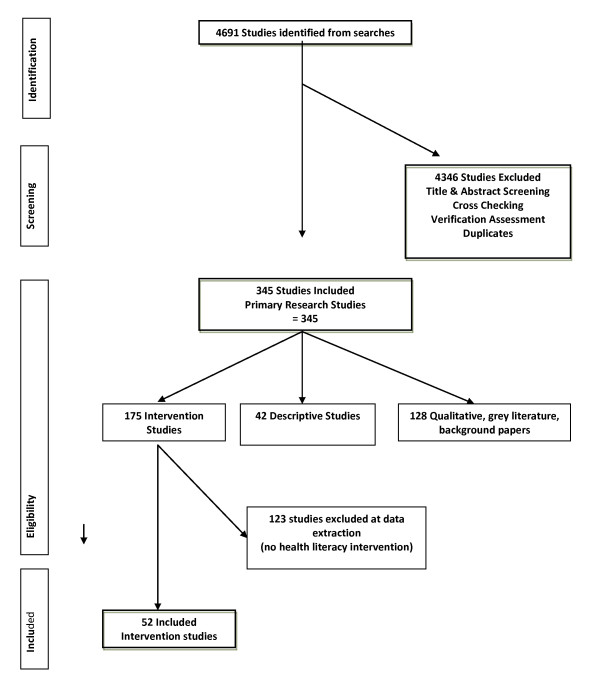
Studies were identified by searching Medline, Embase, Cochrane Library, CINAHL, Joanna Briggs Institute, Psychinfo, Web of Science, Scopus, APAIS, Australian Medical Index, Community of Science and Google Scholar from 1 January 1985 to 30 April 2009. Health literacy and related concepts are poorly indexed in the databases so a list of text words were developed and tested for use. Hand searches were also conducted of four key journals. Studies published in English and included males and females aged 18 years and over with at least one SNAPW risk factor for the development of a chronic disease. The interventions had to be implemented within primary health care, with an aim to influence the health literacy of patients to make SNAPW lifestyle changes. The studies had to report an outcome measure associated with health literacy (knowledge, skills, attitudes, self efficacy, stages of change, motivation and patient activation) and SNAPW risk factor.The definition of health literacy in terms of functional, communicative and critical health literacy provided the guiding framework for the review.
52 papers were included that described interventions to address health literacy and lifestyle risk factor modification provided by different health professionals. Most of the studies (71%, 37/52) demonstrated an improvement in health literacy, in particular interventions of a moderate to high intensity.Non medical health care providers were effective in improving health literacy. However this was confounded by intensity of intervention. Provider barriers impacted on their relationship with patients.
Capacity to provide interventions of sufficient intensity is an important condition for effective health literacy support for lifestyle change. This has implications for workforce development and the organisation of primary health care.
健康素养低的人可能没有能力通过生活方式风险因素的改变来自我管理健康和预防慢性病的发生。本叙述性综述的目的是确定初级保健提供者在提高患者健康素养以使 SNAPW(吸烟、营养、酒精、身体活动和体重)生活方式发生改变方面的效果。
通过检索 Medline、Embase、Cochrane 图书馆、CINAHL、Joanna Briggs 研究所、Psychinfo、Web of Science、Scopus、APAIS、澳大利亚医学索引、科学社区和 Google Scholar,从 1985 年 1 月 1 日至 2009 年 4 月 30 日,确定了研究。健康素养和相关概念在数据库中索引不佳,因此开发并测试了一组文本词以供使用。还对四本主要期刊进行了手工检索。发表于英文期刊,纳入年龄在 18 岁及以上的男性和女性,且至少有一个 SNAPW 风险因素会发展为慢性病。干预措施必须在初级卫生保健中实施,旨在影响患者的健康素养以使 SNAPW 生活方式发生改变。研究必须报告与健康素养(知识、技能、态度、自我效能、改变阶段、动机和患者激活)和 SNAPW 风险因素相关的结果测量。健康素养的功能性、交际性和批判性定义为综述提供了指导框架。
纳入了 52 篇描述了不同健康专业人员提供的健康素养和生活方式风险因素改变干预措施的论文。大多数研究(71%,37/52)表明健康素养得到了提高,特别是中等强度到高强度的干预措施。非医疗保健提供者在提高健康素养方面是有效的。然而,这受到干预强度的影响。提供者的障碍影响了他们与患者的关系。
提供足够强度的干预措施的能力是为生活方式改变提供有效健康素养支持的重要条件。这对劳动力发展和初级卫生保健的组织有影响。