Department of Cardiology, The Second Hospital of Shandong University, Jinan, 250033, China.
BMC Cardiovasc Disord. 2012 May 29;12:35. doi: 10.1186/1471-2261-12-35.
YKL-40, a proposed marker of inflammation and endothelial dysfunction, is associated with atherosclerosis and an increased cardiovascular mortality in the general population. However, the relationship between YKL-40 and arterial stiffness in hypertensive patients has not been adequately assessed.
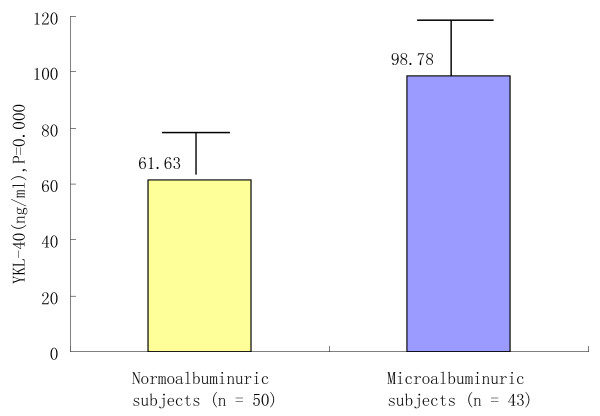
The relationship between serum levels of YKL-40 and arterial stiffness was evaluated in 93 essential hypertensive subjects and 80 normal subjects. Essential hypertensive subjects were divided into two groups based upon urinary albumin-to-creatinine ratio (ACR): nonmicroalbuminuric group, (ACR <30 mg/g, n = 50) and microalbuminuric group (ACR ≥ 30 mg/g, n = 43). Large artery wall stiffness was assessed by measuring femoral arterial stiffness and carotid-femoral pulse wave velocity (cf-PWV). Serum levels of YKL-40 were determined by enzyme-linked immunosorbent assay (ELISA).
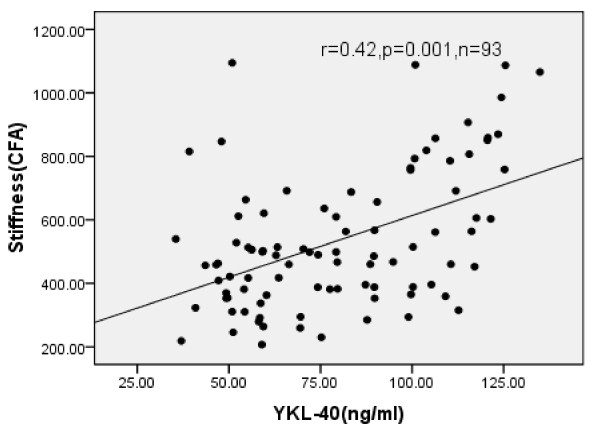
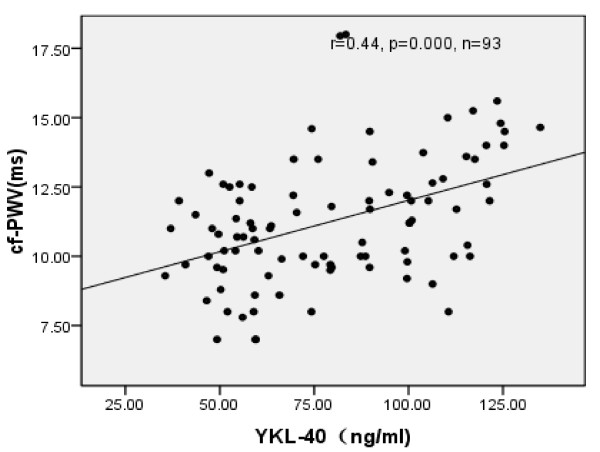
The study demonstrated that YKL-40,cf-PWV and femoral arterial stiffness were increased significantly (P<0.05) in the hypertensive group compared with normal controls. These measurements were also increased significantly ( P<0.05) in the microalbuminuric group compared with the nonmicroalbuminuric group. YKL-40 was positively correlated with cf-PWV( r = 0.44, P = 0.000) and femoral arterial stiffness ( r = 0.42, P =0.001). Multiple linear stepwise regression analysis showed that YKL-40 was the impact factor of arterial stiffness ( P<0.05).
YKL-40 levels are elevated in essential hypertension subjects with an independent association between increasing YKL-40 levels and increasing arterial stiffness. The study suggests it played a positive role of YKL-40 in the progressing vascular complications in patients with essential hypertension.
YKL-40,一种炎症和内皮功能障碍的标志物,与动脉粥样硬化和普通人群心血管死亡率增加有关。然而,在高血压患者中,YKL-40 与动脉僵硬之间的关系尚未得到充分评估。
评估 93 例原发性高血压患者和 80 例正常对照者血清 YKL-40 水平与动脉僵硬的关系。根据尿白蛋白与肌酐比值(ACR)将原发性高血压患者分为两组:非微量白蛋白尿组(ACR<30mg/g,n=50)和微量白蛋白尿组(ACR≥30mg/g,n=43)。通过测量股动脉僵硬和颈股脉搏波速度(cf-PWV)来评估大动脉壁僵硬。通过酶联免疫吸附试验(ELISA)测定血清 YKL-40 水平。
研究表明,与正常对照组相比,高血压组的 YKL-40、cf-PWV 和股动脉僵硬明显增加(P<0.05)。与非微量白蛋白尿组相比,微量白蛋白尿组的这些测量值也明显增加(P<0.05)。YKL-40 与 cf-PWV(r=0.44,P=0.000)和股动脉僵硬(r=0.42,P=0.001)呈正相关。多元线性逐步回归分析表明,YKL-40 是动脉僵硬的影响因素(P<0.05)。
原发性高血压患者的 YKL-40 水平升高,YKL-40 水平升高与动脉僵硬程度增加之间存在独立关系。研究表明,YKL-40 在原发性高血压患者血管并发症进展中起积极作用。