Evidence to Policy initiative, Global Health Group, University of California San Francisco, San Francisco, CA 94105, USA.
Global Health. 2012 May 29;8:11. doi: 10.1186/1744-8603-8-11.
Most low and middle income countries (LMICs) are currently not on track to reach the health-related Millennium Development Goals (MDGs). One way to accelerate progress would be through the large-scale implementation of evidence-based health tools and interventions. This study aimed to: (a) explore the barriers that have impeded such scale-up in LMICs, and (b) lay out an "implementation research agenda"--a series of key research questions that need to be addressed in order to help overcome such barriers.
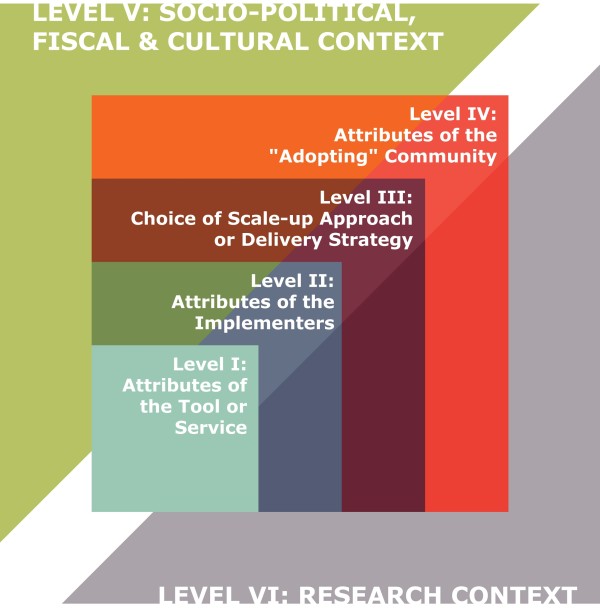
Interviews were conducted with fourteen key informants, all of whom are academic leaders in the field of implementation science, who were purposively selected for their expertise in scaling up in LMICs. Interviews were transcribed by hand and manually coded to look for emerging themes related to the two study aims. Barriers to scaling up, and unanswered research questions, were organized into six categories, representing different components of the scaling up process: attributes of the intervention; attributes of the implementers; scale-up approach; attributes of the adopting community; socio-political, fiscal, and cultural context; and research context.
Factors impeding the success of scale-up that emerged from the key informant interviews, and which are areas for future investigation, include: complexity of the intervention and lack of technical consensus; limited human resource, leadership, management, and health systems capacity; poor application of proven diffusion techniques; lack of engagement of local implementers and of the adopting community; and inadequate integration of research into scale-up efforts.
Key steps in expanding the evidence base on implementation in LMICs include studying how to: simplify interventions; train "scale-up leaders" and health workers dedicated to scale-up; reach and engage communities; match the best delivery strategy to the specific health problem and context; and raise the low profile of implementation science.
大多数中低收入国家(LMICs)目前尚未走上实现与健康相关的千年发展目标(MDGs)的轨道。加快这一进程的一种方法是大规模实施基于证据的卫生工具和干预措施。本研究旨在:(a)探讨阻碍这些国家扩大规模的障碍;(b)制定“实施研究议程”——一系列需要解决的关键研究问题,以帮助克服这些障碍。
对 14 名关键信息提供者进行了访谈,他们都是实施科学领域的学术领导者,根据在 LMICs 扩大规模方面的专业知识有目的地选择了这些领导者。访谈内容由手工转录并手动编码,以寻找与两个研究目的相关的主题。阻碍扩大规模的障碍和未回答的研究问题被组织成六个类别,代表了扩大规模过程的不同组成部分:干预措施的属性;实施者的属性;扩大规模的方法;采用社区的属性;社会政治、财政和文化背景;以及研究背景。
关键信息提供者访谈中出现的阻碍扩大规模的成功的因素,以及未来需要调查的领域,包括:干预措施的复杂性和缺乏技术共识;人力资源、领导力、管理和卫生系统能力有限;证明扩散技术应用不足;缺乏当地实施者和采用社区的参与;以及将研究纳入扩大规模工作的不足。
扩大实施证据基础的关键步骤包括研究如何:简化干预措施;培训专门从事扩大规模的“扩大规模领导者”和卫生工作者;接触和参与社区;将最佳的交付策略与特定的健康问题和背景相匹配;以及提高实施科学的知名度。