Arch Orthop Trauma Surg. 2012 Aug;132(8):1153-63. doi: 10.1007/s00402-012-1528-1. Epub 2012 May 27.
To investigate fast-track rehabilitation concept in terms of a measurable effect on the early recovery after total knee arthroplasty (TKA).
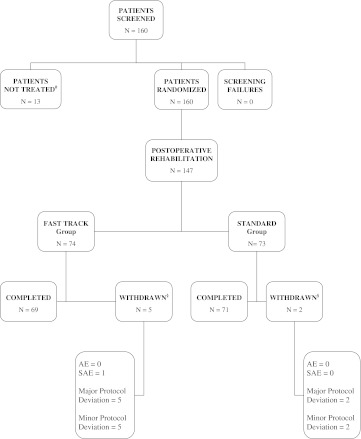
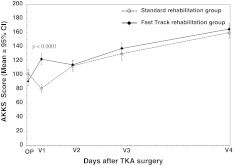
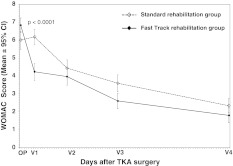
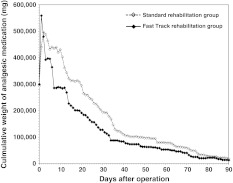
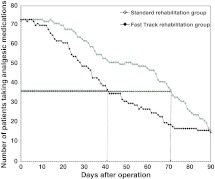
This was an open, randomized, prospective clinical study, comparing the fast-track rehabilitation--a pathway-controlled early recovery program (Joint Care(®))--with standard postoperative rehabilitation care, after TKA. Overall, 147 patients had TKA (N = 74 fast-track rehabilitation, N = 73 standard rehabilitation). The fast-track rehabilitation patients received a group therapy, early mobilization (same day as surgery) and 1:1 physiotherapy (2 h/day). Patient monitoring occurred over 3 months (1 pre- and 4 post-operative visits). The standard rehabilitation group received individual postoperative care according to the existing protocol, with 1:1 physiotherapy (1 h/day). The cumulative American Knee Society Score (AKSS) was the primary evaluation variable, used to detect changes in joint function and perception of pain. The secondary evaluation variables were WOMAC index score, analgesic drug consumption, length of stay (LOS), and safety.
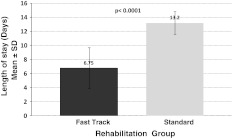
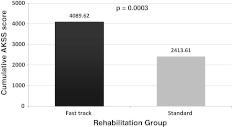
After TKA, patients in the fast-track rehabilitation group showed enhanced recovery compared with the standard rehabilitation group, as based on the differences between the groups for the cumulative AKSS (p = 0.0003), WOMAC index score (<0.0001), reduced intake of concomitant analgesic drugs, reduced LOS (6.75 vs. 13.20 days, p < 0001), and lower number of adverse events.
For TKA, implementation of pathway-controlled fast-track rehabilitation is achievable and beneficial as based on the AKSS and WOMAC score, reduced intake of analgesic drugs, and reduced LOS.
探讨加速康复理念对全膝关节置换术(TKA)后早期恢复的影响。
这是一项开放、随机、前瞻性临床研究,比较了 TKA 后的加速康复——一种路径控制的早期康复方案(关节护理(®))与标准术后康复护理。共有 147 例患者接受了 TKA(N=74 例加速康复,N=73 例标准康复)。加速康复组接受小组治疗、早期活动(手术当天)和 1:1 物理治疗(每天 2 小时)。患者监测持续 3 个月(术前 1 次,术后 4 次就诊)。标准康复组根据现有方案接受个体化术后护理,1:1 物理治疗(每天 1 小时)。累积美国膝关节协会评分(AKSS)是主要评估变量,用于检测关节功能和疼痛感知的变化。次要评估变量为 WOMAC 指数评分、镇痛药消耗、住院时间(LOS)和安全性。
TKA 后,与标准康复组相比,加速康复组患者的恢复更快,这体现在两组之间的累积 AKSS(p=0.0003)、WOMAC 指数评分(<0.0001)、伴随镇痛药消耗减少、LOS 降低(6.75 比 13.20 天,p<0.0001)和不良事件减少。
对于 TKA,实施路径控制的加速康复是可行且有益的,基于 AKSS 和 WOMAC 评分、镇痛药消耗减少和 LOS 降低。