Waksman Institute of Microbiology, Rutgers University, 190 Frelinghuysen Road, Piscataway, NJ 08854, USA.
BMC Plant Biol. 2012 May 30;12:77. doi: 10.1186/1471-2229-12-77.
A balanced composition of amino acids in seed flour is critical because of the demand on essential amino acids for nutrition. However, seed proteins in cereals like maize, the crop with the highest yield, are low in lysine, tryptophan, and methionine. Although supplementation with legumes like soybean can compensate lysine deficiency, both crops are also relatively low in methionine. Therefore, understanding the mechanism of methionine accumulation in the seed could be a basis for breeding cultivars with superior nutritional quality.
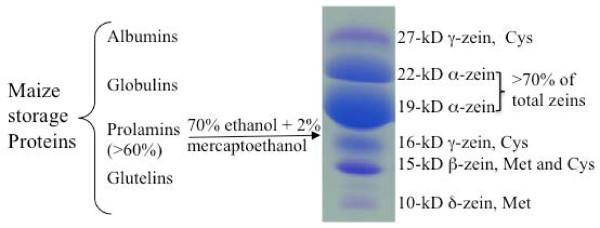
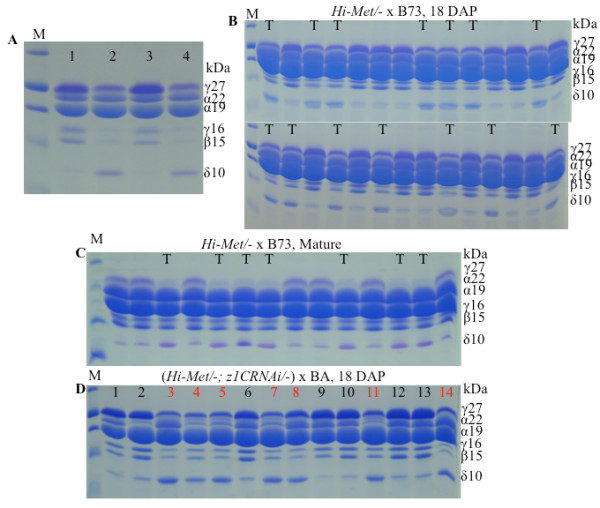
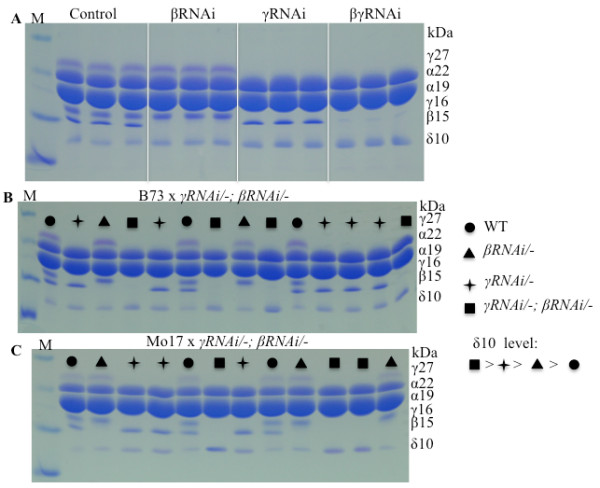
In maize (Zea mays), the 22- and 19-kDa α-zeins are the most prominent storage proteins, nearly devoid of lysine and methionine. Although silencing synthesis of these proteins through RNA interference (RNAi) raises lysine levels in the seed, it fails to do so for methionine. Computational analysis of annotated gene models suggests that about 57% of all proteins exhibit a lysine content of more than 4%, whereas the percentage of proteins with methionine above 4% is only around 8%. To compensate for this low representation, maize seeds produce specialized storage proteins, the 15-kDa β-, 18-kDa and 10-kDa δ-zeins, rich in methionine. However, they are expressed at variant levels in different inbred lines. A654, an inbred with null δ-zein alleles, methionine levels are significantly lower than when the two intact δ-zein alleles are introgressed. Further silencing of β-zein results in dramatic reduction in methionine levels, indicating that β- and δ-zeins are the main sink of methionine in maize seed. Overexpression of the 10-kDa δ-zein can increase the methionine level, but protein analysis by SDS-PAGE shows that the increased methionine levels occur at least in part at the expense of cysteines present in β- and γ-zeins. The reverse is true when β- and γ-zein expression is silenced through RNAi, then 10-kDa δ-zein accumulates to higher levels.
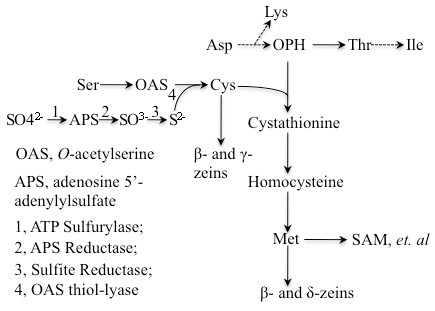
Because methionine receives the sulfur moiety from cysteine, it appears that when seed protein synthesis of cysteine-rich proteins is blocked, the synthesis of methionine-rich seed proteins is induced, probably at the translational level. The same is true, when methionine-rich proteins are overexpressed, synthesis of cysteine-rich proteins is reduced, probably also at the translational level. Although we only hypothesize a translational control of protein synthesis at this time, there are well known paradigms of how amino acid concentration can play a role in differential gene expression. The latter we think is largely controlled by the flux of reduced sulfur during plant growth.
由于必需氨基酸对营养的需求,种子粉中氨基酸的均衡组成至关重要。然而,玉米等谷物中的谷类种子蛋白赖氨酸、色氨酸和蛋氨酸含量低,玉米是产量最高的作物。虽然用大豆等豆类补充赖氨酸可以弥补赖氨酸的不足,但这两种作物的蛋氨酸含量也相对较低。因此,了解种子中蛋氨酸积累的机制可能是培育具有优良营养品质的品种的基础。
在玉米(Zea mays)中,22kDa 和 19kDa 的α-玉米醇溶蛋白是最主要的储存蛋白,几乎不含赖氨酸和蛋氨酸。尽管通过 RNA 干扰(RNAi)沉默这些蛋白的合成可以提高种子中的赖氨酸水平,但对蛋氨酸却没有效果。对注释基因模型的计算分析表明,大约 57%的蛋白质赖氨酸含量超过 4%,而蛋氨酸含量超过 4%的蛋白质百分比仅为 8%左右。为了弥补这一低含量,玉米种子产生了富含蛋氨酸的特殊储存蛋白,即 15kDa 的β-、18kDa 和 10kDa 的δ-玉米醇溶蛋白。然而,它们在不同的自交系中的表达水平不同。A654 是一种没有δ-玉米醇溶蛋白等位基因的自交系,其蛋氨酸水平明显低于两个完整的δ-玉米醇溶蛋白等位基因被导入时的水平。进一步沉默β-玉米醇溶蛋白会导致蛋氨酸水平显著降低,表明β-和δ-玉米醇溶蛋白是玉米种子中蛋氨酸的主要储存库。过表达 10kDa 的δ-玉米醇溶蛋白可以增加蛋氨酸水平,但 SDS-PAGE 蛋白分析表明,增加的蛋氨酸水平至少部分是由于β-和γ-玉米醇溶蛋白中存在的半胱氨酸。当通过 RNAi 沉默β-和γ-玉米醇溶蛋白的表达时,情况正好相反,10kDa 的δ-玉米醇溶蛋白积累到更高的水平。
由于蛋氨酸从半胱氨酸中获得硫部分,因此,当富含半胱氨酸的种子蛋白合成被阻断时,蛋氨酸丰富的种子蛋白的合成似乎被诱导,可能是在翻译水平上。当过表达富含蛋氨酸的蛋白质时,富含半胱氨酸的蛋白质的合成减少,这可能也是在翻译水平上。尽管目前我们只是假设蛋白质合成的翻译控制,但有许多关于氨基酸浓度如何在差异基因表达中发挥作用的已知范例。我们认为,后者主要受植物生长过程中还原硫通量的控制。