Department of Surgery, Texas Tech University Health Sciences Center, Lubbock, TX 79430, USA.
Proc Biol Sci. 2012 Sep 7;279(1742):3584-8. doi: 10.1098/rspb.2012.0843. Epub 2012 May 30.
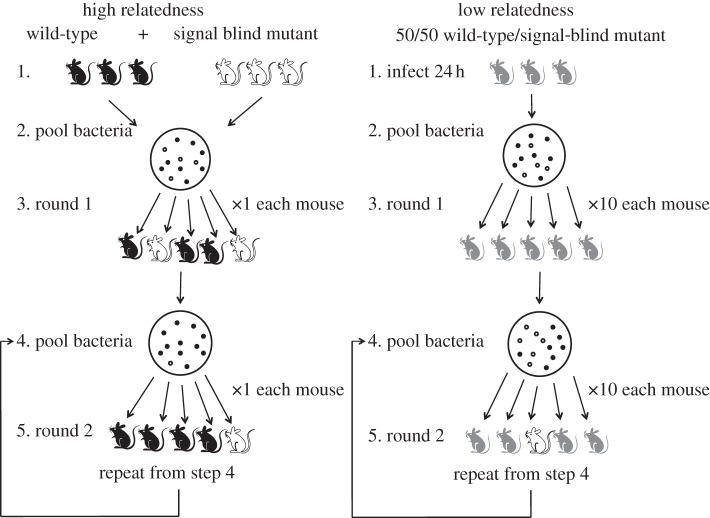
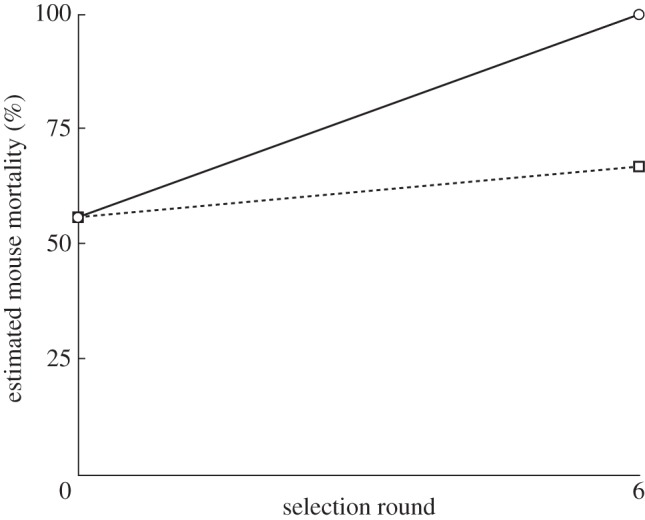
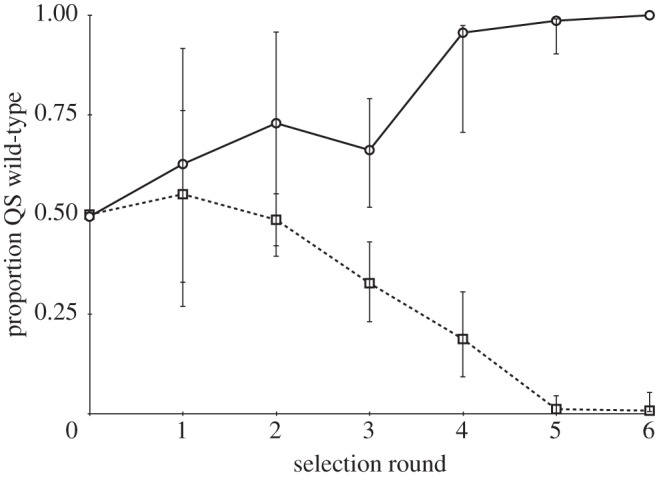
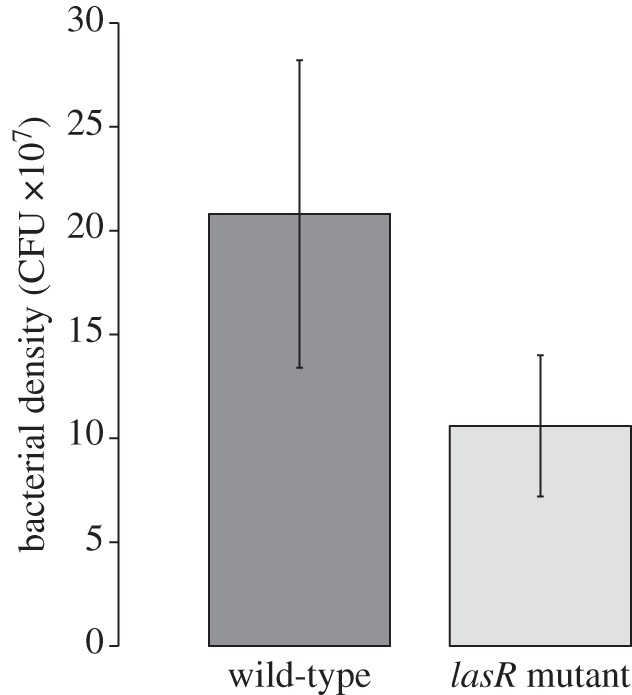
Bacterial growth and virulence often depends upon the cooperative release of extracellular factors excreted in response to quorum sensing (QS). We carried out an in vivo selection experiment in mice to examine how QS evolves in response to variation in relatedness (strain diversity), and the consequences for virulence. We started our experiment with two bacterial strains: a wild-type that both produces and responds to QS signal molecules, and a lasR (signal-blind) mutant that does not release extracellular factors in response to signal. We found that: (i) QS leads to greater growth within hosts; (ii) high relatedness favours the QS wild-type; and (iii) low relatedness favours the lasR mutant. Relatedness matters in our experiment because, at relatively low relatedness, the lasR mutant is able to exploit the extracellular factors produced by the cells that respond to QS, and hence increase in frequency. Furthermore, our results suggest that because a higher relatedness favours cooperative QS, and hence leads to higher growth, this will also lead to a higher virulence, giving a relationship between relatedness and virulence that is in the opposite direction to that usually predicted by virulence theory.
细菌的生长和毒力通常取决于群体感应(QS)响应下共同释放的细胞外因子。我们在小鼠体内进行了选择实验,以研究 QS 如何响应亲缘关系(菌株多样性)的变化而进化,以及对毒力的影响。我们的实验从两种细菌株开始:一种是野生型,既能产生 QS 信号分子,也能对其作出反应;另一种是 lasR(信号盲)突变株,它不能响应信号释放细胞外因子。我们发现:(i)QS 促进宿主内的生长;(ii)高亲缘关系有利于 QS 野生型;(iii)低亲缘关系有利于 lasR 突变株。在我们的实验中,亲缘关系很重要,因为在相对较低的亲缘关系下,lasR 突变株能够利用对 QS 作出反应的细胞产生的细胞外因子,从而增加其频率。此外,我们的结果表明,由于较高的亲缘关系有利于合作的 QS,从而导致更高的生长,这也将导致更高的毒力,因此亲缘关系与毒力之间的关系与毒力理论通常预测的方向相反。