Department of Behavioral Sciences, Rush University Medical Center, 600 S. Paulina St. 1022, Chicago, IL 60612, USA.
Brain Imaging Behav. 2012 Dec;6(4):610-20. doi: 10.1007/s11682-012-9177-0.
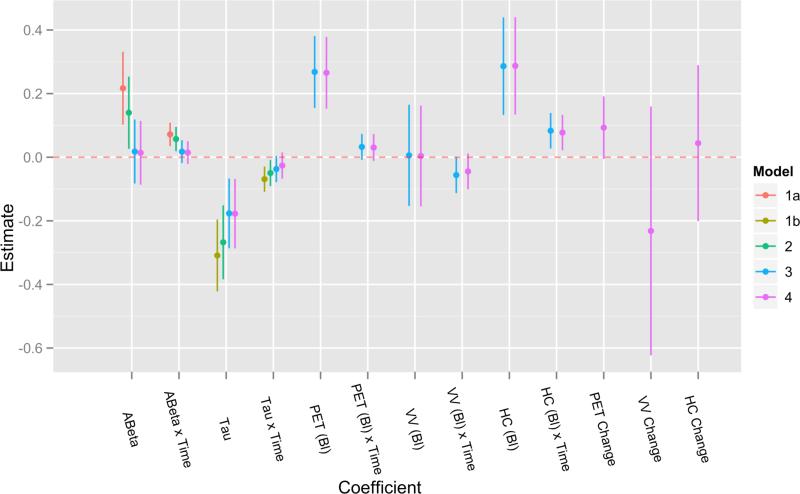
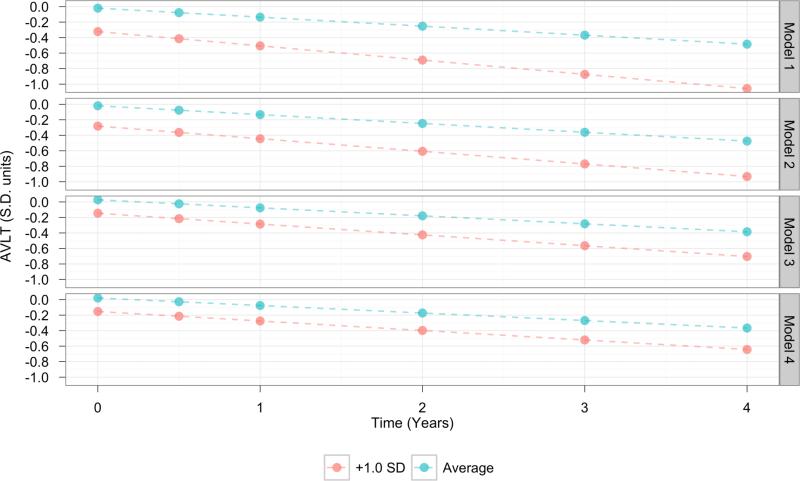
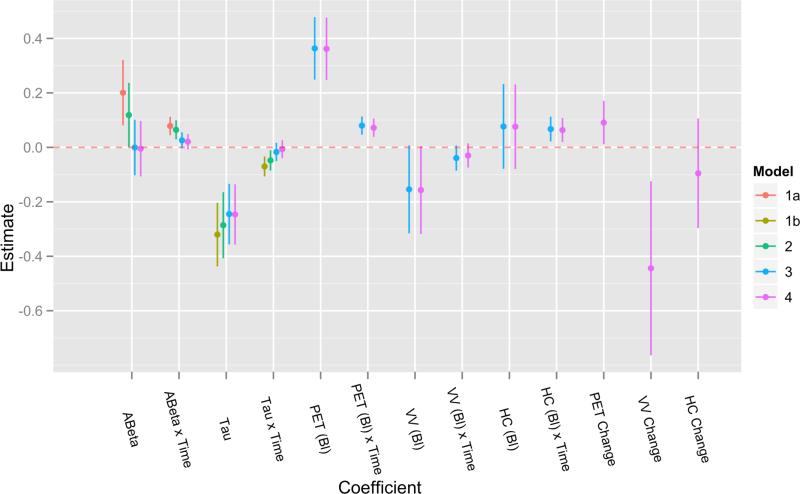
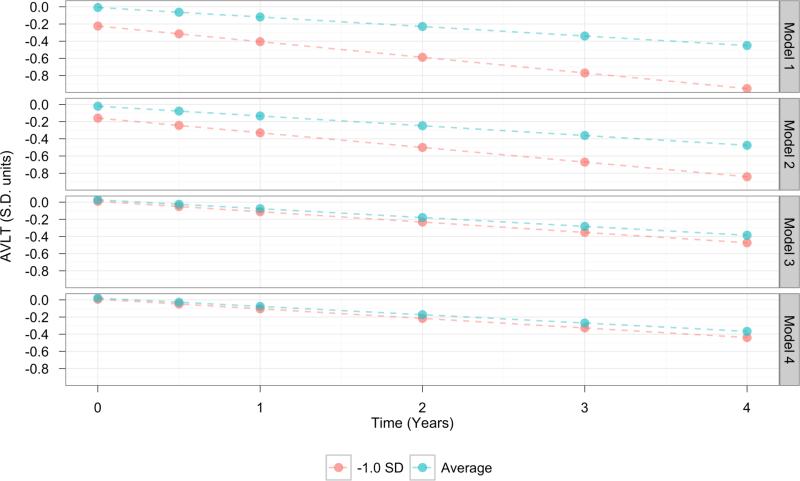
Alzheimer's disease (AD) is associated with a cascade of pathological events involving formation of amyloid-based neuritic plaques and tau-based neurofibrillary tangles, changes in brain structure and function, and eventually, cognitive impairment and functional disability. The precise sequence of when each of these disease markers becomes abnormal is not yet clearly understood. The present study systematically tested the relationship between classes of biomarkers according to a proposed model of temporal sequence by Jack et al. (Lancet Neurology 9:119-128, 2010). We examined temporal relations among four classes of biomarkers: CSF Aβ, CSF tau, neuroimaging variables (hippocampal volume, ventricular volume, FDG PET), and cognitive variables (memory and executive function). Random effects modeling of longitudinal data obtained from the Alzheimer's Disease Neuroimaging Initiative (ADNI) was used to test hypotheses that putative earlier markers of AD predicted change in later markers, and that intervening markers reduced effects of earlier on later markers. Specifically, we hypothesized that CSF tau would explain CSF Aβ's relation to neuroimaging and cognitive variables, and neuroimaging variables would explain tau's relation to cognitive variables. Consistent with hypotheses, results indicated that CSF Aβ effects on cognition change were substantially attenuated by CSF tau and measures of brain structure and function, and CSF tau effects on cognitive change were attenuated by neuroimaging variables. Contrary to hypotheses, CSF Aβ and CSF tau were observed to have independent effects on neuroimaging and CSF tau had a direct effect on baseline cognition independent of brain structure and function. These results have implications for clarifying the temporal sequence of AD changes and corresponding biomarkers.
阿尔茨海默病(AD)与一系列病理事件有关,包括淀粉样蛋白为基础的神经原纤维缠结和 tau 为基础的神经原纤维缠结的形成、大脑结构和功能的变化,最终导致认知障碍和功能障碍。目前尚不清楚这些疾病标志物中每一个何时异常的确切顺序。本研究系统地根据 Jack 等人提出的时间序列模型(Lancet Neurology 9:119-128, 2010)检验了各生物标志物类别之间的关系。我们检查了四类生物标志物之间的时间关系:脑脊液 Aβ、脑脊液 tau、神经影像学变量(海马体积、脑室体积、FDG PET)和认知变量(记忆和执行功能)。使用来自阿尔茨海默病神经影像学倡议(ADNI)的纵向数据的随机效应模型来检验假设,即 AD 的假定早期标志物预测后期标志物的变化,并且中间标志物减少了早期标志物对后期标志物的影响。具体而言,我们假设 CSF tau 将解释 CSF Aβ 与神经影像学和认知变量的关系,而神经影像学变量将解释 tau 与认知变量的关系。与假设一致,结果表明,CSF tau 和大脑结构和功能的测量大大减弱了 CSF Aβ 对认知变化的影响,CSF tau 对认知变化的影响被神经影像学变量减弱。与假设相反,观察到 CSF Aβ 和 CSF tau 对神经影像学有独立的影响,CSF tau 对基线认知有直接影响,与大脑结构和功能无关。这些结果对阐明 AD 变化的时间顺序和相应的生物标志物具有重要意义。