
肺动脉导管(PAC)与流量探头及经皮多普勒(USCOM)相比的准确性和有效性:一项绵羊心输出量验证研究。
Pulmonary Artery Catheter (PAC) Accuracy and Efficacy Compared with Flow Probe and Transcutaneous Doppler (USCOM): An Ovine Cardiac Output Validation.
作者信息
Phillips Robert A, Hood Sally G, Jacobson Beverley M, West Malcolm J, Wan Li, May Clive N
机构信息
School of Medicine, The University of Queensland, Brisbane QLD 3010, Australia.
出版信息
Crit Care Res Pract. 2012;2012:621496. doi: 10.1155/2012/621496. Epub 2012 May 9.
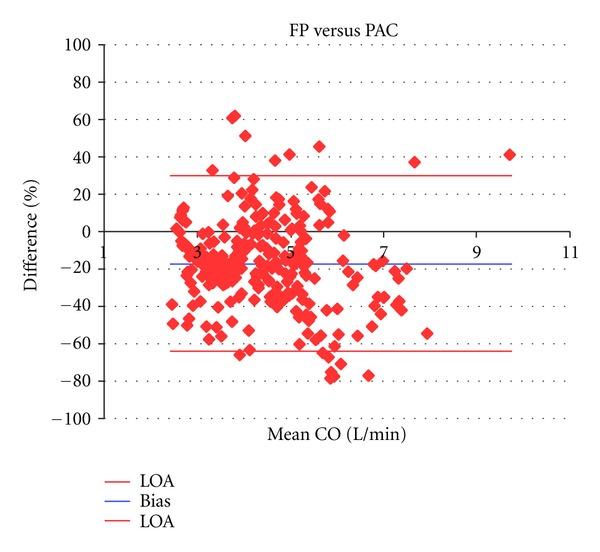
Background. The pulmonary artery catheter (PAC) is an accepted clinical method of measuring cardiac output (CO) despite no prior validation. The ultrasonic cardiac output monitor (USCOM) is a noninvasive alternative to PAC using Doppler ultrasound (CW). We compared PAC and USCOM CO measurements against a gold standard, the aortic flow probe (FP), in sheep at varying outputs. Methods. Ten conscious sheep, with implanted FPs, had measurements of CO by FP, USCOM, and PAC, at rest and during intervention with inotropes and vasopressors. Results. CO measurements by FP, PAC, and USCOM were 4.0 ± 1.2 L/min, 4.8 ± 1.5 L/min, and 4.0 ± 1.4 L/min, respectively, (n = 280, range 1.9 L/min to 11.7 L/min). Percentage bias and precision between FP and PAC, and FP and USCOM was -17 and 47%, and 1 and 36%, respectively. PAC under-measured Dobutamine-induced CO changes by 20% (relative 66%) compared with FP, while USCOM measures varied from FP by 3% (relative 10%). PAC reliably detected -30% but not +40% CO changes, as measured by receiver operating characteristic area under the curve (AUC), while USCOM reliably detected ±5% changes in CO (AUC > 0.70). Conclusions. PAC demonstrated poor accuracy and sensitivity as a measure of CO. USCOM provided equivalent measurements to FP across a sixfold range of outputs, reliably detecting ±5% changes.
背景。尽管肺动脉导管(PAC)此前未经验证,但它仍是一种公认的测量心输出量(CO)的临床方法。超声心输出量监测仪(USCOM)是一种使用多普勒超声(连续波)的非侵入性替代PAC的方法。我们在不同心输出量的绵羊中,将PAC和USCOM测量的心输出量与金标准主动脉流量探头(FP)进行了比较。方法。十只植入了FP的清醒绵羊,在静息状态以及使用正性肌力药和血管升压药进行干预期间,通过FP、USCOM和PAC测量心输出量。结果。FP、PAC和USCOM测量的心输出量分别为4.0±1.2升/分钟、4.8±1.5升/分钟和4.0±1.4升/分钟(n = 280,范围1.9升/分钟至11.7升/分钟)。FP与PAC以及FP与USCOM之间的百分比偏差和精密度分别为-17%和47%,以及1%和36%。与FP相比,PAC测量多巴酚丁胺诱导的心输出量变化低20%(相对66%),而USCOM测量值与FP的差异为3%(相对10%)。根据曲线下面积(AUC)的受试者工作特征分析,PAC能可靠检测到-30%的心输出量变化,但不能检测到+40%的变化,而USCOM能可靠检测到±5%的心输出量变化(AUC>0.70)。结论。作为一种测量心输出量的方法,PAC显示出较差的准确性和敏感性。USCOM在六倍的心输出量范围内提供了与FP相当的测量值,能可靠检测到±5%的变化。




 Zotero 插件