Occupational and Environmental Epidemiology Branch, Division of Cancer Epidemiology and Genetics, National Cancer Institute Bethesda, MD, USA.
Front Oncol. 2012 Jan 10;1:53. doi: 10.3389/fonc.2011.00053. eCollection 2011.
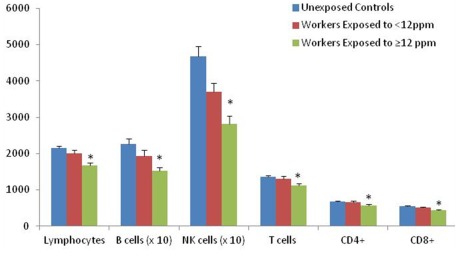
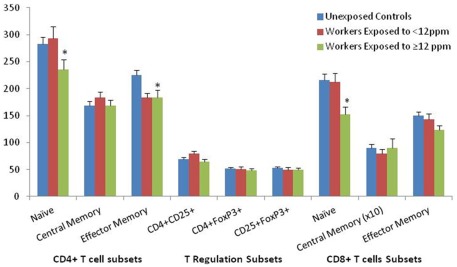
Trichloroethylene (TCE) is a volatile chlorinated organic compound that is commonly used as a solvent for lipophilic compounds. Although recognized as an animal carcinogen, TCE's carcinogenic potential in humans is still uncertain. We have carried out a cross-sectional study of 80 workers exposed to TCE and 96 unexposed controls matched on age and sex in Guangdong, China to study TCE's early biologic effects. We previously reported that the total lymphocyte count and each of the major lymphocyte subsets (i.e., CD4(+) T cells, CD8(+) T cells, natural killer cells, and B cells) were decreased in TCE-exposed workers compared to controls, suggesting a selective effect on lymphoid progenitors, and/or lymphocyte survival. To explore which T lymphocyte subsets are affected in the same study population, we investigated the effect of TCE exposure on the numbers of CD4(+) naïve and memory T cells, CD8(+) naïve and memory T cells, and regulatory T cells by FACS analysis. Linear regression of each subset was used to test for differences between exposed workers and controls adjusting for potential confounders. We observed that CD4(+) and CD8(+) naïve T cell counts were about 8% (p = 0.056) and 17% (p = 0.0002) lower, respectively, among exposed workers. CD4(+) effector memory T cell counts were decreased by about 20% among TCE-exposed workers compared to controls (p = 0.001). The selective targeting of TCE on CD8(+) naive and possibly CD4(+) naive T cells, and CD4(+) effector memory T cells, provide further insights into the immunosuppression-related response of human immune cells upon TCE exposure.
三氯乙烯(TCE)是一种挥发性有机氯化物,通常用作亲脂性化合物的溶剂。尽管 TCE 已被确认为动物致癌物,但它在人类中的致癌潜能仍不确定。我们在中国广东进行了一项横断面研究,共 80 名 TCE 暴露工人和 96 名年龄和性别相匹配的未暴露对照者,以研究 TCE 的早期生物学效应。我们之前报道过,与对照组相比,TCE 暴露工人的总淋巴细胞计数和主要淋巴细胞亚群(即 CD4(+) T 细胞、CD8(+) T 细胞、自然杀伤细胞和 B 细胞)均有所下降,这表明 TCE 对淋巴祖细胞和/或淋巴细胞存活具有选择性作用。为了探究在同一研究人群中哪些 T 淋巴细胞亚群受到影响,我们通过流式细胞术分析研究了 TCE 暴露对 CD4(+)幼稚和记忆 T 细胞、CD8(+)幼稚和记忆 T 细胞以及调节性 T 细胞数量的影响。用线性回归分析每个亚群,以在调整潜在混杂因素后,检验暴露工人与对照组之间的差异。我们发现,暴露工人的 CD4(+)和 CD8(+)幼稚 T 细胞计数分别约低 8%(p=0.056)和 17%(p=0.0002),而 CD4(+)效应记忆 T 细胞计数则低约 20%(p=0.001)。TCE 对 CD8(+)幼稚和可能 CD4(+)幼稚 T 细胞以及 CD4(+)效应记忆 T 细胞的选择性靶向作用,进一步深入了解了人类免疫细胞在 TCE 暴露下的免疫抑制相关反应。