US Military HIV Research Program, Division of Retrovirology, Walter Reed Army Institute of Research, Rockville, MD, USA.
Lancet Infect Dis. 2012 Jul;12(7):531-7. doi: 10.1016/S1473-3099(12)70088-9. Epub 2012 May 30.
The Thai phase 3 HIV vaccine trial RV 144 showed modest efficacy of a vaccine against HIV acquisition. Baseline variables of age, sex, marital status, and risk did not modify vaccine efficacy. We did a post-hoc analysis of the trial's data to investigate behavioural risk and efficacy every 6 months after vaccination.
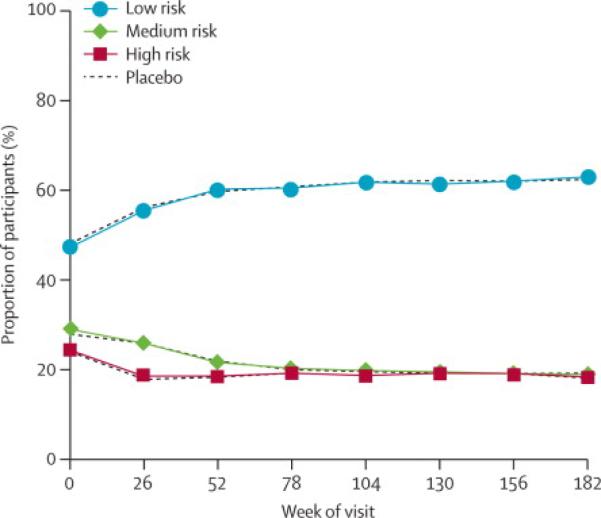
RV 144 was a randomised, multicentre, double-blind, placebo-controlled efficacy trial testing the combination of the HIV vaccines ALVAC-HIV (vCP1521) and AIDSVAX B/E to prevent HIV infection or reduce setpoint viral load. Male and female volunteers aged 18-30 years were recruited from the community. In this post-hoc analysis of the modified intention-to-treat population (16,395 participants), HIV risk behaviour was assessed with a self-administered questionnaire at the time of initial vaccination in the trial and every 6 months thereafter for 3 years. We classified participants' behaviour as low, medium, or high risk. Both the acquisition endpoint and the early viral-load endpoint were examined for interactions with risk status over time and temporal effects after vaccination. Multiple proportional hazards regression models with treatment and time-varying risk covariates were analysed.
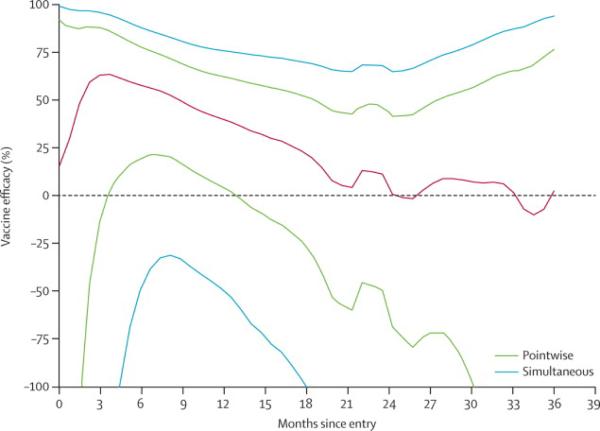
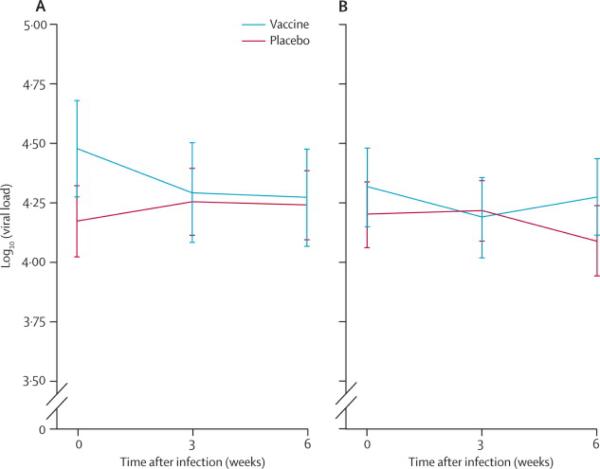
Risk of acquisition of HIV was low in each risk group, but 9187 (58·2%) participants reported higher-risk behaviour at least once during the study. Participants classified as high or increasing risk at least once during follow-up were compared with those who maintained low-risk or medium-risk behaviour as a time-varying covariate, and the interaction of risk status and acquisition efficacy was significant (p=0·01), with greater benefit in low-risk individuals. Vaccine efficacy seemed to peak early--cumulative vaccine efficacy was estimated to be 60·5% (95% CI 22-80) through the 12 months after initial vaccination--and declined quickly. Vaccination did not seem to affect viral load in either early or late infections.
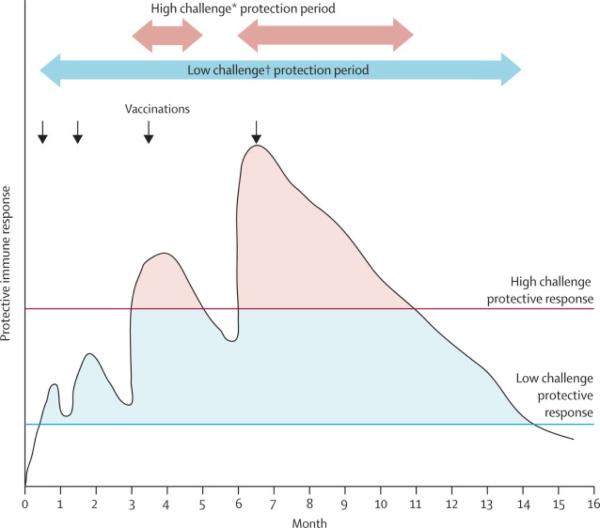
Future HIV vaccine trials should recognise potential interactions between challenge intensity and risk heterogeneity in both population and treatment effects. The regimen tested in the RV 144 phase 3 trial might benefit from extended immunisation schedules.
US Army Medical Research and Materiel Command and Division of AIDS, National Institute of Allergy and Infectious Disease, National Institutes of Health.
泰国 3 期 HIV 疫苗试验 RV144 显示出针对 HIV 获得性感染的疫苗具有一定的功效。年龄、性别、婚姻状况和风险等基线变量并未改变疫苗的功效。我们对该试验的数据进行了事后分析,以调查接种疫苗后每 6 个月的行为风险和疗效。
RV144 是一项随机、多中心、双盲、安慰剂对照的疗效试验,旨在测试 HIV 疫苗 ALVAC-HIV(vCP1521)和 AIDSVAX B/E 的联合使用,以预防 HIV 感染或降低基准病毒载量。从社区招募了年龄在 18-30 岁的男性和女性志愿者。在该试验的改良意向治疗人群(16395 名参与者)的这项事后分析中,在试验初始接种时和此后每 6 个月使用自我管理问卷评估 HIV 风险行为,为期 3 年。我们将参与者的行为分类为低、中、高风险。同时,在整个时间范围内,均对获得终点和早期病毒载量终点与风险状况之间的相互作用以及接种疫苗后的时间效应进行了检查。采用具有治疗和时间变化风险协变量的多个比例风险回归模型进行分析。
在每个风险组中,HIV 获得的风险均较低,但在研究期间,9187 名(58.2%)参与者至少有一次报告了高风险行为。与那些始终保持低风险或中风险行为的参与者相比,至少一次报告高风险或风险增加的参与者被视为时间变化的协变量,风险状况与获得疗效的相互作用具有统计学意义(p=0.01),低风险个体获益更大。疫苗疗效似乎早期达到峰值——最初接种后 12 个月的累积疫苗疗效估计为 60.5%(95%CI 22-80)——且迅速下降。疫苗接种似乎对早期或晚期感染的病毒载量均无影响。
未来的 HIV 疫苗试验应认识到人群和治疗效果中挑战强度和风险异质性之间的潜在相互作用。在 RV144 3 期试验中测试的方案可能受益于扩展免疫接种方案。
美国陆军医学研究与物资司令部和艾滋病分部,美国国立过敏和传染病研究所,美国国立卫生研究院。