Montague Enid, Perchonok Jennifer
Department of Industrial and Systems Engineering, University of Wisconsin-Madison, Madison, WI, USA.
J Med Internet Res. 2012 May 31;14(3):e78. doi: 10.2196/jmir.2095.
The implementation of health technology is a national priority in the United States and widely discussed in the literature. However, literature about the use of this technology by historically underserved populations is limited. Information on culturally informed health and wellness technology and the use of these technologies to reduce health disparities facing historically underserved populations in the United States is sparse in the literature.
To examine ways in which technology is being used by historically underserved populations to decrease health disparities through facilitating or improving health care access and health and wellness outcomes.
We conducted a systematic review in four library databases (PubMed, PsycINFO, Web of Science, and Engineering Village) to investigate the use of technology by historically underserved populations. Search strings consisted of three topics (eg, technology, historically underserved populations, and health).
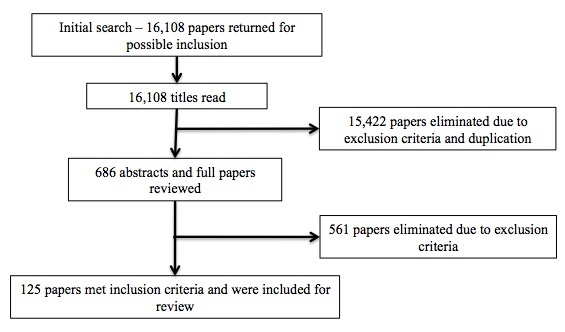
A total of 424 search phrases applied in the four databases returned 16,108 papers. After review, 125 papers met the selection criteria. Within the selected papers, 30 types of technology, 19 historically underserved groups, and 23 health issues were discussed. Further, almost half of the papers (62 papers) examined the use of technology to create effective and culturally informed interventions or educational tools. Finally, 12 evaluation techniques were used to assess the technology.
While the reviewed studies show how technology can be used to positively affect the health of historically underserved populations, the technology must be tailored toward the intended population, as personally relevant and contextually situated health technology is more likely than broader technology to create behavior changes. Social media, cell phones, and videotapes are types of technology that should be used more often in the future. Further, culturally informed health information technology should be used more for chronic diseases and disease management, as it is an innovative way to provide holistic care and reminders to otherwise underserved populations. Additionally, design processes should be stated regularly so that best practices can be created. Finally, the evaluation process should be standardized to create a benchmark for culturally informed health information technology.
健康技术的实施是美国的一项国家优先事项,在文献中得到广泛讨论。然而,关于历史上服务不足人群使用该技术的文献有限。关于具有文化针对性的健康与保健技术以及利用这些技术减少美国历史上服务不足人群所面临的健康差距的信息,在文献中也很稀少。
探讨历史上服务不足人群如何通过促进或改善医疗保健可及性以及健康与保健成果来利用技术减少健康差距。
我们在四个图书馆数据库(PubMed、PsycINFO、科学引文索引和工程索引)中进行了系统综述,以调查历史上服务不足人群对技术的使用情况。检索词由三个主题组成(例如,技术、历史上服务不足人群和健康)。
在四个数据库中应用的总共424个检索短语返回了16108篇论文。经过筛选,125篇论文符合入选标准。在入选的论文中,讨论了30种技术类型、19个历史上服务不足的群体以及23个健康问题。此外,几乎一半的论文(62篇)研究了利用技术创建有效且具有文化针对性的干预措施或教育工具。最后,使用了12种评估技术来评估该技术。
虽然所审查的研究表明技术可如何用于对历史上服务不足人群的健康产生积极影响,但技术必须针对目标人群进行定制,因为与个人相关且因地制宜的健康技术比宽泛的技术更有可能带来行为改变。社交媒体、手机和录像带是未来应更频繁使用的技术类型。此外,具有文化针对性的健康信息技术应更多地用于慢性病和疾病管理,因为这是为其他服务不足人群提供全面护理和提醒的创新方式。此外,应定期阐述设计流程,以便创建最佳实践。最后,评估流程应标准化,为具有文化针对性的健康信息技术创建一个基准。