Martinez-Ferre Almudena, Martinez Salvador
Instituto de Neurociencias, UMH-CSIC Alicante, Spain.
Front Neurosci. 2012 May 25;6:73. doi: 10.3389/fnins.2012.00073. eCollection 2012.
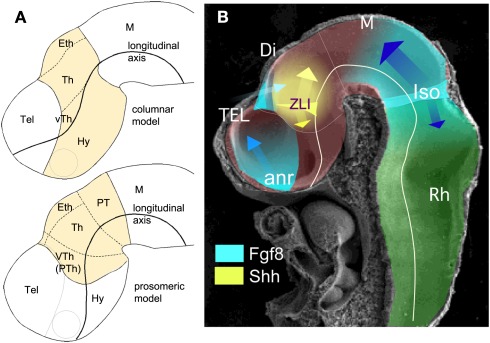
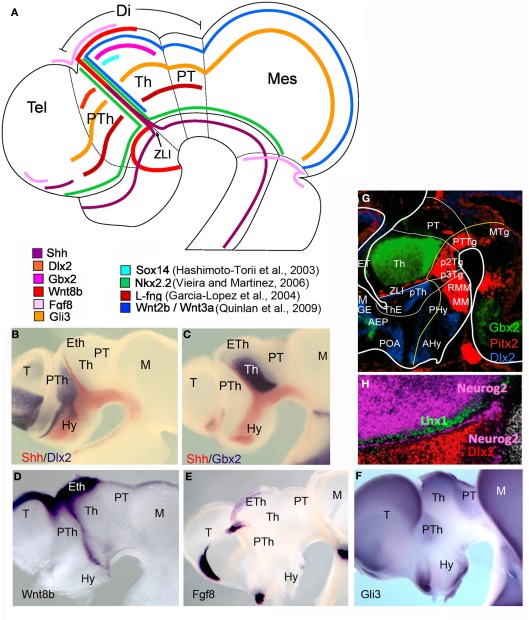
The anatomic complexity of the diencephalon depends on precise molecular and cellular regulative mechanisms orchestrated by regional morphogenetic organizers at the neural tube stage. In the diencephalon, like in other neural tube regions, dorsal and ventral signals codify positional information to specify ventro-dorsal regionalization. Retinoic acid, Fgf8, BMPs, and Wnts signals are the molecular factors acting upon the diencephalic epithelium to specify dorsal structures, while Shh is the main ventralizing signal. A central diencephalic organizer, the zona limitans intrathalamica (ZLI), appears after neurulation in the central diencephalic alar plate, establishing additional antero-posterior positional information inside diencephalic alar plate. Based on Shh expression, the ZLI acts as a morphogenetic center, which cooperates with other signals in thalamic specification and pattering in the alar plate of diencephalon. Indeed, Shh is expressed first in the basal plate extending dorsally through the ZLI epithelium as the development proceeds. Despite the importance of ZLI in diencephalic morphogenesis the mechanisms that regulate its development remain incompletely understood. Actually, controversial interpretations in different experimental models have been proposed. That is, experimental results have suggested that (i) the juxtaposition of the molecularly heterogeneous neuroepithelial areas, (ii) cell reorganization in the epithelium, and/or (iii) planar and vertical inductions in the neural epithelium, are required for ZLI specification and development. We will review some experimental data to approach the study of the molecular regulation of diencephalic regionalization, with special interest in the cellular mechanisms underlying planar inductions.
间脑的解剖复杂性取决于神经管阶段区域形态发生组织者精心编排的精确分子和细胞调节机制。在间脑,与其他神经管区域一样,背侧和腹侧信号编码位置信息以指定腹背区域化。视黄酸、Fgf8、骨形态发生蛋白(BMPs)和Wnt信号是作用于间脑上皮以指定背侧结构的分子因子,而音猬因子(Shh)是主要的腹侧化信号。一个间脑中央组织者,即丘脑间限制带(ZLI),在神经胚形成后出现在间脑中央翼板中,在间脑翼板内建立额外的前后位置信息。基于Shh的表达,ZLI作为一个形态发生中心,在间脑翼板的丘脑特化和模式形成中与其他信号协同作用。事实上,随着发育的进行,Shh首先在基板中表达,并通过ZLI上皮向背侧延伸。尽管ZLI在间脑形态发生中很重要,但其发育的调节机制仍未完全了解。实际上,在不同的实验模型中已经提出了有争议的解释。也就是说,实验结果表明,(i)分子异质性神经上皮区域的并置,(ii)上皮中的细胞重组,和/或(iii)神经上皮中的平面诱导和垂直诱导,是ZLI特化和发育所必需的。我们将回顾一些实验数据,以探讨间脑区域化的分子调节研究,特别关注平面诱导背后的细胞机制。