Laboratory for Molecular Endocrinology - GPCRs, Western Australian Institute for Medical Research and Centre for Medical Research, University of Western Australia Perth, WA, Australia.
Front Endocrinol (Lausanne). 2011 Jan 14;1:12. doi: 10.3389/fendo.2010.00012. eCollection 2010.
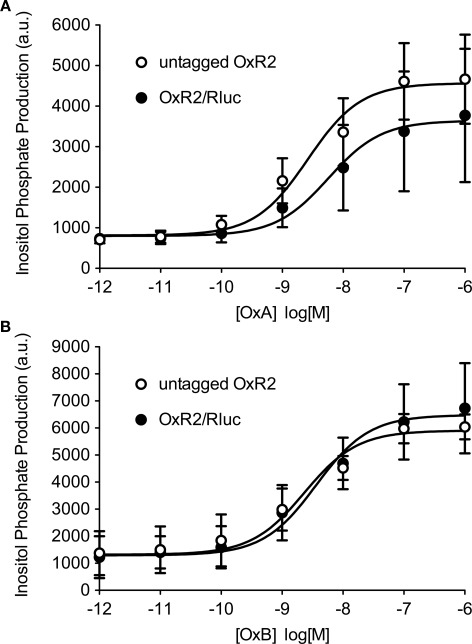
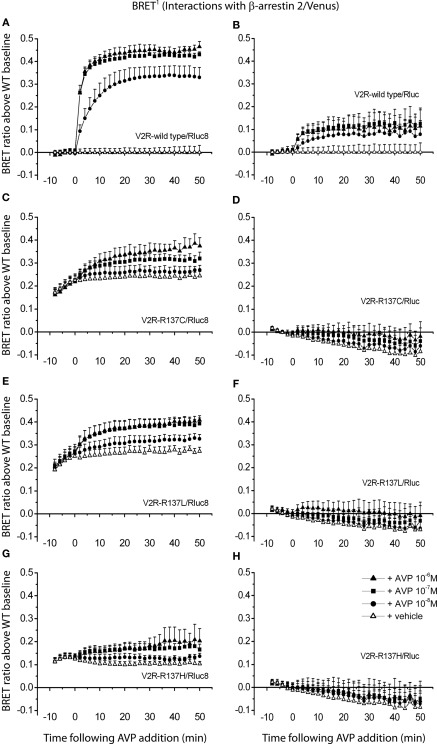
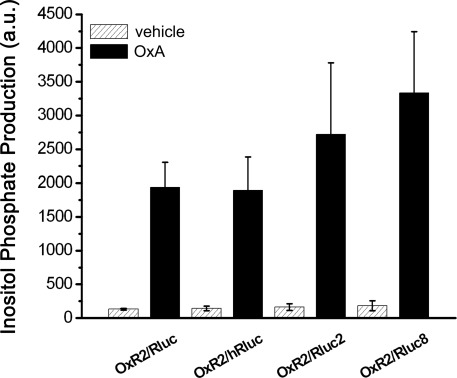
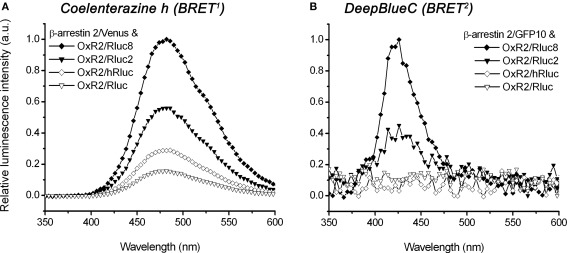
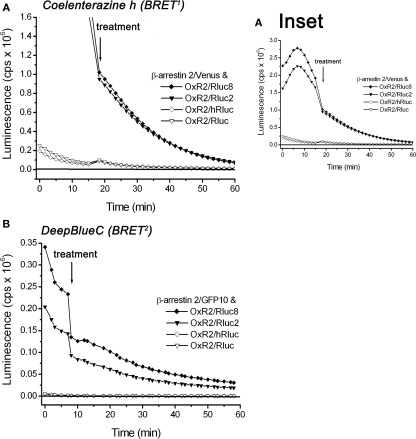
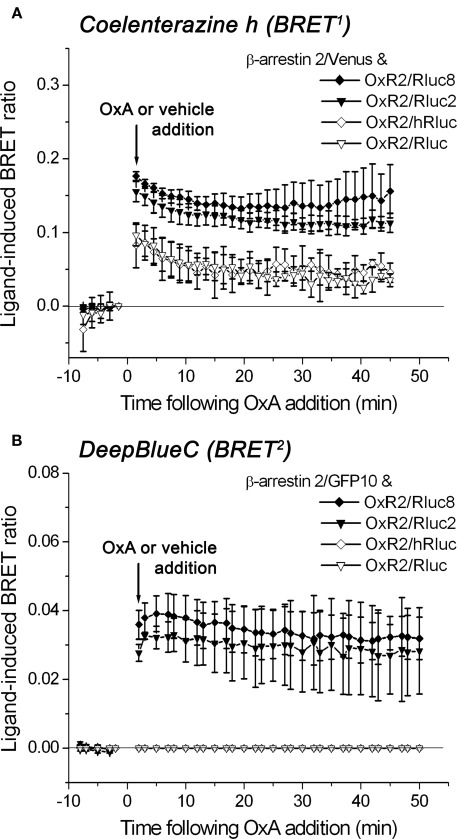
The bioluminescence resonance energy transfer (BRET) technique has become extremely valuable for the real-time monitoring of protein-protein interactions in live cells. This method is highly amenable to the detection of G protein-coupled receptor (GPCR) interactions with proteins critical for regulating their function, such as β-arrestins. Of particular interest to endocrinologists is the ability to monitor interactions involving endocrine receptors, such as orexin receptor 2 or vasopressin type II receptor. The BRET method utilizes heterologous co-expression of fusion proteins linking one protein of interest (GPCR) to a bioluminescent donor enzyme, a variant of Renilla luciferase, and a second protein of interest (β-arrestin) to an acceptor fluorophore. If in close proximity, energy resulting from oxidation of the coelenterazine substrate by the donor will transfer to the acceptor, which in turn fluoresces. Using novel luciferase constructs, we were able to monitor interactions not detectable using less sensitive BRET combinations in the same configuration. In particular, we were able to show receptor/β-arrestin interactions in an agonist-independent manner using Rluc8-tagged mutant receptors, in contrast to when using Rluc. Therefore, the enhanced BRET methodology has not only enabled live cell compound screening as we have recently published, it now provides a new level of sensitivity for monitoring specific transient, weak or hardly detectable protein-protein complexes, including agonist-independent GPCR/β-arrestin interactions. This has important implications for the use of BRET technologies in endocrine drug discovery programs as well as academic research.
生物发光共振能量转移 (BRET) 技术已成为实时监测活细胞中蛋白质-蛋白质相互作用的极为有用的工具。该方法非常适合检测 G 蛋白偶联受体 (GPCR) 与调节其功能的关键蛋白(如β-arrestin)之间的相互作用。内分泌学家特别感兴趣的是监测涉及内分泌受体(如食欲素受体 2 或血管加压素 II 受体)的相互作用的能力。BRET 方法利用将感兴趣的蛋白质(GPCR)与生物发光供体酶(海肾荧光素酶的一种变体)连接的融合蛋白异源共表达,以及将第二个感兴趣的蛋白质(β-arrestin)与受体荧光团连接。如果彼此靠近,供体酶氧化 coelenterazine 底物产生的能量将转移到受体上,受体转而发出荧光。使用新型荧光素酶构建体,我们能够监测使用相同配置下不太敏感的 BRET 组合无法检测到的相互作用。特别是,我们能够以激动剂非依赖性的方式使用 Rluc8 标记的突变受体显示受体/β-arrestin 相互作用,而不是使用 Rluc 时。因此,增强的 BRET 方法不仅使我们最近发表的活细胞化合物筛选成为可能,而且还为监测特定的瞬时、弱或难以检测的蛋白质-蛋白质复合物提供了新的灵敏度水平,包括激动剂非依赖性 GPCR/β-arrestin 相互作用。这对内分泌药物发现计划以及学术研究中 BRET 技术的应用具有重要意义。