Centre de Biophysique Moléculaire, CNRS, UPR 4301, University of Orléans and INSERM, 45071 Orléans, France.
PRC, INRA, CNRS, Université François Rabelais-Tours, 37380 Nouzilly, France.
Molecules. 2019 Feb 1;24(3):537. doi: 10.3390/molecules24030537.
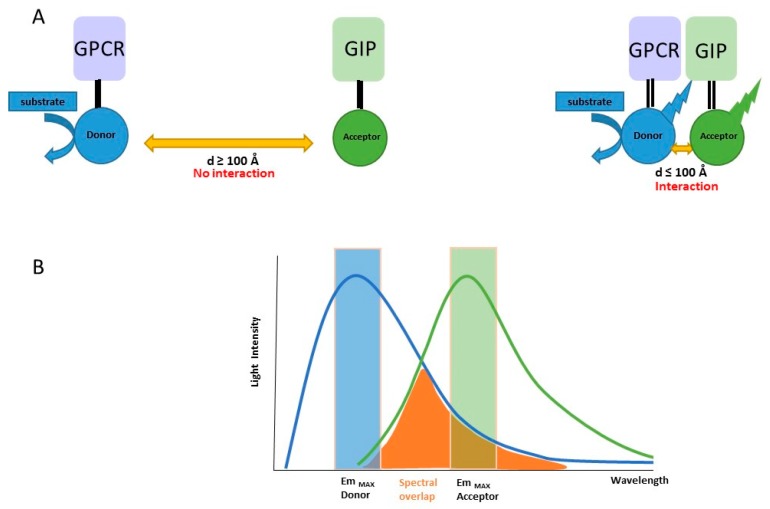
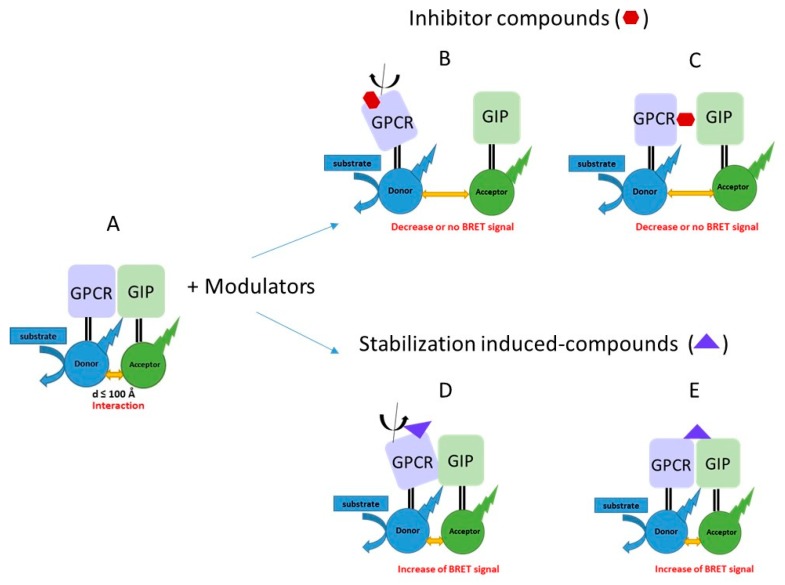
The bioluminescence resonance energy transfer (BRET) approach involves resonance energy transfer between a light-emitting enzyme and fluorescent acceptors. The major advantage of this technique over biochemical methods is that protein-protein interactions (PPI) can be monitored without disrupting the natural environment, frequently altered by detergents and membrane preparations. Thus, it is considered as one of the most versatile technique for studying molecular interactions in living cells at "physiological" expression levels. BRET analysis has been applied to study many transmembrane receptor classes including G-protein coupled receptors (GPCR). It is well established that these receptors may function as dimeric/oligomeric forms and interact with multiple effectors to transduce the signal. Therefore, they are considered as attractive targets to identify PPI modulators. In this review, we present an overview of the different BRET systems developed up to now and their relevance to identify inhibitors/modulators of protein⁻protein interaction. Then, we introduce the different classes of agents that have been recently developed to target PPI, and provide some examples illustrating the use of BRET-based assays to identify and characterize innovative PPI modulators in the field of GPCRs biology. Finally, we discuss the main advantages and the limits of BRET approach to characterize PPI modulators.
生物发光共振能量转移(BRET)方法涉及发光酶和荧光受体之间的共振能量转移。与生化方法相比,该技术的主要优势在于可以在不破坏天然环境的情况下监测蛋白质-蛋白质相互作用(PPI),而天然环境常常被洗涤剂和膜制剂改变。因此,它被认为是研究活细胞中“生理”表达水平下分子相互作用的最通用的技术之一。BRET 分析已应用于研究许多跨膜受体类别,包括 G 蛋白偶联受体(GPCR)。已经证实,这些受体可以作为二聚体/寡聚体形式发挥作用,并与多种效应物相互作用以传递信号。因此,它们被认为是识别 PPI 调节剂的有吸引力的靶标。在这篇综述中,我们介绍了迄今为止开发的不同 BRET 系统及其与识别蛋白质-蛋白质相互作用抑制剂/调节剂的相关性。然后,我们介绍了最近开发的用于靶向 PPI 的不同类别的试剂,并提供了一些示例,说明如何使用基于 BRET 的测定法来鉴定和表征 GPCR 生物学领域的创新型 PPI 调节剂。最后,我们讨论了 BRET 方法用于表征 PPI 调节剂的主要优点和局限性。