Population Health and Immunity Division, Walter and Eliza Hall Institute of Medical Research, Parkville, Victoria, Australia.
Department of Medical Biology, University of Melbourne, Parkville, Victoria, Australia.
PLoS One. 2018 Aug 23;13(8):e0202408. doi: 10.1371/journal.pone.0202408. eCollection 2018.
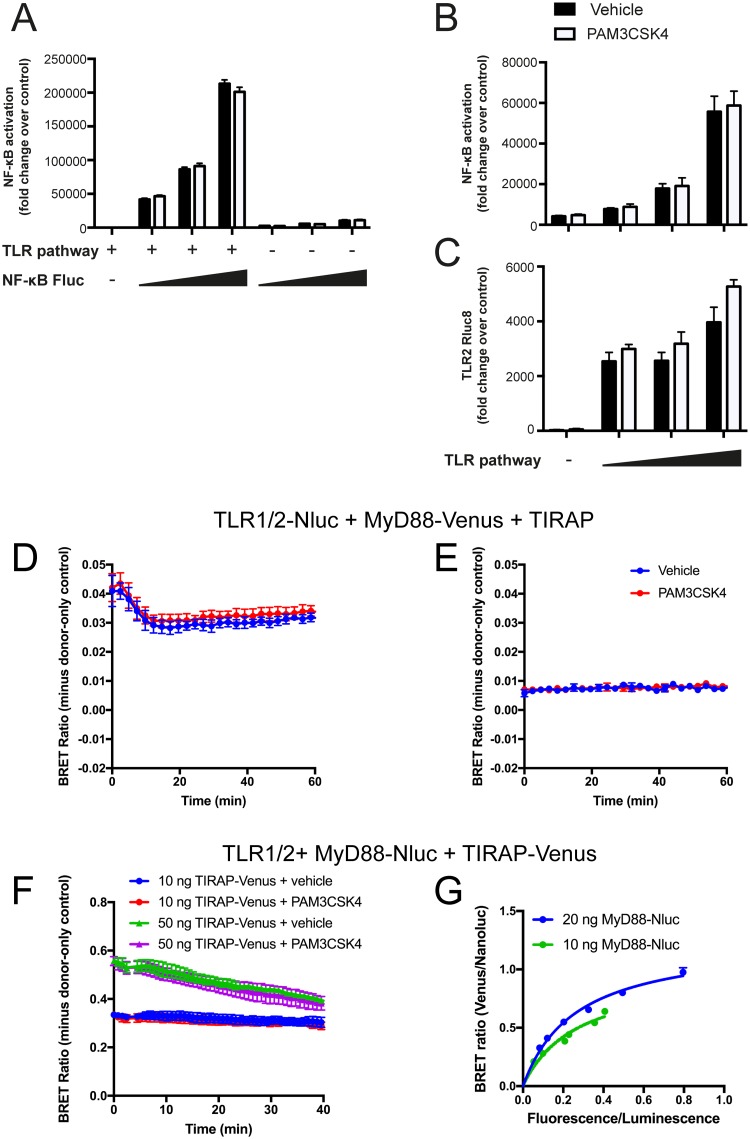
Toll like receptors (TLRs) are important pattern recognition receptors that can detect pathogen and danger associated molecular patterns to initiate an innate immune response. TLR1 and 2 heterodimerize at the plasma membrane upon binding to triacylated lipopeptides from bacterial cell walls, or to the synthetic ligand Pam3CSK4. TLR1/2 dimers interact with adaptor molecules TIRAP and MyD88 to initiate a signalling cascade that leads to activation of key transcription factors, including NF-kB. Despite TLRs being extensively studied over the last two decades, the real-time kinetics of ligand binding and receptor activation remains largely unexplored. We aimed to study the kinetics of TLR activation and recruitment of adaptors, using TLR1/2 dimer interactions with adaptors MyD88 and TIRAP. Bioluminescence resonance energy transfer (BRET) allows detection of real-time protein-protein interactions in living cells, and was applied to study adaptor recruitment to TLRs. Energy transfer showed interactions between TLR2 and TIRAP, and between TLR2 and MyD88 only in the presence of TIRAP. Quantitative BRET and confocal microscopy confirmed that TIRAP is necessary for MyD88 interaction with TLR2. Furthermore, constitutive proximity between the proteins in the absence of Pam3CSK4 stimulation was observed with BRET, and was not abrogated with lowered protein expression, changes in protein tagging strategies, or use of the brighter NanoLuc luciferase. However, co-immunoprecipitation studies did not demonstrate constitutive interaction between these proteins, suggesting that the interaction observed with BRET likely represents artefacts of protein overexpression. Thus, caution should be taken when utilizing protein overexpression in BRET studies and in investigations of the TLR pathway.
Toll 样受体 (TLRs) 是重要的模式识别受体,能够识别病原体和危险相关的分子模式,从而启动先天免疫反应。TLR1 和 2 在与细菌细胞壁的三酰化脂肽结合,或与合成配体 Pam3CSK4 结合时,在质膜上异二聚化。TLR1/2 二聚体与衔接子分子 TIRAP 和 MyD88 相互作用,启动信号级联反应,导致关键转录因子(包括 NF-κB)的激活。尽管 TLRs 在过去的二十年中得到了广泛的研究,但配体结合和受体激活的实时动力学在很大程度上仍未得到探索。我们旨在使用 TLR1/2 二聚体与衔接子 MyD88 和 TIRAP 的相互作用,研究 TLR 激活和衔接子募集的动力学。生物发光共振能量转移(BRET)允许在活细胞中检测实时的蛋白质-蛋白质相互作用,并应用于研究衔接子向 TLR 的募集。能量转移显示 TLR2 与 TIRAP 之间,以及 TLR2 与 MyD88 之间的相互作用仅在存在 TIRAP 时才发生。定量 BRET 和共聚焦显微镜证实 TIRAP 对于 MyD88 与 TLR2 的相互作用是必需的。此外,在没有 Pam3CSK4 刺激的情况下,用 BRET 观察到蛋白质之间的组成型接近,并且不会因蛋白表达降低、蛋白标记策略改变或使用更亮的 NanoLuc 荧光素酶而消除。然而,共免疫沉淀研究并未表明这些蛋白质之间存在组成型相互作用,这表明用 BRET 观察到的相互作用可能代表蛋白质过表达的人为产物。因此,在 BRET 研究和 TLR 途径的研究中,在利用蛋白质过表达时应谨慎。