Graduate School of Frontier Sciences, Department of Complex Science and Engineering, The University of Tokyo, Chiba, Tokyo, Japan.
PLoS One. 2012;7(5):e37594. doi: 10.1371/journal.pone.0037594. Epub 2012 May 24.
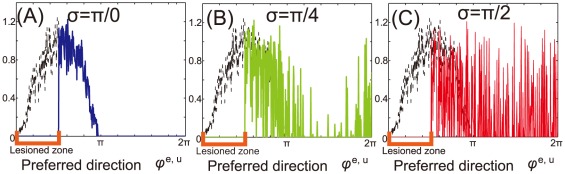
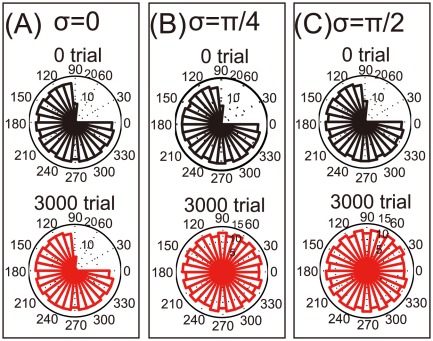
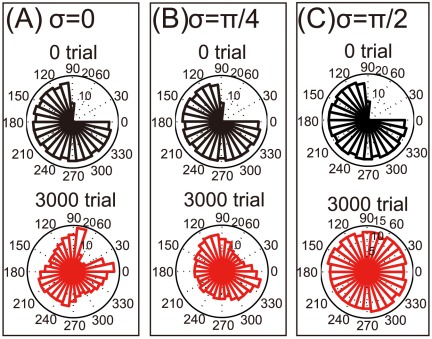
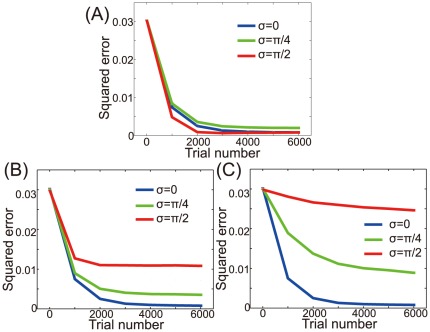
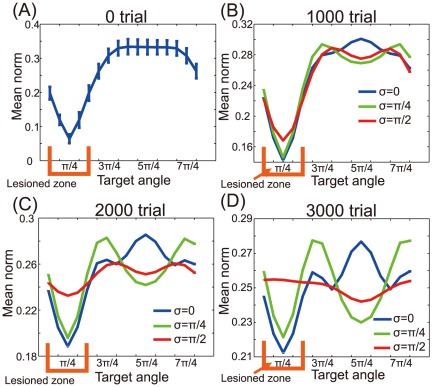
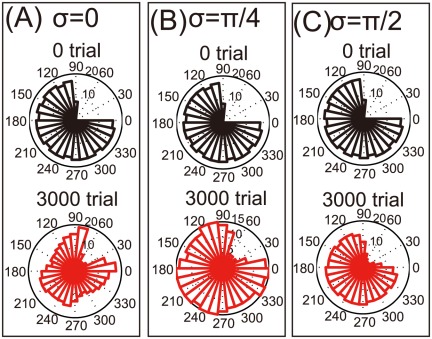
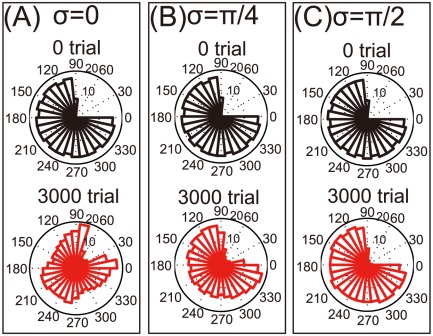
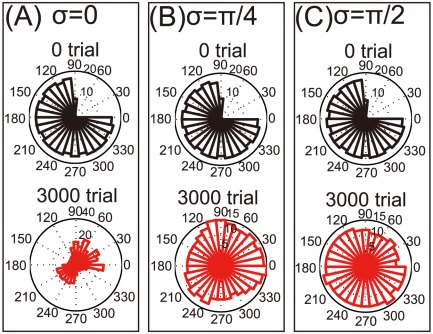
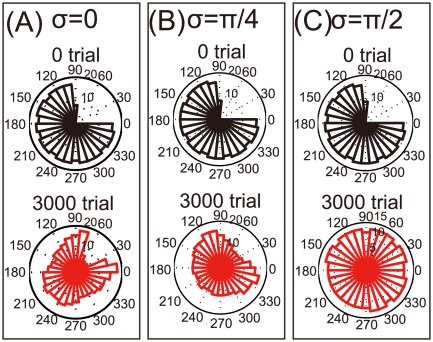
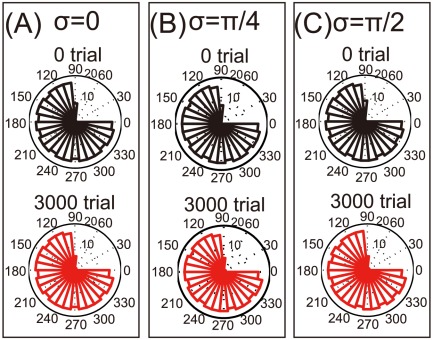
Stroke patients recover more effectively when they are rehabilitated with bimanual movement rather than with unimanual movement; however, it remains unclear why bimanual movement is more effective for stroke recovery. Using a computational model of stroke recovery, this study suggests that bimanual movement facilitates the reorganization of a damaged motor cortex because this movement induces rotations in the preferred directions (PDs) of motor cortex neurons. Although the tuning curves of these neurons differ during unimanual and bimanual movement, changes in PD, but not changes in modulation depth, facilitate such reorganization. In addition, this reorganization was facilitated only when encoding PDs are rotated, but decoding PDs are not rotated. Bimanual movement facilitates reorganization because this movement changes neural activities through inter-hemispheric inhibition without changing cortical-spinal-muscle connections. Furthermore, stronger inter-hemispheric inhibition between motor cortices results in more effective reorganization. Thus, this study suggests that bimanual movement is effective for stroke rehabilitation because this movement rotates the encoding PDs of motor cortex neurons.
中风患者在进行双手运动康复治疗时比单手运动康复治疗恢复得更有效;然而,为什么双手运动对中风康复更有效仍不清楚。本研究通过中风康复的计算模型表明,双手运动促进受损运动皮层的重组,因为这种运动诱导运动皮层神经元的优势方向(PD)旋转。尽管这些神经元的调谐曲线在单手和双手运动期间不同,但 PD 的变化而不是调制深度的变化促进了这种重组。此外,只有当编码 PD 旋转而解码 PD 不旋转时,才会促进这种重组。双手运动促进重组,因为这种运动通过半球间抑制改变神经活动,而不改变皮质脊髓肌肉连接。此外,运动皮层之间更强的半球间抑制导致更有效的重组。因此,本研究表明,双手运动对中风康复有效,因为这种运动使运动皮层神经元的编码 PD 旋转。