School of Nursing, Midwifery and Social Work, The University of Manchester, Manchester, UK.
BMC Pediatr. 2012 Jun 1;12:59. doi: 10.1186/1471-2431-12-59.
Some national guidelines recommend the use of water alone for napkin cleansing. Yet, there is a readiness, amongst many parents, to use baby wipes. Evidence from randomised controlled trials, of the effect of baby wipes on newborn skin integrity is lacking. We conducted a study to examine the hypothesis that the use of a specifically formulated cleansing wipe on the napkin area of newborn infants (<1 month) has an equivalent effect on skin hydration when compared with using cotton wool and water (usual care).
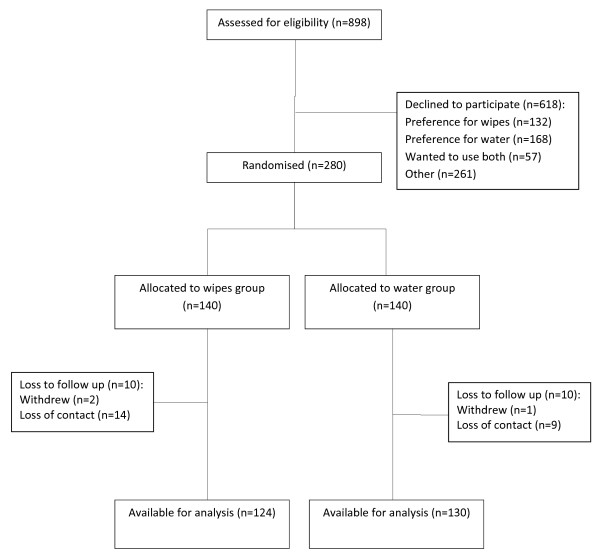
A prospective, assessor-blinded, randomised controlled equivalence trial was conducted during 2010. Healthy, term babies (n=280), recruited within 48 hours of birth, were randomly assigned to have their napkin area cleansed with an alcohol-free baby wipe (140 babies) or cotton wool and water (140 babies). Primary outcome was change in hydration from within 48 hours of birth to 4 weeks post-birth. Secondary outcomes comprised changes in trans-epidermal water loss, skin surface pH and erythema, presence of microbial skin contaminants/irritants at 4 weeks and napkin dermatitis reported by midwife at 4 weeks and mother during the 4 weeks.
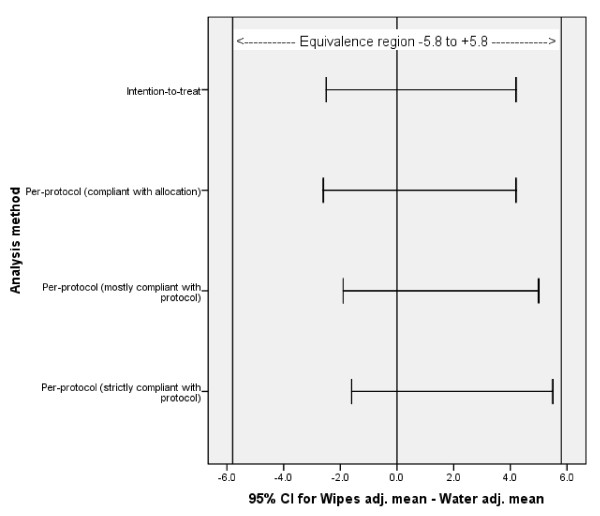
Complete hydration data were obtained for 254 (90.7 %) babies. Wipes were shown to be equivalent to water and cotton wool in terms of skin hydration (intention-to-treat analysis: wipes 65.4 (SD 12.4) vs. water 63.5 (14.2), p=0.47, 95% CI -2.5 to 4.2; per protocol analysis: wipes 64.6 (12.4) vs. water 63.6 (14.3), p=0.53, 95% CI -2.4 to 4.2). No significant differences were found in the secondary outcomes, except for maternal-reported napkin dermatitis, which was higher in the water group (p=0.025 for complete responses).
Baby wipes had an equivalent effect on skin hydration when compared with cotton wool and water. We found no evidence of any adverse effects of using these wipes. These findings offer reassurance to parents who choose to use baby wipes and to health professionals who support their use.
Current Controlled Trials ISRCTN86207019.
一些国家的指南建议单独使用水来清洁尿布。然而,许多父母已经准备好用婴儿湿巾了。目前缺乏随机对照试验证据来证明婴儿湿巾对新生儿皮肤完整性的影响。我们进行了一项研究,以检验以下假设,即在新生儿(<1 个月)的尿布区域使用专门配制的清洁湿巾与使用棉花和水(常规护理)相比,对皮肤水合作用具有等效效果。
在 2010 年进行了一项前瞻性、评估者盲法、随机对照等效性试验。在出生后 48 小时内招募了健康的足月婴儿(n=280),并将其随机分配使用不含酒精的婴儿湿巾(140 名婴儿)或棉花和水(140 名婴儿)清洁尿布区域。主要结局是出生后 48 小时至 4 周时的水合作用变化。次要结局包括 4 周时的经皮水分丢失、皮肤表面 pH 值和红斑变化、4 周时微生物皮肤污染物/刺激物的存在以及助产士在 4 周时和母亲在 4 周内报告的尿布性皮炎。
254 名(90.7%)婴儿完整获得了水合数据。湿巾在皮肤水合方面与水和棉花等效(意向治疗分析:湿巾 65.4(12.4)vs. 水 63.5(14.2),p=0.47,95%CI-2.5 至 4.2;符合方案分析:湿巾 64.6(12.4)vs. 水 63.6(14.3),p=0.53,95%CI-2.4 至 4.2)。除了母亲报告的尿布性皮炎较高(完整应答者 p=0.025)外,次要结局没有发现显著差异。
与棉花和水相比,婴儿湿巾对皮肤水合作用具有等效效果。我们没有发现使用这些湿巾有任何不良反应的证据。这些发现为选择使用婴儿湿巾的父母和支持他们使用的卫生专业人员提供了保证。
当前对照试验 ISRCTN86207019。