Department of Internal Medicine, Yonsei University College of Medicine, Seoul, Korea.
Yonsei Med J. 2012 Jul 1;53(4):708-14. doi: 10.3349/ymj.2012.53.4.708.
This study aimed to elucidate whether stone removal by extracorporeal shock wave lithotripsy (ESWL) is associated with delayed chronic kidney disease (CKD) progression.
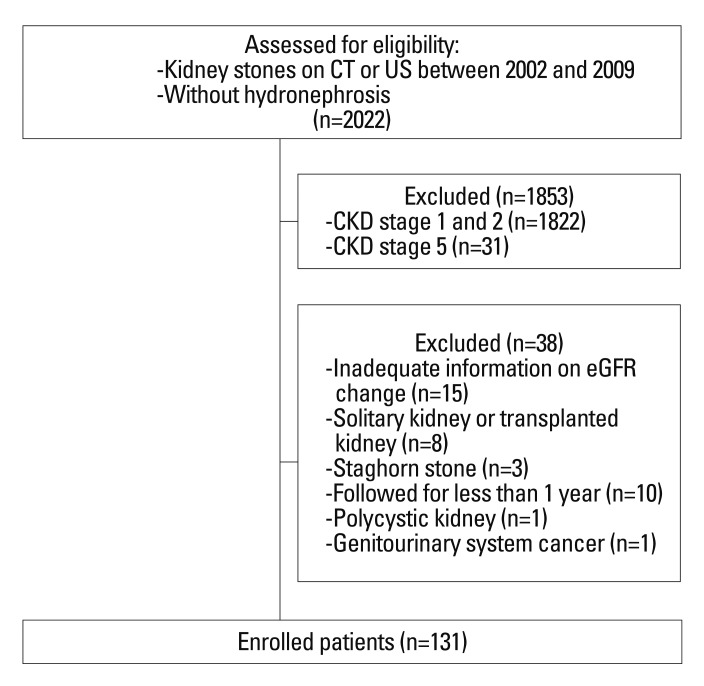
We conducted a retrospective analysis of 131 nephrolithiasis patients with stage 3 and 4 CKD. We collected baseline clinical and laboratory data, kidney stone characteristics, and history of receiving ESWL. We classified study patients into two groups according to whether they underwent ESWL or not (Non-ESWL group vs. ESWL group). We initially compared annual estimated glomerular filtration rate (eGFR) changes of Non-ESWL group with those of ESWL group before undergoing ESWL. In the next step, we sought to compare annual eGFR changes in the same patients before and after ESWL. Finally, we compared annual eGFR changes between success and failure groups among patients undergoing ESWL.
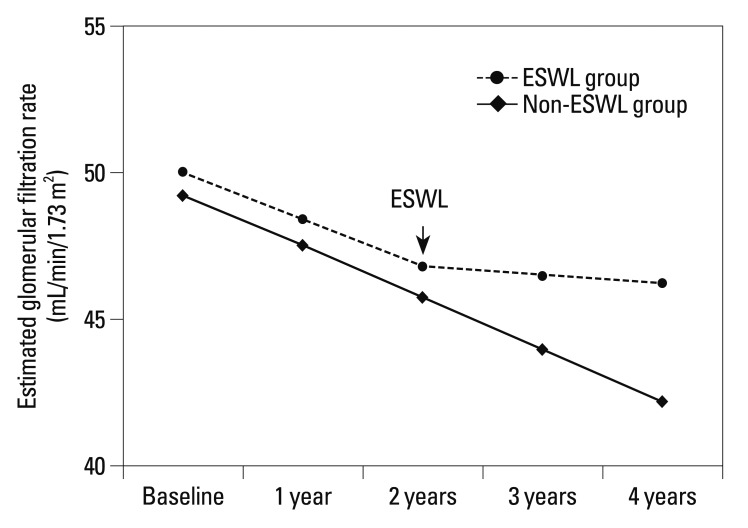
The mean age of the patients was 62 years and 72.5% were male. The mean observation period was 3.2 years. Non-ESWL group and ESWL group before undergoing ESWL showed similar annual eGFR changes (-1.75±6.5 vs. -1.63±7.2 mL/min/1.73 m²/year, p=0.425). However, eGFR declined slower after undergoing ESWL than before ESWL (annual eGFR changes, -0.29±6.1 vs. -1.63±7.2 mL/min/1.73 m²/year, p<0.05). In addition, among patients in ESWL group, eGFR declined faster in the failure group than in the success group (annual eGFR change, -1.01±4.7 vs. -0.05±5.2 mL/min/1.73 m²/year, p<0.05).
Our results suggest that stone removal by ESWL is associated with delayed deterioration of renal function in CKD patients with nephrolithiasis.
本研究旨在阐明体外冲击波碎石术(ESWL)取石是否与慢性肾脏病(CKD)进展的延迟有关。
我们对 131 例患有 3 期和 4 期 CKD 的肾结石患者进行了回顾性分析。收集了基线临床和实验室数据、肾结石特征以及接受 ESWL 的病史。根据是否接受 ESWL,我们将研究患者分为两组(非 ESWL 组与 ESWL 组)。我们首先比较了非 ESWL 组与 ESWL 组在接受 ESWL 前的每年估算肾小球滤过率(eGFR)变化。下一步,我们试图比较同一患者在接受 ESWL 前后的每年 eGFR 变化。最后,我们比较了接受 ESWL 的患者中成功组和失败组的每年 eGFR 变化。
患者的平均年龄为 62 岁,72.5%为男性。平均观察期为 3.2 年。非 ESWL 组和 ESWL 组在接受 ESWL 前的每年 eGFR 变化相似(-1.75±6.5 与-1.63±7.2 mL/min/1.73 m²/年,p=0.425)。然而,接受 ESWL 后 eGFR 下降速度比接受 ESWL 前更慢(每年 eGFR 变化,-0.29±6.1 与-1.63±7.2 mL/min/1.73 m²/年,p<0.05)。此外,在 ESWL 组中,失败组的 eGFR 下降速度快于成功组(每年 eGFR 变化,-1.01±4.7 与-0.05±5.2 mL/min/1.73 m²/年,p<0.05)。
我们的结果表明,ESWL 取石与肾结石合并 CKD 患者肾功能恶化的延迟有关。