Instituto Cajal, IC-CSIC & Centro de Investigación Biomédica en Red sobre Enfermedades Neurodegenerativas (CIBERNED), Madrid, Spain.
PLoS Biol. 2012;10(5):e1001335. doi: 10.1371/journal.pbio.1001335. Epub 2012 May 29.
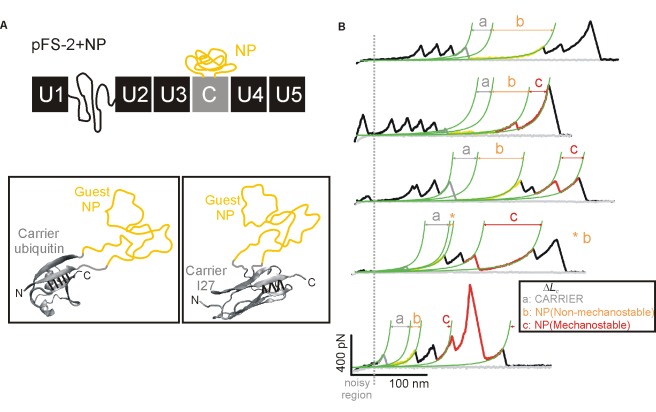
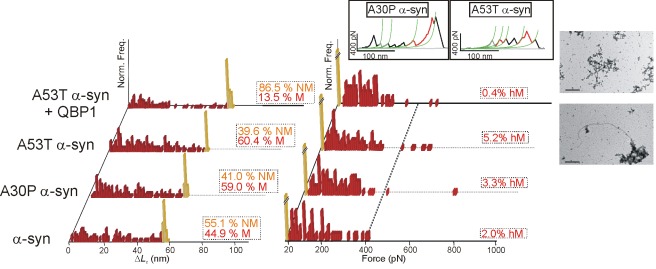
Amyloidogenic neurodegenerative diseases are incurable conditions with high social impact that are typically caused by specific, largely disordered proteins. However, the underlying molecular mechanism remains elusive to established techniques. A favored hypothesis postulates that a critical conformational change in the monomer (an ideal therapeutic target) in these "neurotoxic proteins" triggers the pathogenic cascade. We use force spectroscopy and a novel methodology for unequivocal single-molecule identification to demonstrate a rich conformational polymorphism in the monomer of four representative neurotoxic proteins. This polymorphism strongly correlates with amyloidogenesis and neurotoxicity: it is absent in a fibrillization-incompetent mutant, favored by familial-disease mutations and diminished by a surprisingly promiscuous inhibitor of the critical monomeric β-conformational change, neurotoxicity, and neurodegeneration. Hence, we postulate that specific mechanostable conformers are the cause of these diseases, representing important new early-diagnostic and therapeutic targets. The demonstrated ability to inhibit the conformational heterogeneity of these proteins by a single pharmacological agent reveals common features in the monomer and suggests a common pathway to diagnose, prevent, halt, or reverse multiple neurodegenerative diseases.
淀粉样变性神经退行性疾病是一种不可治愈的疾病,具有很高的社会影响,通常由特定的、大部分无序的蛋白质引起。然而,其潜在的分子机制仍然难以用现有的技术来确定。一个被广泛认可的假说假设,在这些“神经毒性蛋白”的单体(理想的治疗靶点)中发生关键的构象变化,触发了致病级联反应。我们使用力谱学和一种新颖的方法来明确单分子的鉴定,以证明四种代表性神经毒性蛋白的单体中存在丰富的构象多态性。这种多态性与淀粉样变性和神经毒性强烈相关:它在无纤维形成能力的突变体中不存在,在家族性疾病突变中更倾向于这种多态性,而在一种对关键单体β构象变化、神经毒性和神经退行性变具有惊人广谱抑制作用的抑制剂中则减少。因此,我们假设特定的机械稳定构象是这些疾病的原因,代表了重要的新的早期诊断和治疗靶点。我们已经证明,通过单一的药理制剂可以抑制这些蛋白质的构象异质性,这揭示了单体之间的共同特征,并提示了一种共同的途径来诊断、预防、阻止或逆转多种神经退行性疾病。